2×4 Raised Bed Vegetable Garden Layout: 9 Simple Plans
A 2×4 raised bed gives you eight square feet — small enough to reach across from one side and cheap enough to fill properly. Here are nine complete layouts you can copy straight into your garden.
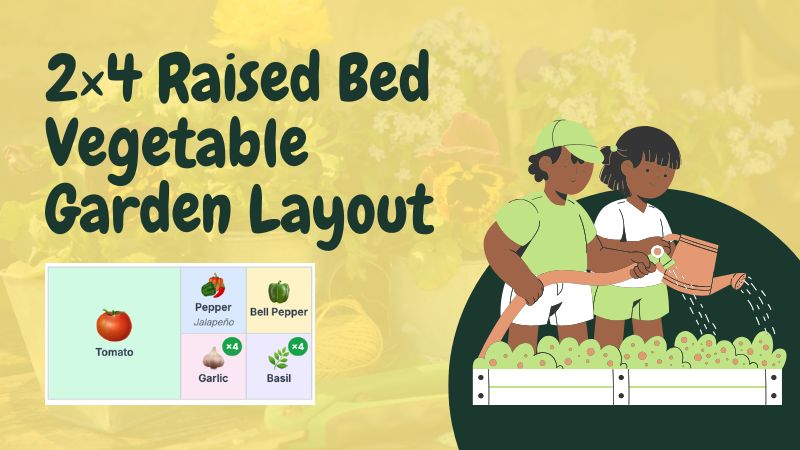
A 2×4 raised bed is the smallest bed that still grows a real harvest. Eight square feet fits on a balcony, along a fence line, on a patio, or in the narrow strip beside a path — the kind of space most people write off as too small to bother with.
It is also the easiest bed to get right. At just two feet deep, you can reach every square from a single side without ever stepping on the soil.
It takes a few boards and a couple of bags of growing mix to build and fill, which makes it the cheapest way to start and the lowest-stakes place to learn.
The trade-off is space. With only eight one-foot squares to work with, there is no room for a plant that sprawls across half the bed or a crop you will not actually eat. A 2×4 rewards a tight, deliberate plan more than a big one ever needs to.
This guide covers how square foot spacing works in a 2×4 bed and gives you nine complete layouts — salad, cool-season crops, roots, summer heat-lovers, a kid's bed, flowers for cutting and for pollinators — each one ready to copy straight into your own garden.
Why a 2×4 Bed Is the Easiest Place to Start
A bed that is only two feet wide changes how you garden.
You can tend every square from one side, so you never compact the soil by climbing in, and nothing is ever more than an arm's length away.
That single fact removes most of the frustration beginners run into with wider beds. The small volume of growing mix is the other advantage.
A 2×4 bed costs very little to fill with good soil, which means you can afford to fill it properly rather than stretching cheap dirt to cover a larger footprint.
Good soil in a small bed beats poor soil in a big one every time. What a 2×4 asks of you in return is focus.
Eight squares is enough for one anchor crop and a handful of dense fillers, or for a single themed harvest done well — a salad bed, a salsa bed, a cut-flower strip.
Try to fit a whole vegetable garden into it and everything underperforms. Pick a purpose and the bed will carry it.
What Fits in Eight Square Feet
Square foot spacing assigns each crop a planting density — how many plants share a single one-foot square — based on its mature size.
In a 2×4 bed you have eight of those squares to spend, so the skill is knowing which crops pack in tightly and which need a whole square (or more) to themselves.
| Crop | Plants per sq ft | Space in a 2×4 | Notes |
|---|---|---|---|
| Radish | 16 per sq ft | Fills gaps between slower crops | Fastest crop in the bed — harvested in under a month |
| Carrot | 16 per sq ft | 32 carrots in 2 squares | Needs loose, deep, stone-free mix to grow straight |
| Spinach | 9 per sq ft | 18 plants in 2 squares | Quick and cool-loving; ideal for succession sowing |
| Beetroot | 9 per sq ft | Two squares gives a steady supply | Leaves are edible too — harvest young as salad greens |
| Onion / Garlic | 4–9 per sq ft | Tuck into any spare corner | Deters pests — a good neighbour throughout the bed |
| Lettuce (loose-leaf) | 4 per sq ft | 16 heads in 4 squares | Cut-and-come-again; tolerates a little shade |
| Basil / Herbs | 4 per sq ft | One or two squares is plenty | Plant beside peppers and tomatoes; keeps aphids down |
| Pepper / Eggplant | 1 per sq ft | A neat mid-height filler | Compact and upright — well suited to a small bed |
| Tomato / Cucumber | 1 per 1–2 sq ft | One plant, trained upward | Stake or trellis it; one is the limit in a 2×4 |
The practical rule for a 2×4: pick one anchor crop at most — a single tomato, cucumber, or squash trained upward — and build the rest of the bed from dense, quick fillers like salad, radish, and carrot.
That keeps all eight squares working without any one plant swallowing its neighbours.
9 Complete 2×4 Garden Bed Layouts
Each plan below was built in EdenVatika's bed designer.
You can open the full grid layout and copy any of them into a free account — spacing is already calculated, companion pairings are built in, and every square can be swapped to suit your season, region, or the crops you actually cook with.
Plan 1 — Kid-Friendly Vegetable Bed
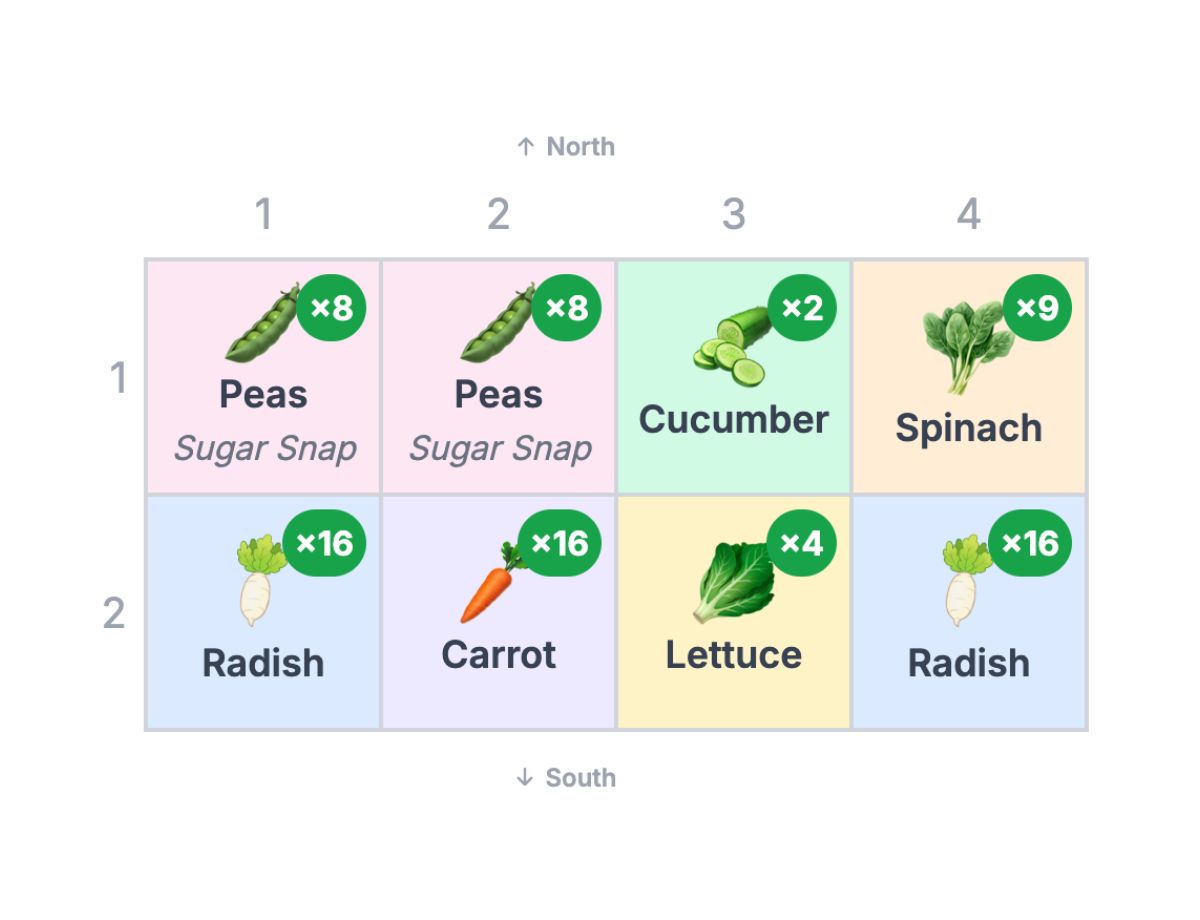
This is the bed to build with a child who wants to grow their own food. Every crop in it is fast, forgiving, and fun to harvest — sugar snap peas to pick straight off the vine, radishes up in under a month, and cucumbers that seem to grow overnight once the weather warms.
Spinach, carrot, and lettuce fill the remaining squares with a steady, low-drama harvest that rewards regular checking without punishing the odd missed watering.
The peas and cucumber climb a small trellis at one end, keeping their footprint tiny while giving little hands something to watch race upward.
What's in it: Peas (Sugar Snap), Cucumber, Spinach, Radish, Carrot, Lettuce
Best for: Gardening with children, first-time growers | Season: Spring into early summer
View the full grid layout, see companion pairings, and copy this plan to your account.
View & Copy This Plan → Free account required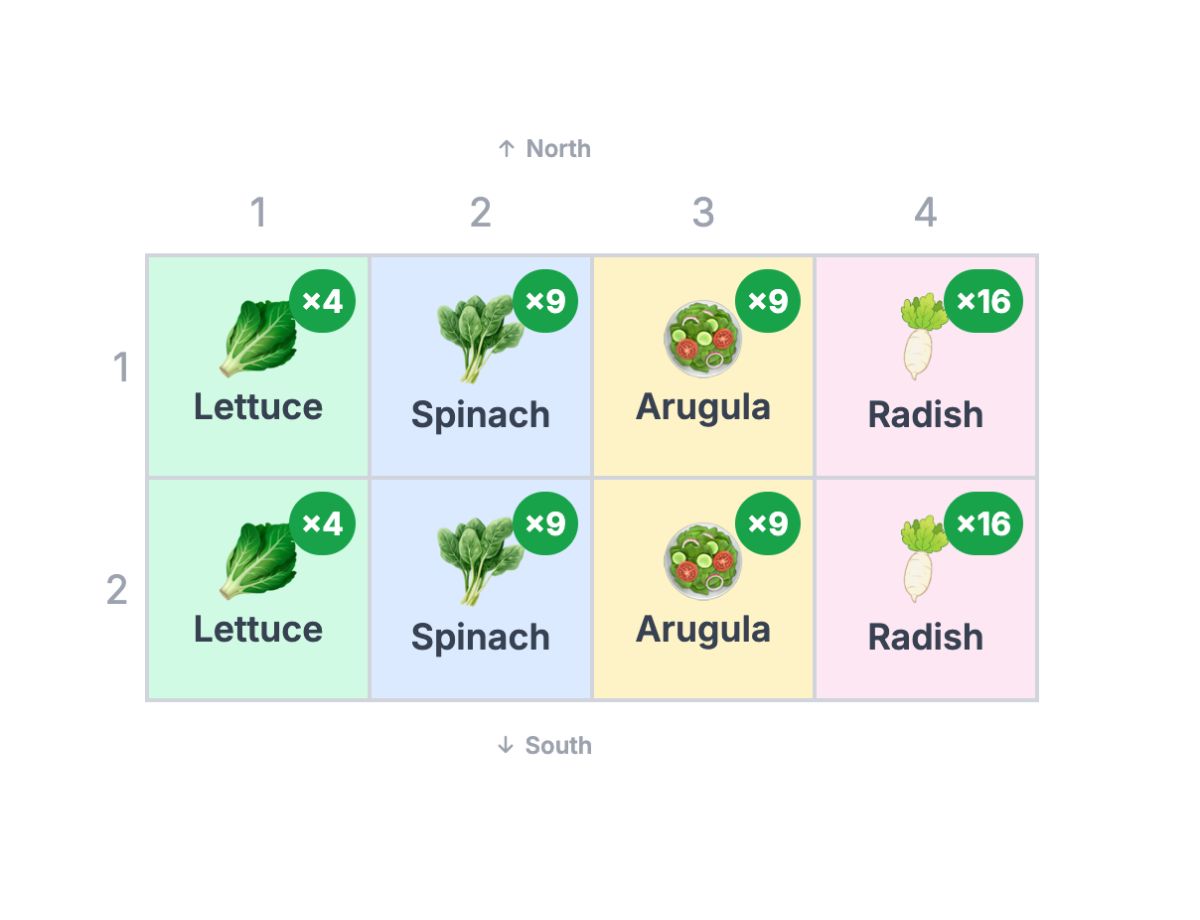
Plan 2 — Cut-and-Come-Again Salad Bed
Eight square feet is enough to stop buying bagged salad for most of the season.
This bed is planted entirely with leaves that regrow after cutting — take the outer leaves, leave the centre, and the plant carries on producing for weeks.
Lettuce, spinach, and arugula share the bed in dense blocks, with radish tucked between them to fill the gaps and mature before the greens need the room.
Sow a fresh square every couple of weeks and a 2×4 will keep a household in salad without ever emptying all at once.
What's in it: Lettuce, Spinach, Arugula, Radish
Best for: Daily salad harvests, succession sowing | Season: Spring and autumn
View the full grid layout, see companion pairings, and copy this plan to your account.
View & Copy This Plan → Free account required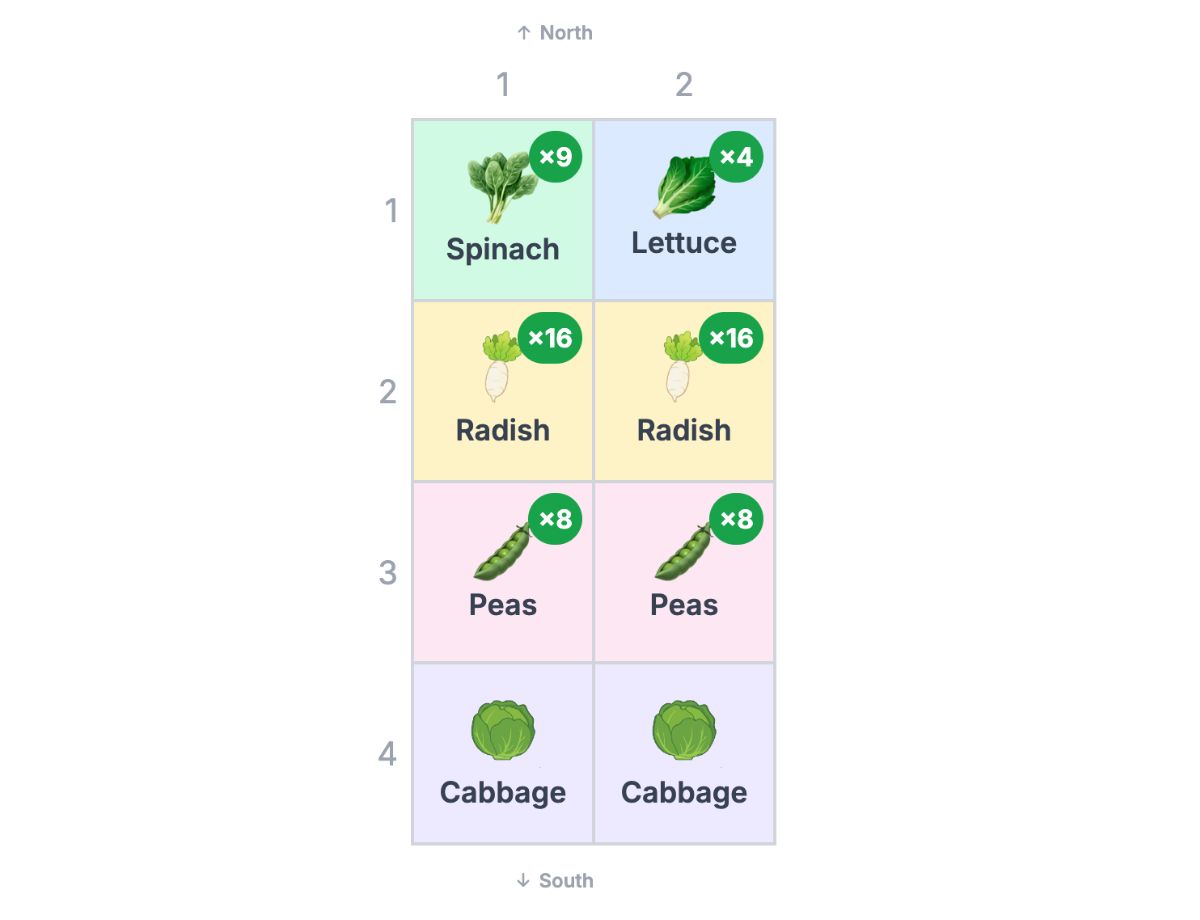
Plan 3 — Cool-Season Starter Bed
This is the layout to plant while the weather is still cool — in early spring as the soil wakes up, or in late summer for an autumn harvest.
Every crop in it prefers cool days and shrugs off a light frost.
Peas climb at one end and fix nitrogen as they grow, feeding the leafy crops beside them. Spinach and lettuce fill the middle squares, radish races ahead in the gaps, and a pair of cabbages anchor the bed with a slower, more substantial harvest.
When the temperature climbs and the greens start to bolt, that is the signal to clear the bed and swap in a warm-season plan.
What's in it: Spinach, Lettuce, Radish, Peas, Cabbage
Best for: Spring and autumn growing, cool-climate gardeners | Season: Early spring or late summer into autumn
View the full grid layout, see companion pairings, and copy this plan to your account.
View & Copy This Plan → Free account required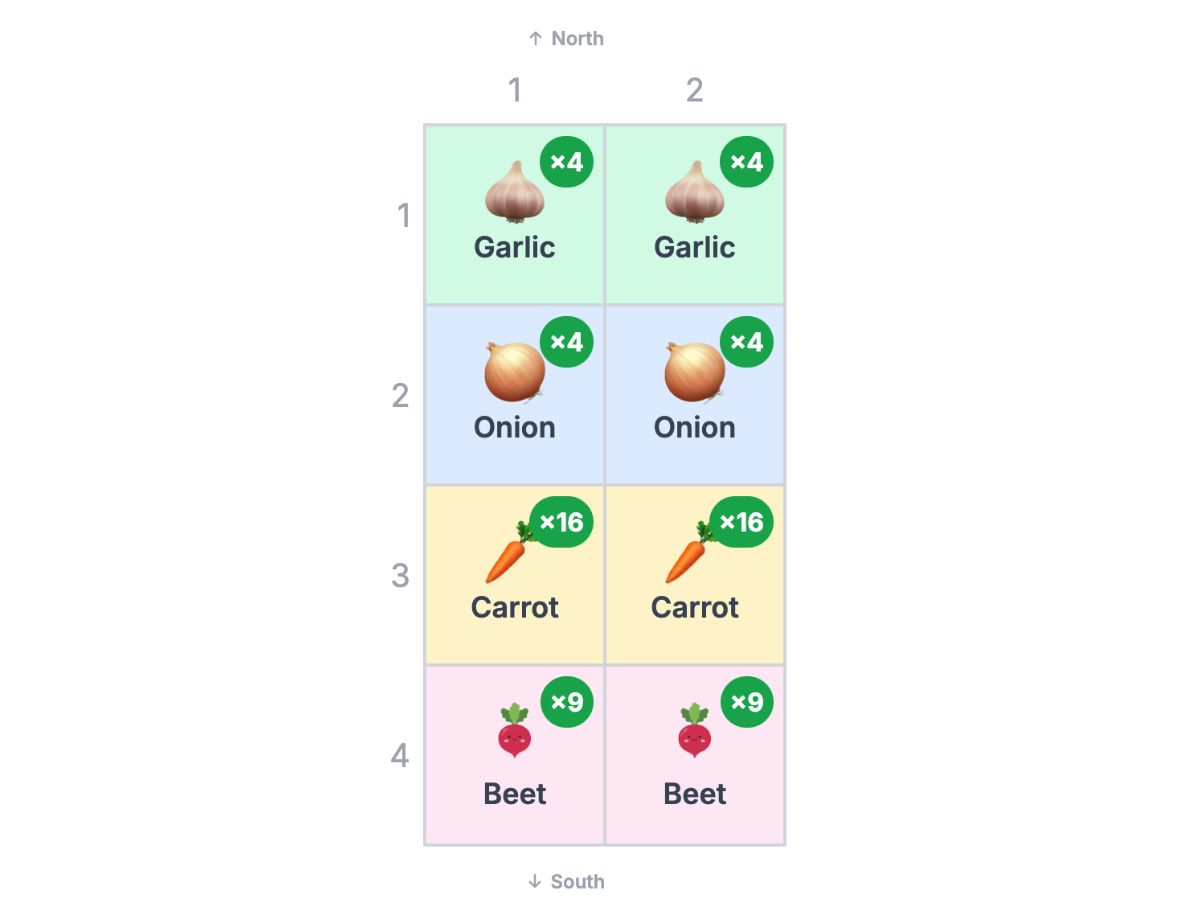
Plan 4 — Allium & Root Bed
Roots and alliums are the crops that ask the least of you — plant them, keep them watered, and largely leave them alone until harvest.
That makes this one of the most low-maintenance ways to use a 2×4 bed. Garlic and onion take the outer squares, where they double as pest deterrents for the whole bed.
Carrot and beetroot fill the centre in dense rows, giving a big harvest from a small footprint.
The onions and carrots also make classic companions — the onion scent helps mask the carrots from carrot fly. It is a bed you can plant and mostly forget until it is time to pull.
What's in it: Garlic, Onion, Carrot, Beetroot
Best for: Low-maintenance growing, storage crops | Season: Spring, or autumn for overwintered garlic
View the full grid layout, see companion pairings, and copy this plan to your account.
View & Copy This Plan → Free account required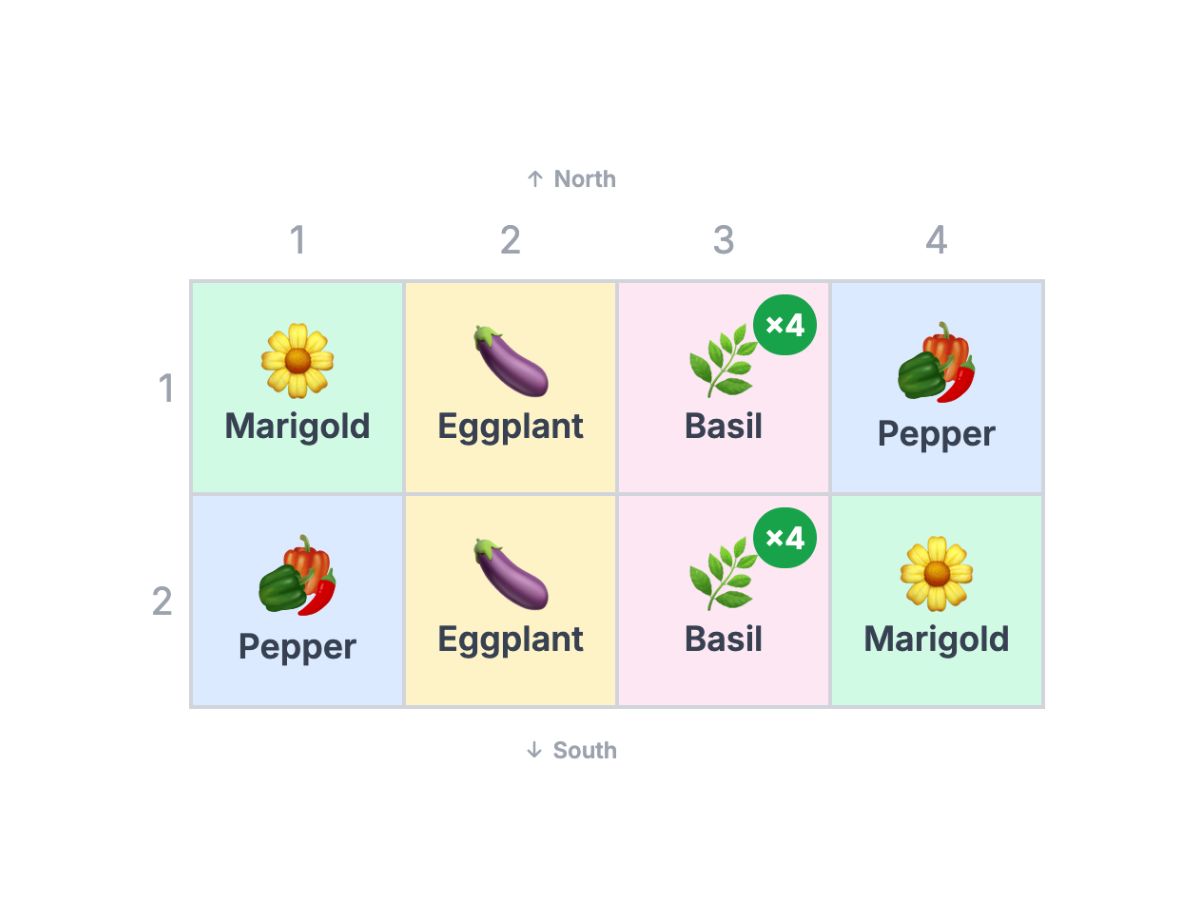
Plan 5 — Heat-Lovers' Bed
When summer arrives in earnest, this is the layout that makes the most of it.
Peppers and eggplant thrive in the heat that makes salad crops bolt, and both stay compact and upright — exactly the shape a small bed wants.
Basil fills the squares between them, improving the flavour of the fruit nearby and keeping aphid pressure down, while a couple of marigolds stand guard at the corners to deter pests from the whole bed.
It is a small planting, but every plant earns its square, and the harvest runs right through the hottest weeks of the year.
What's in it: Pepper, Eggplant, Basil, Marigold
Best for: Hot summers, compact heat-loving crops | Season: After last frost, through peak summer
View the full grid layout, see companion pairings, and copy this plan to your account.
View & Copy This Plan → Free account required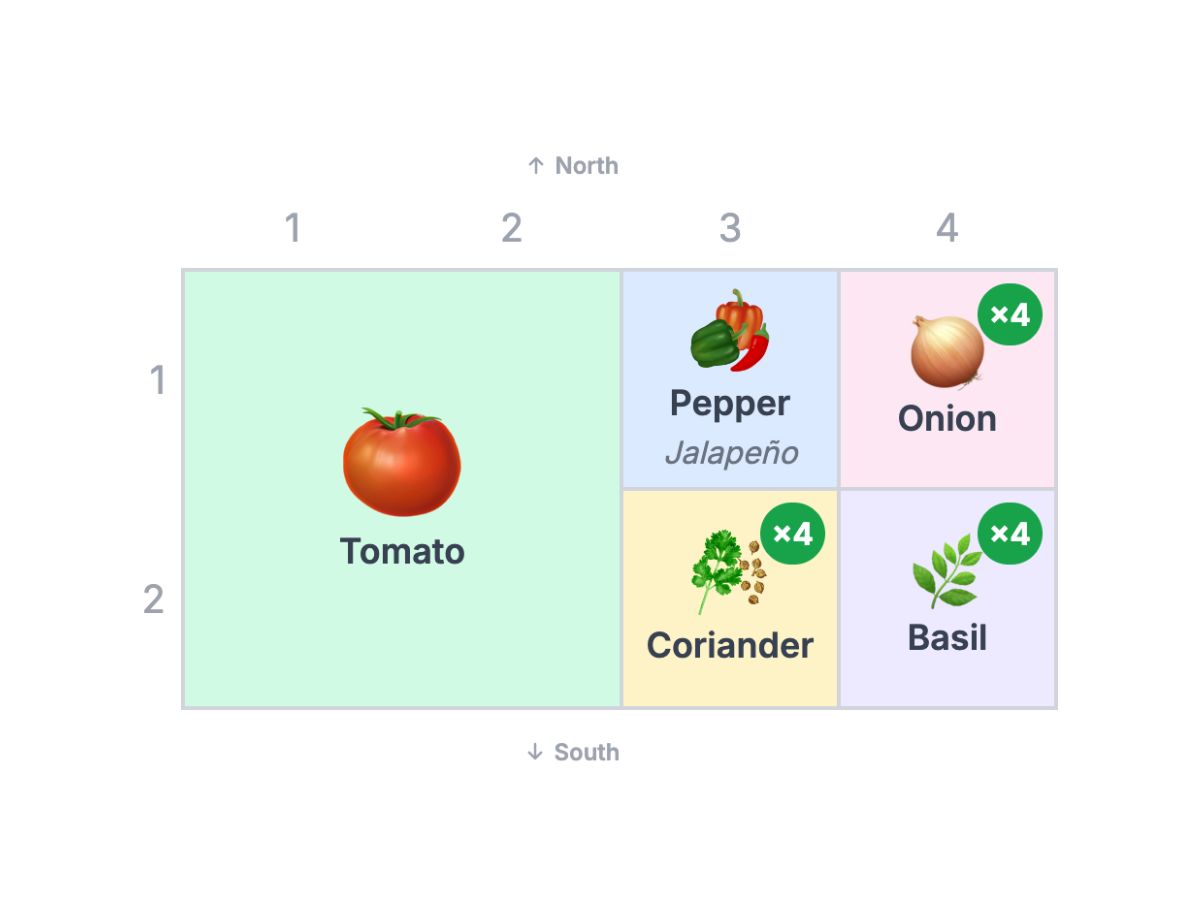
Plan 6 — Small Summer Salsa Bed
Everything you need for a bowl of fresh salsa, grown in eight square feet. A single tomato plant anchors the bed and, trained up a stake, produces all season without dominating the space.
A jalapeño brings the heat from one square over.
Coriander and onion fill the remaining squares — both essential in the bowl and both useful in the bed, the onion deterring pests and the coriander drawing in beneficial insects.
Basil rounds it out beside the tomato, sharpening its flavour as it grows. Pick everything on the same afternoon and the salsa is made from a single bed.
What's in it: Tomato, Jalapeño Pepper, Coriander, Onion, Basil
Best for: Fresh salsa lovers, themed kitchen gardens | Season: Summer
View the full grid layout, see companion pairings, and copy this plan to your account.
View & Copy This Plan → Free account required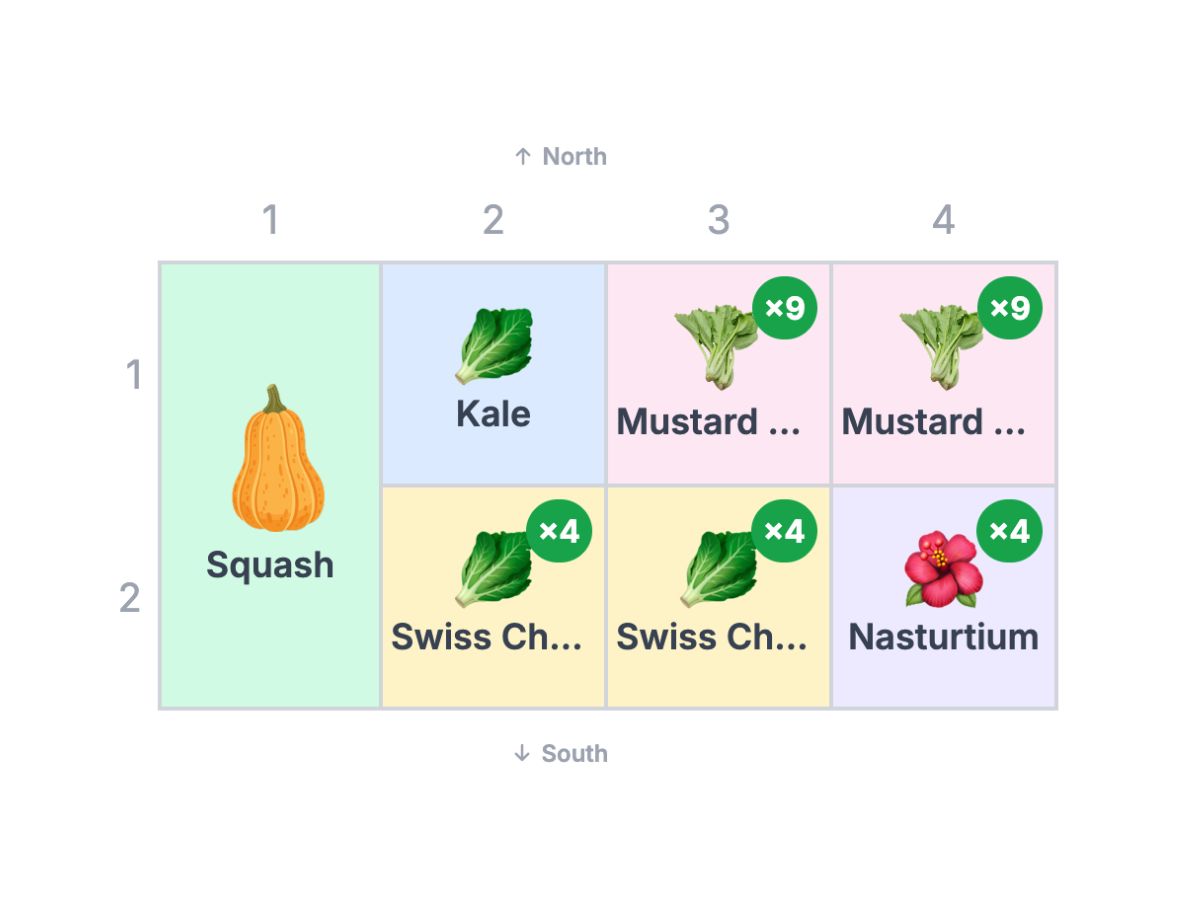
Plan 7 — Fall Squash & Greens Bed
This layout carries a 2×4 bed into autumn. A single squash plant anchors it — trained to trail off one end so its big leaves shade the soil rather than crowd the bed — while hardy greens do the everyday work.
Swiss chard and mustard greens fill the central squares with a cut-and-come-again harvest that only sweetens as the nights cool, and a kale plant adds structure and a crop that stands well into frost.
Nasturtiums spill from the corners as an edible flower and a living trap for aphids, keeping them off the greens. It is a bed that keeps producing after the summer crops have given up.
What's in it: Squash, Kale, Swiss Chard, Mustard Greens, Nasturtium
Best for: Autumn harvests, frost-tolerant greens | Season: Late summer into autumn
View the full grid layout, see companion pairings, and copy this plan to your account.
View & Copy This Plan → Free account required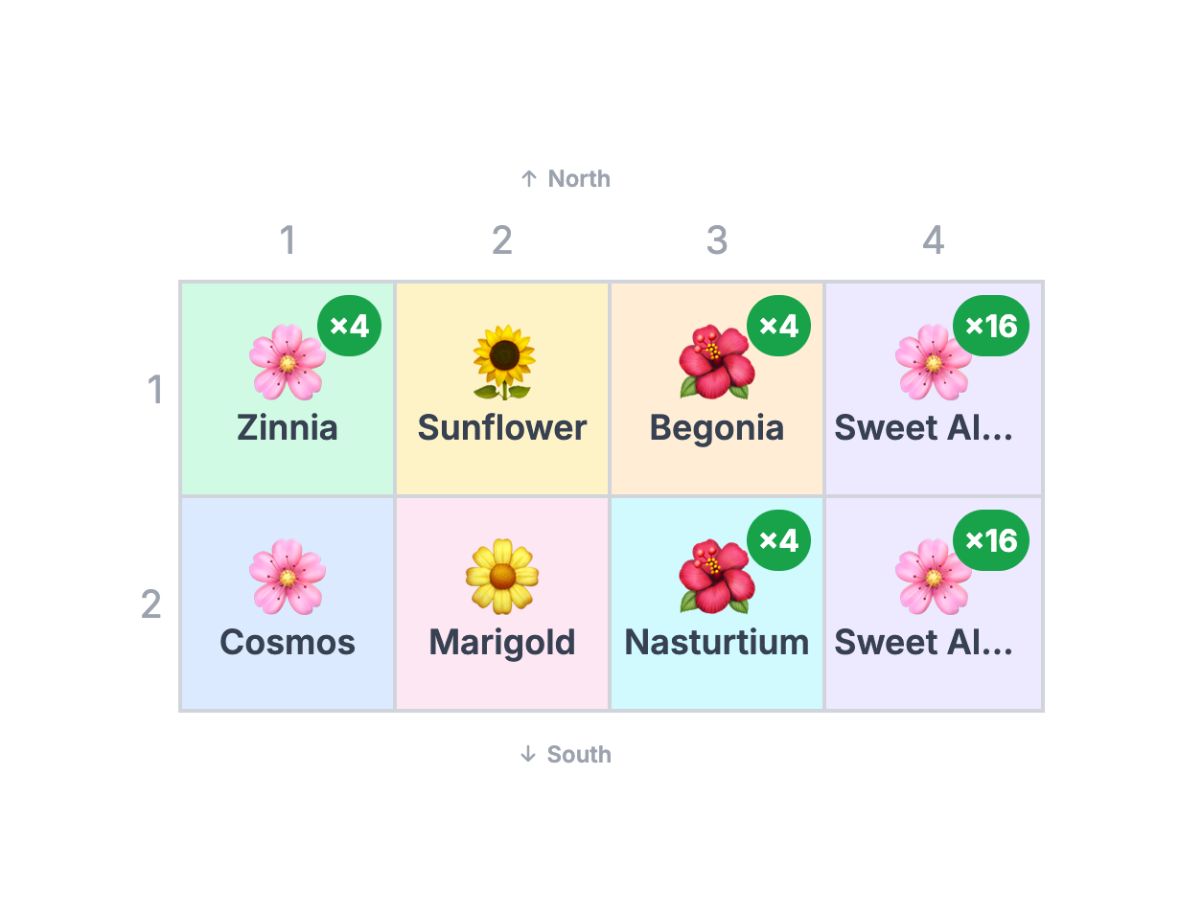
Plan 8 — Pollinator Strip Bed
A narrow 2×4 makes an ideal pollinator strip — long, low, and easy to slot alongside a vegetable bed or a patio to pull in bees and butterflies. This plan packs seven flowering varieties into eight squares for colour from early summer to first frost.
A sunflower and a few zinnias give height at the back, cosmos and marigold fill the middle, and sweet alyssum spills over the front edge as a dense carpet that draws in hoverflies and other beneficial insects.
Begonia and nasturtium round out the colour, the nasturtium doubling as an edible bloom. Placed next to your food crops, a strip like this measurably improves fruit set on everything nearby.
What's in it: Sunflower, Zinnia, Cosmos, Marigold, Sweet Alyssum, Begonia, Nasturtium
Best for: Attracting pollinators, edging a vegetable garden | Season: Summer into autumn
View the full grid layout, see companion pairings, and copy this plan to your account.
View & Copy This Plan → Free account required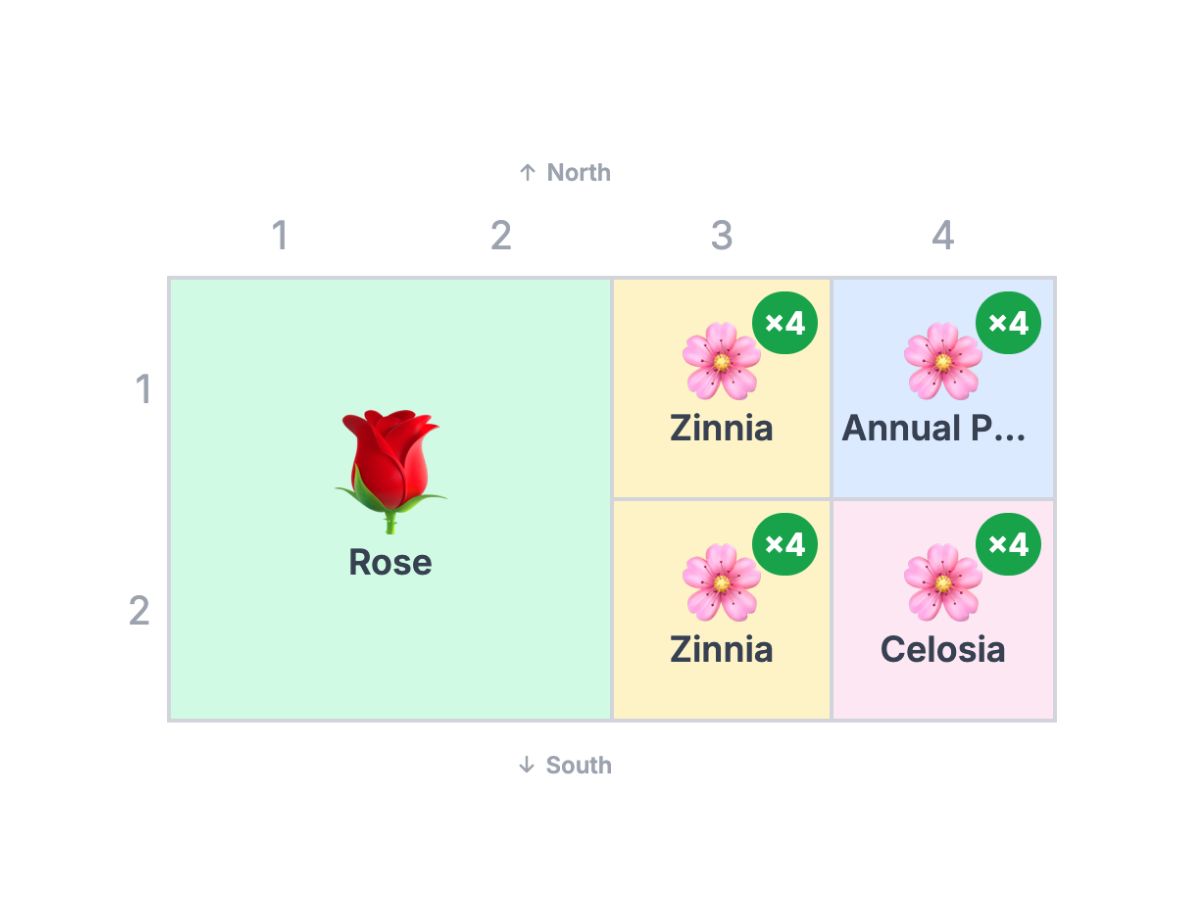
Plan 9 — Beginner Cut-Flower Bed
If you would rather fill a vase than a salad bowl, a 2×4 is enough to keep fresh flowers on the table for months. This beginner-friendly plan sticks to varieties that are hard to fail with and generous when you cut them — the more you pick, the more they bloom.
Zinnias do the heavy lifting, throwing out cut stems all summer, with celosia adding texture and annual phlox filling in soft colour between them.
A single rose gives the bed a longer-lived anchor and a few show-stopping blooms. Keep cutting through the season and this small strip keeps replacing what you take.
What's in it: Rose, Zinnia, Celosia, Annual Phlox
Best for: Fresh cut flowers, beginner flower growers | Season: Late spring through summer
View the full grid layout, see companion pairings, and copy this plan to your account.
View & Copy This Plan → Free account requiredHow to Adapt These Plans to Your Space
These nine plans are starting points. Any of them can be adjusted for your climate, season, or taste without losing the logic underneath.
Swap crops you will not eat. There is no reason to grow eggplant if it never reaches your plate. Replace any unfamiliar crop with a well-known one of similar size — swap eggplant for a second pepper, mustard greens for more spinach, celosia for another zinnia. Spacing rarely changes between crops of the same scale.
Match the plan to your season. Plans 2, 3, and 4 are built for cool weather and go in during early spring or late summer. Plans 5 and 6 need real heat and should wait until after your last frost. Plan 7 is timed for autumn. Choose the plan that fits the season you are actually planting into.
Keep tall plants on the north side. The sunflower, the tomato, the trellised peas and cucumber all cast shade. In the northern hemisphere, keep them along the north edge so they throw shadow away from the bed rather than over it. Reverse that if you garden in the south.
Run two 2×4 beds side by side. The most natural way to grow from here is a second bed rather than a bigger one. A salad bed next to a heat-lovers' bed, or a vegetable bed beside the pollinator strip, gives you variety and a built-in rotation for next year — while keeping every square within easy reach.
Common Mistakes in a 2×4 Bed
Trying to grow too many things. Eight squares tempts beginners into planting one of everything. The result is a cramped bed where nothing has room to mature. A 2×4 does one theme well — pick a purpose for the bed and plant it fully, rather than a little of everything.
Letting one crop take over. A single squash or an untrained cucumber can smother a bed this small within weeks. If you grow a sprawling crop, train it up or off the end of the bed, and never plant more than one.
Ignoring vertical space. A 2×4 footprint holds far more than eight squares suggest if you grow upward. Peas, cucumber, and small tomatoes all climb happily on a trellis at one end, freeing the ground below for salad or roots.
Underwatering in summer. A small, shallow bed dries out faster than the ground does. In hot weather a 2×4 can need water every day. Mulch the surface to slow moisture loss, and check it more often than you think you need to during fruiting.
Frequently Asked Questions
How many plants can you fit in a 2×4 raised bed?
Anywhere from a handful to around eighty, depending on what you grow. A bed of peppers, eggplant, and herbs might hold a dozen plants, while a salad or root bed can hold seventy or more small plants across the same eight squares.
The square foot method sets a sensible density for each crop — match your choices to those numbers and the bed will be full without being overcrowded.
What vegetables grow best in a 2×4 raised bed?
Compact and quick crops do best: lettuce, spinach, arugula, radish, carrot, beetroot, onion, garlic, bush beans, peppers, and herbs of all kinds.
One anchor crop — a single tomato, cucumber, or squash trained upward — works well too. Avoid anything that sprawls widely, such as pumpkins, melons, or squash left to run.
How deep should a 2×4 raised bed be?
Six inches is enough for salad, herbs, and shallow roots. Eight to twelve inches is better if you want to grow carrots, beetroot, or a tomato, giving the roots room to develop and holding moisture longer between waterings. Deeper is always more forgiving in a bed this small.
Is a 2×4 bed really big enough to be worth it?
For a focused harvest, yes. A 2×4 will not feed a family from one planting, but it will keep you in salad, herbs, or cut flowers for a whole season, and it is the best possible place to learn the rhythm of planting, watering, and harvesting before committing to anything larger.
Many gardeners find one small bed done well teaches more than a big one left half-managed.
Can you grow tomatoes in a 2×4 bed?
Yes — one plant. A single tomato staked or trellised at the end of a 2×4 bed will produce all season and leave room for lower-growing companions like basil, onion, and salad in the remaining squares.
Two tomatoes in a bed this size will compete and disappoint; keep it to one and let it climb.
Start With a Plan That Already Works
These nine layouts cover most of what a well-planned 2×4 bed can do: a kids' bed and a salad bed for easy first harvests, cool-season and root beds for spring and autumn, a heat-lovers' bed and a salsa bed for summer, an autumn greens bed, and two beds of flowers — one for pollinators, one for the vase.
Between them, there is a plan for almost any season and any reason to start.
A small bed rewards a good plan more than a large one needs to. Pick the layout closest to what you would like to grow, adjust a square or two to match your own taste, and the spacing, companions, and structure are already handled — all that is left is the planting.
Whenever you're ready to plant
There's no rush on any of this. If one of these beds looks close to what you'd like to grow, you can open it in EdenVatika, copy it across, and adjust the squares to fit your space and season — whenever the timing feels right. The first couple of beds stay free, so there's nothing to commit to today. The plan will be there when you are.
Open these plans in EdenVatika →