Beginner 20×20 Vegetable Garden Layout: 5 Complete Plans You Can Copy
A 20×20 garden gives you 400 square feet to grow serious quantities of food — enough to fill a family's plate all season. Here are five complete beginner-friendly layouts you can copy directly into your garden today.
A 20×20 garden is where things get real.
At 400 square feet, you are no longer growing a handful of tomatoes beside the back door. You are growing enough to feed a family across an entire season.
Courgettes piling up faster than you can use them, salad greens on rotation, beans to freeze, and herbs within arm's reach of the kitchen.
The challenge — and the reason most beginners end up with an overgrown, lopsided plot by July — is that 400 square feet needs a plan.
Without one, fast-growing crops shade the slower ones, sprawling plants take over neighbouring squares, and you end up with a lot of one thing and none of another.
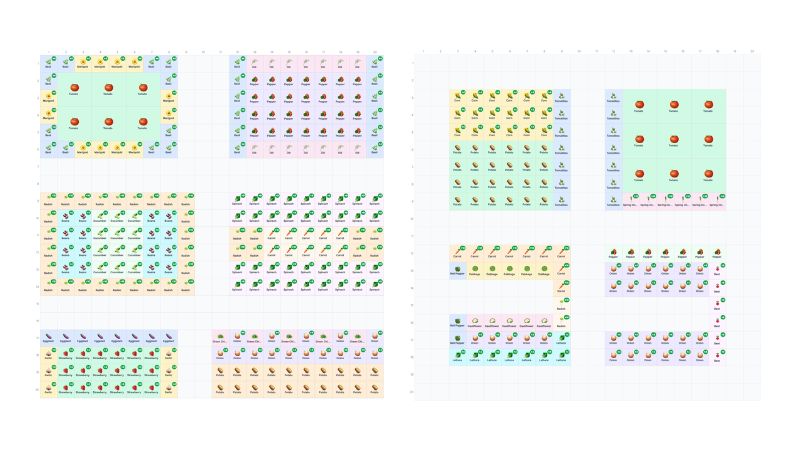
This guide walks you through how to think about a beginner 20×20 vegetable garden layout, what to grow, and five complete plans you can copy directly into EdenVatika's free planner and start planting today.
Why 20×20 Is the Right Size for a Serious Kitchen Garden
Most gardening advice starts small — a 4×4 raised bed for your first season, maybe a 4×8 if you're feeling ambitious. That advice is sound. But if you've grown for a season or two and found yourself buying most of your vegetables anyway, it's time to scale up.
A 20×20 plot:
- Feeds a family of 4 across a full season — with the right crops and rotation, 400 sq ft is genuinely productive enough to replace a significant portion of your grocery bill
- Gives you room to experiment — you can grow your reliable staples in one zone and try new crops in another without gambling your whole harvest
- Supports companion planting properly — at this scale you can place beneficial neighbours close together and create real pest-deterring combinations
- Justifies better infrastructure — a trellis, a watering system, a compost corner — these pay off at 400 sq ft in a way they don't for a small raised bed
The workload is honest too. A 20×20 plot needs around 2–3 hours of maintenance per week at peak season. That's a manageable Saturday morning, not a second job.
How to Divide Your 400 Square Feet
Before picking individual plants, think in zones. A 20×20 garden is most productive when it's mentally divided into sections by crop type and behaviour:
| Zone | What Goes Here | Typical Size | Notes |
|---|---|---|---|
| Tall / Trellis | Tomatoes, beans, cucumbers, corn | 4×20 ft (north edge) | Place at the back so they don't shade shorter crops |
| Mid-height crops | Peppers, courgette, kale, chard, eggplant | 6×20 ft (centre) | Core of the harvest; most visited zone |
| Ground-level crops | Lettuce, spinach, carrots, radishes, beets, onions | 6×20 ft (front) | Quick-growing; harvest frequently and resow |
| Herbs & flowers | Basil, marigolds, dill, nasturtiums, coriander | 4×20 ft (borders / edges) | Companion planting along edges; deter pests |
This structure keeps tall crops from casting afternoon shade across your salad greens, and puts the crops you harvest most frequently (lettuce, herbs) closest to your walking path.
What Fits in a 20×20 Vegetable Garden
Using square foot gardening spacing, here is a realistic crop list for a 400 sq ft beginner plot:
| Crop | Plants per sq ft | Sq ft needed for a good harvest |
|---|---|---|
| Tomato (indeterminate) | 1 per 4 sq ft | 6–9 plants = 24–36 sq ft |
| Cucumber | 2 per sq ft | 12–24 plants = 6–12 sq ft (on trellis) |
| Corn | 1 per sq ft | 40+ plants = 40 sq ft (needs block planting) |
| Bell Pepper | 1 per sq ft | 8–28 plants = 8–28 sq ft |
| Bush Beans / Climbing Beans | 4–9 per sq ft | 32–80 plants = 8–20 sq ft |
| Lettuce (loose-leaf) | 4 per sq ft | 32–48 plants = 8–12 sq ft |
| Carrot | 16 per sq ft | 80–160 carrots = 5–10 sq ft |
| Onion | 9 per sq ft | 60–116 onions = 7–13 sq ft |
| Radish | 16 per sq ft | Succession sow; 32+ radishes = 2+ sq ft per batch |
| Basil | 4 per sq ft | 10–96 plants depending on how much you use |
The five plans below each take a different approach to filling these 400 squares — from a classic Three Sisters setup to a maximum-variety kitchen garden to a plot built entirely around South Asian cooking.
5 Beginner 20×20 Vegetable Garden Layouts
Each plan below is live inside EdenVatika. Click through to see the full grid, plant list, and companion planting notes. You can copy any plan to your free account and edit it to suit your space.
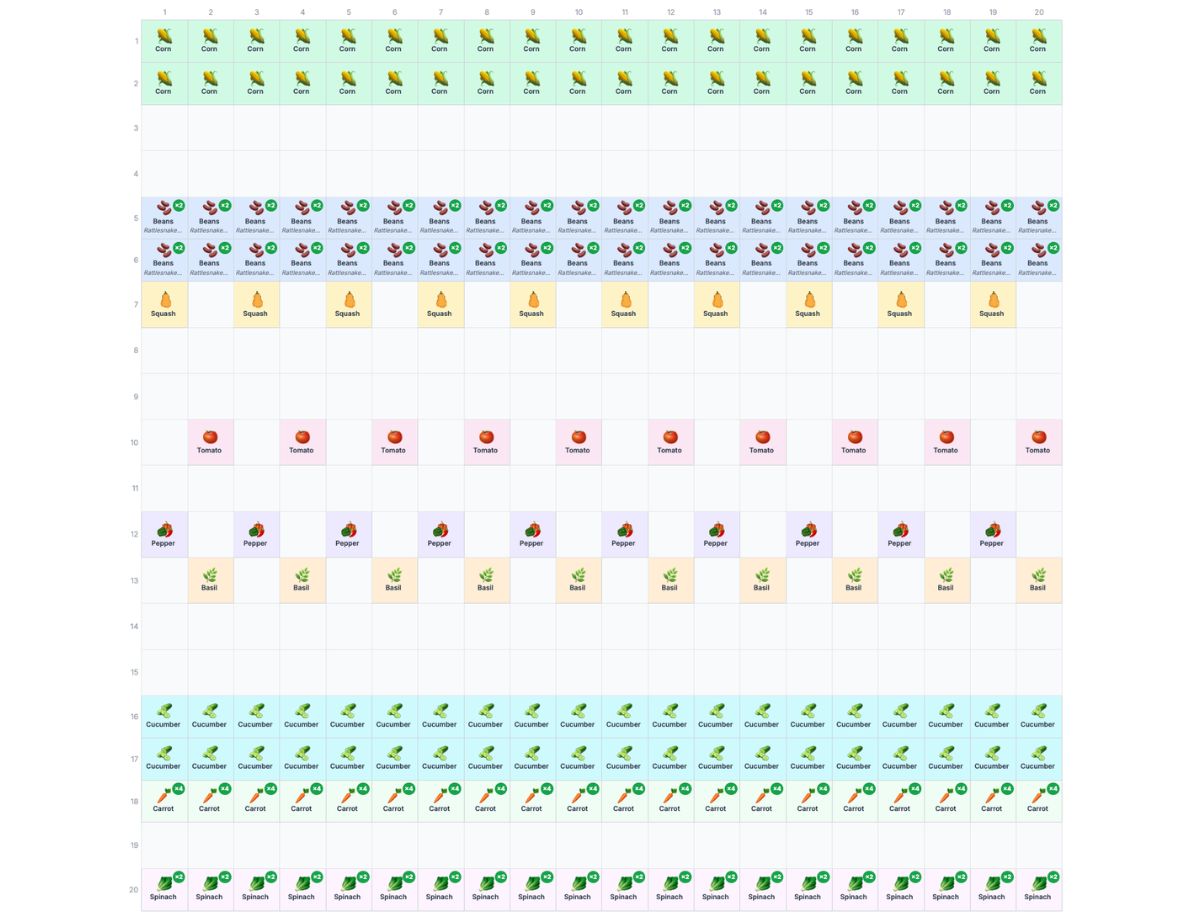
Plan 1 — The Three Sisters Community Plot
Best for: Growers who want traditional companion planting combined with classic vegetables
This plan is built around the Three Sisters — corn (40 plants), rattlesnake pole beans (80 plants), and squash (10 plants) — one of the oldest and most effective companion planting systems in the world.
Corn provides the trellis for beans to climb, beans fix nitrogen into the soil that feeds the corn and squash, and squash leaves spread across the ground suppressing weeds and locking in moisture.
Surrounding the Three Sisters block, the rest of the 20×20 fills out with tomatoes, peppers, cucumbers, carrots, and spinach — nine varieties in total across roughly 320 plants. Basil is interplanted with the tomatoes for flavour and pest deterrence.
This is a highly productive plan that manages a large share of its own fertility and pest control through plant relationships. If you've grown basic vegetables before and want to try something more intentional, this is the layout to start with.
🌿 View the Three Sisters Community Plot →
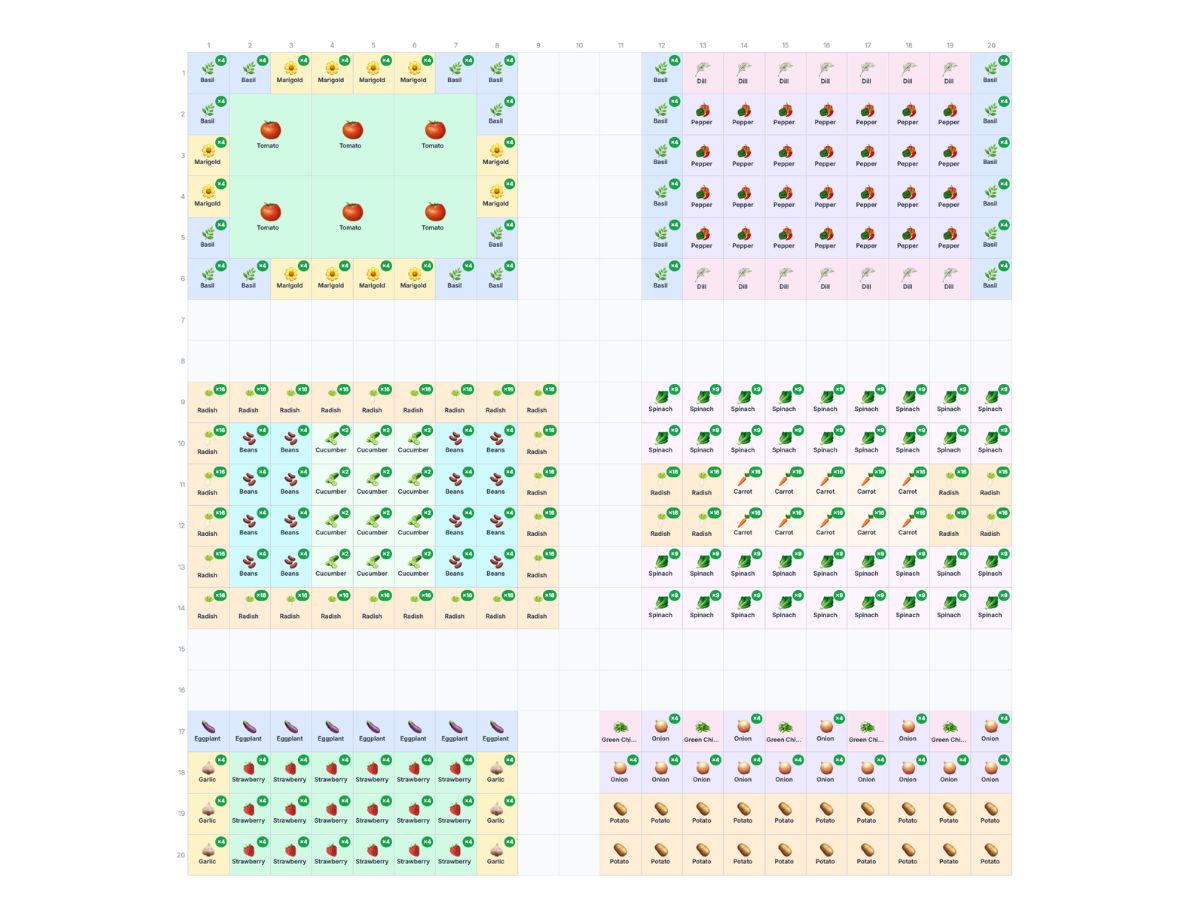
Plan 2 — The Companion Planting Backyard Garden
Best for: Families who want maximum natural pest control without chemicals
This is the most companion-planting-dense plan in this guide.
Marigolds (48 plants) and dill are distributed throughout the bed as natural pest deterrents; basil (96 plants) is planted alongside tomatoes and peppers to repel aphids and improve flavour; garlic and onions border the plot to deter larger pests.
The vegetable mix is deliberately broad — tomatoes, peppers, eggplant, beans, cucumber, carrot, spinach, potato, strawberry, and green chillies across 16 varieties and 264 plants total.
The generous spinach and radish blocks are designed for succession sowing: sow a third of each block every three weeks and you'll always have something ready to pick rather than a glut all at once.
If you've had pest problems in previous seasons — aphids on tomatoes, carrot fly, caterpillars on brassicas — this layout is specifically designed to use plants to solve those problems before they start.
🌿 View the Companion Planting Backyard Garden →
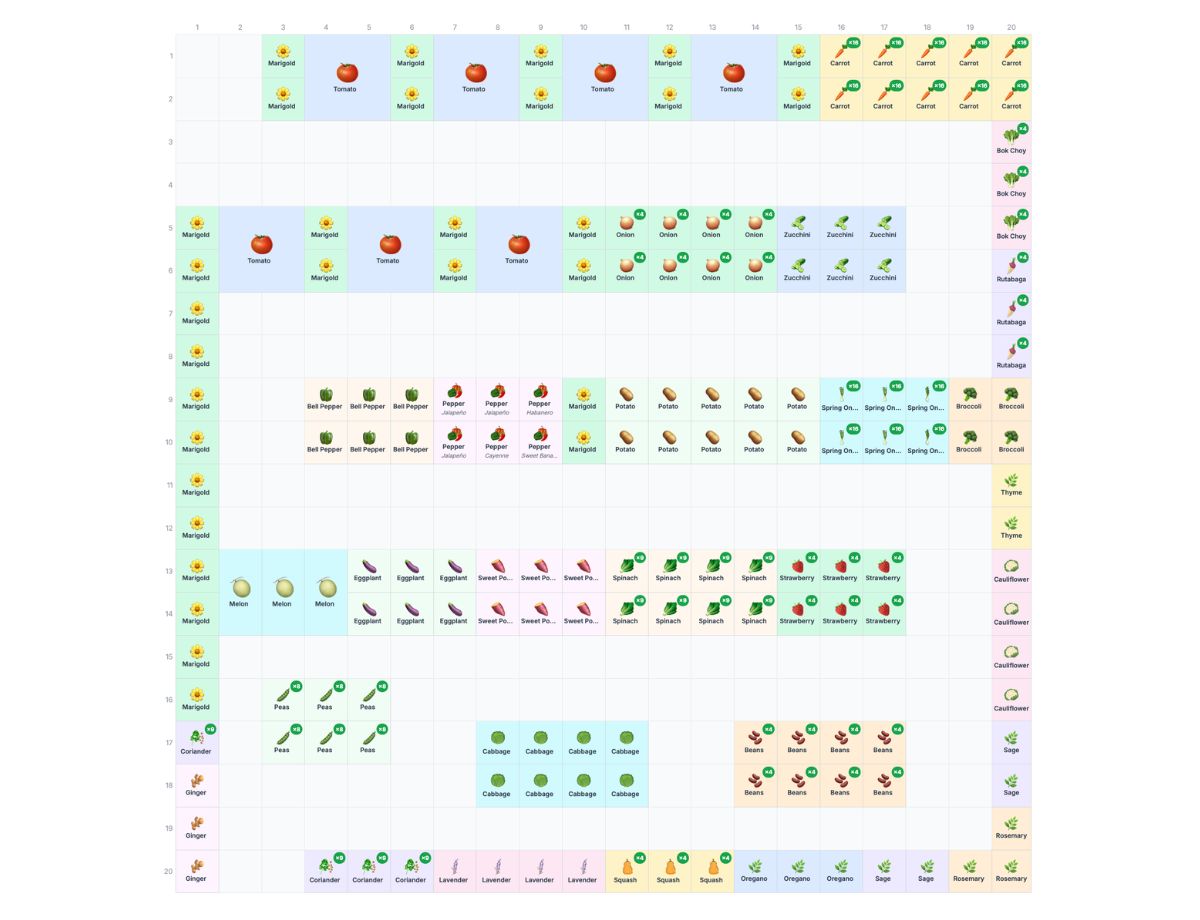
Plan 3 — The Maximum Variety Kitchen Garden
Best for: Adventurous beginners who want to grow as many different crops as possible in one season
At 32 varieties across 180 plants, this is the most diverse plan in this guide.
It covers the full range of the kitchen garden — staples like tomatoes, zucchini, beans, peas, spinach, and carrots alongside more adventurous crops like bok choy, melon, ginger, sweet potato, and rutabaga.
The herb section is equally generous: thyme, sage, rosemary, oregano, coriander, and lavender fill the border strips, providing year-round picking and natural pest deterrence.
For heat lovers, the pepper selection is serious — bell pepper, jalapeño, cayenne, habanero, and sweet banana pepper all feature, along with broccoli, cauliflower, cabbage, squash, eggplant, and strawberry.
This plan is intentionally experimental. By the end of the season, you'll know exactly which crops you love growing and eating — and which 10 or 12 to prioritise in year two. It teaches you more in one season than three years of growing the same five vegetables.
🌿 View the Maximum Variety Kitchen Garden →
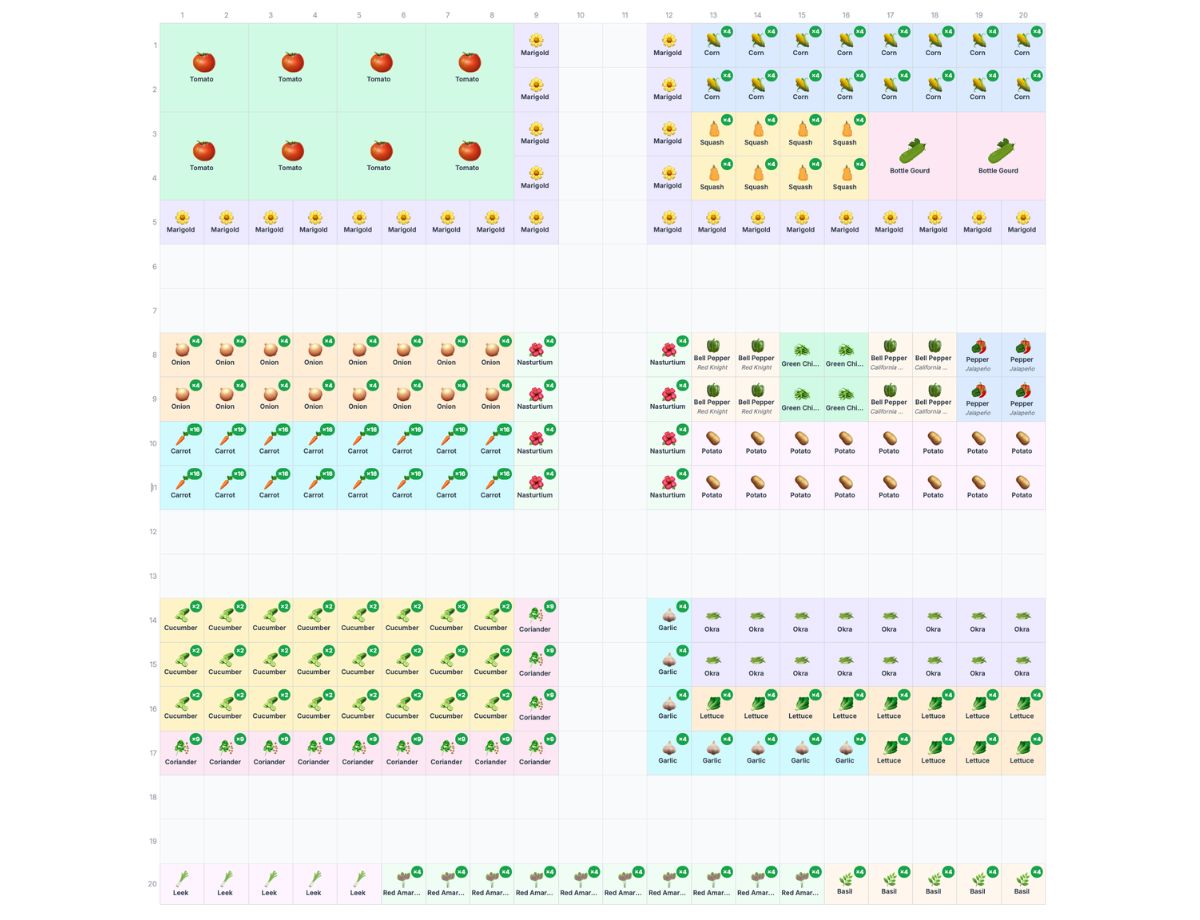
Plan 4 — The South Asian Kitchen Garden
Best for: Cooks who want to grow the vegetables that form the backbone of Indian and South Asian cooking
This plan is built around the crops used daily in South Asian kitchens: okra (16 plants), coriander (108 plants — enough for constant cutting across the whole season), green chillies, jalapeño, bottle gourd, and red amaranth, alongside high-volume producers like corn (64), carrot (256), and onion (64).
Companion planting runs throughout: marigolds (26) and nasturtiums (32) border the plot as natural pest deterrents, basil pairs with tomatoes, and garlic interplants with the pepper blocks.
Leek, cucumber, lettuce, potato, and two varieties of bell pepper round out the plan's 21 varieties and 224 plants.
If you cook with coriander, chillies, and okra daily, this layout will keep your kitchen genuinely stocked without weekly supermarket trips.
The 108-plant coriander block in particular is designed for cut-and-come-again harvesting — cut the outer leaves regularly and it will produce all season.
🌿 View the South Asian Kitchen Garden →
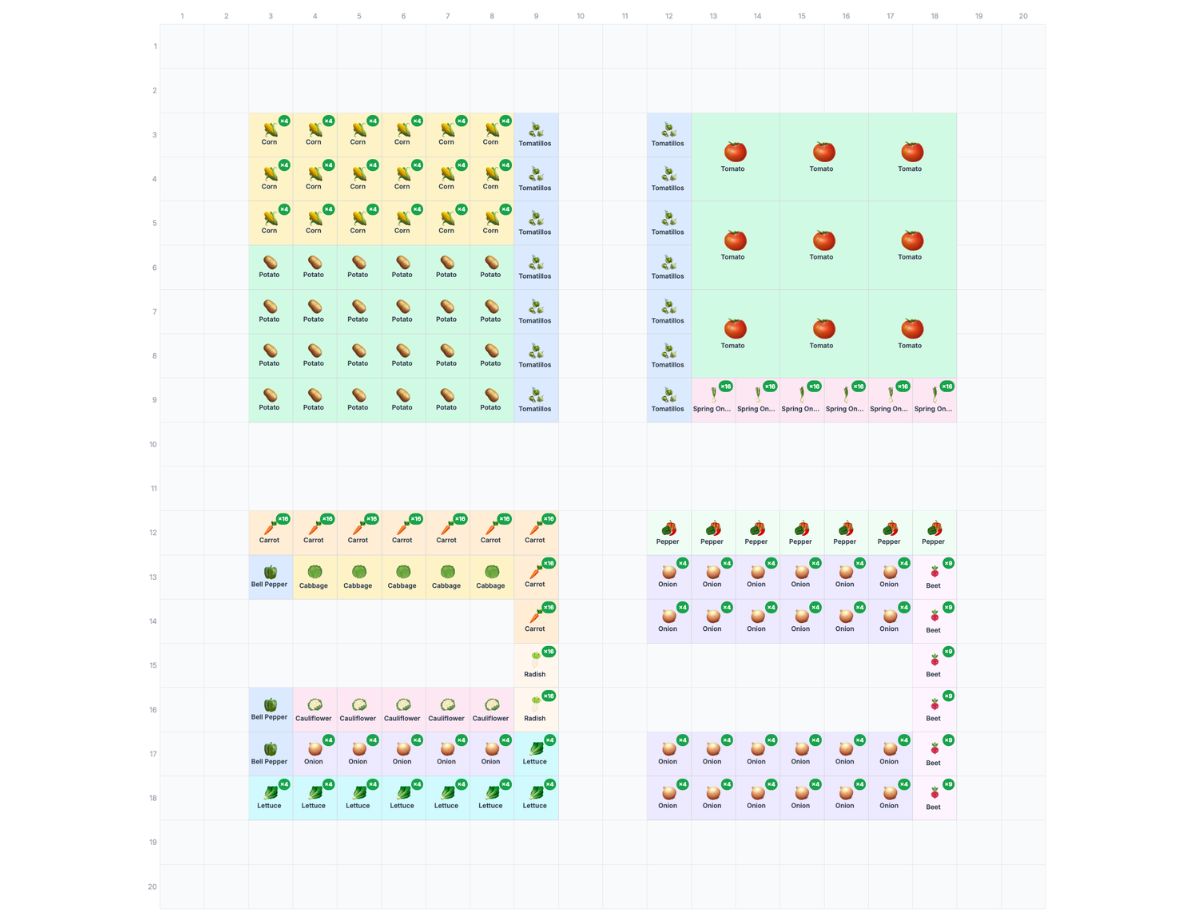
Plan 5 — The Classic First Vegetable Garden
Best for: True beginners who want a reliable, manageable plot of proven vegetables
This is the most straightforward plan in this guide. Fourteen varieties, 145 plants, and nothing exotic — just the crops that work in almost every climate and reward beginners with real harvests from their first season.
Root vegetables take up a significant share of the planting: 144 carrots, 54 beets, 32 radishes, and 24 potatoes give you a serious autumn harvest to store or eat fresh.
Above ground, 9 tomatoes, 7 peppers, 3 bell peppers, 116 onions, 96 spring onions, and 32 lettuce plants cover everything a family kitchen needs through summer.
Cabbage and cauliflower take over the late-season slots as the summer crops finish. And tomatillos — 14 plants — are the one surprise in an otherwise classic list.
Easy to grow, very productive, and underused in most beginner gardens: if you've never tried them, this is a low-risk way to add them to your first season.
🌿 View the Classic First Vegetable Garden →
Tips for Making Your 20×20 Garden Actually Work
The plans above are starting points. Here are the things that separate a thriving 20×20 plot from an overgrown one by July:
1. Stake and trellis early
Install your tomato cages, bean poles, and cucumber trellis before you plant — not after the plants have already sprawled. A young tomato plant tied to a stake once a week stays manageable. An unsupported tomato at three feet tall becomes a project.
2. Succession sow your fast crops
Lettuce, spinach, radishes, and beans all bolt or finish within a few weeks. Instead of sowing the whole block at once, sow a third of the area every three weeks. You will always have something coming on rather than everything going to seed simultaneously.
3. Water deeply and less often
Shallow daily watering encourages shallow roots. Deep watering two or three times a week pushes roots down into the soil where moisture is more consistent. A 20×20 garden is much easier to manage with drip irrigation or soaker hoses than with a hand watering can.
4. Harvest aggressively
The single biggest mistake in a productive garden: not harvesting often enough. Beans left on the plant signal the plant to stop producing. Courgettes left to become marrows do the same. Pick regularly — every two or three days during peak season — and the plants will reward you with continuous production.
5. Keep a simple log
At this scale, it is easy to forget what you planted where, when you last watered, or which bed had the pest problem last year. A simple note in your phone or a piece of paper pinned to the shed will save you a lot of confusion in year two. EdenVatika's planner keeps this automatically — your beds, plant lists, and planting dates are all saved in your account.
🌿 Your 20×20 Garden Plan Is One Click Away.
Every layout in this post is live inside EdenVatika — free to copy, customise, and print. You see the full grid, the plant counts, and the companion pairings before anything goes in the ground. Your work is always saved. We never delete your plans.
Copy a Free Garden Plan →Free account. No credit card. Plans stay yours forever.