Simple 10×10 Garden Layout Ideas: 5 Plans You Can Copy
A 10×10 garden is large enough to grow a real variety of vegetables, but small enough to manage without overwhelm. Here are five complete layouts you can copy directly into your garden today.
A 10×10 garden is one of the best decisions a first-time grower can make.
It is large enough to grow a meaningful variety of vegetables — tomatoes, cucumbers, salad greens, herbs, and root crops all fit comfortably — but small enough to manage without overwhelm. You can weed it in twenty minutes.
You can reach every inch of it without stepping on the soil. And when the season goes well, it produces more food than most households expect from a hundred square feet.
The problem is that most 10×10 garden layouts people start with are not actually designed. They are just a patch of ground with whatever fit the shopping trolley that weekend — no thought given to spacing, companions, or what happens when the squash decides to take over.
This guide covers how a simple 10×10 vegetable garden plan actually works — what belongs in it, how to think about spacing, and five complete plans you can copy directly into your own garden today.
Why 10×10 Is the Right Size for Most Gardeners
A hundred square feet is the sweet spot between ambition and sustainability.
Smaller plots — a 4×4 or 4×8 raised bed — are excellent starter formats but limit what you can grow. You cannot fit meaningful quantities of tall crops alongside sprawling ones without everything feeling squeezed.
A 10×10 in-ground bed or a pair of 4×8 raised beds arranged together give you proper growing zones without the workload of a market garden.
The commitment is honest, too. A 10×10 plot needs watering, weeding, and regular harvesting. Those tasks are manageable for one person maintaining a kitchen garden. A 20×20 can quickly become a burden in a busy summer.
Most importantly: a 10×10 garden, planned well, can produce continuously from early spring through late autumn. That full-season productivity is the goal — not just a summer flush followed by an empty patch.
What Fits in 100 Square Feet
Square foot gardening is the most practical framework for a simple 10×10 vegetable garden plan. Divide the bed into one-foot squares and assign each square a planting density based on the crop. The result is an intensive layout that uses every inch without overcrowding.
| Crop | Plants per sq ft | Space it takes in a 10×10 | Notes |
|---|---|---|---|
| Tomato (indeterminate) | 1 per 4 sq ft | 4–6 plants uses 16–24 sq ft | Needs staking; plant on north side |
| Cucumber | 2 per sq ft | 8 plants uses 4 sq ft | Train vertically to save space |
| Zucchini / Courgette | 1 per 4 sq ft | 2 plants uses 8 sq ft minimum | Sprawling; limit to 1–2 plants |
| Pepper | 1 per sq ft | 8–12 plants uses 8–12 sq ft | Compact; good filler crop |
| Lettuce (loose-leaf) | 4 per sq ft | 20 plants uses 5 sq ft | Tolerates partial shade; good under trellis |
| Spinach | 9 per sq ft | 45 plants uses 5 sq ft | Quick-growing; harvest outer leaves |
| Carrot | 16 per sq ft | 80 carrots uses 5 sq ft | Needs loose, stone-free soil |
| Onion / Spring Onion | 9 per sq ft | 36 onions uses 4 sq ft | Good companion; deters many pests |
| Beans (bush) | 4 per sq ft | 20 plants uses 5 sq ft | Fixes nitrogen; good before brassicas |
| Basil | 4 per sq ft | 8 plants uses 2 sq ft | Plant near tomatoes; repels aphids |
The key insight from this table: a 10×10 plot is dominated quickly by just one or two sprawling crops. Two tomatoes, two cucumbers, and a single zucchini can claim 30 sq ft between them. The remaining 70 sq ft fills with peppers, herbs, salad greens, and root vegetables.
The 5 Best 10×10 Vegetable Garden Plans
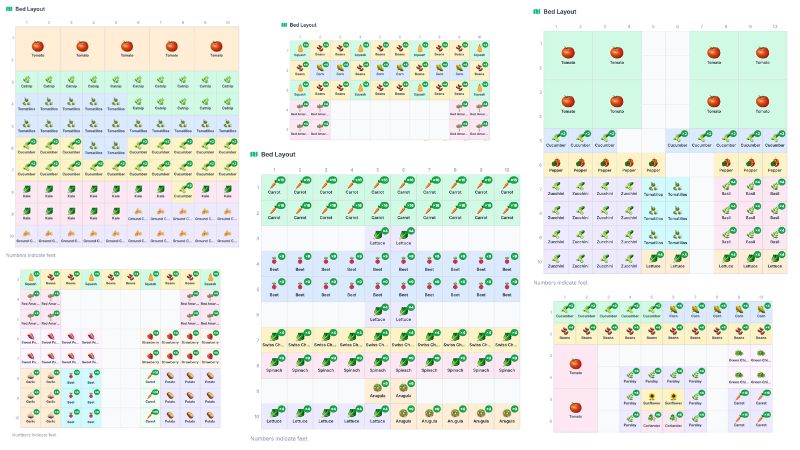
Each plan below has been built and tested in EdenVatika's garden designer. You can view the full grid layout and copy any of them directly to your free account — spacing is already handled, companion pairs are built in, and you can edit the layout to suit your season or region.
Plan 1 — 10×10 Spring Garden Bed
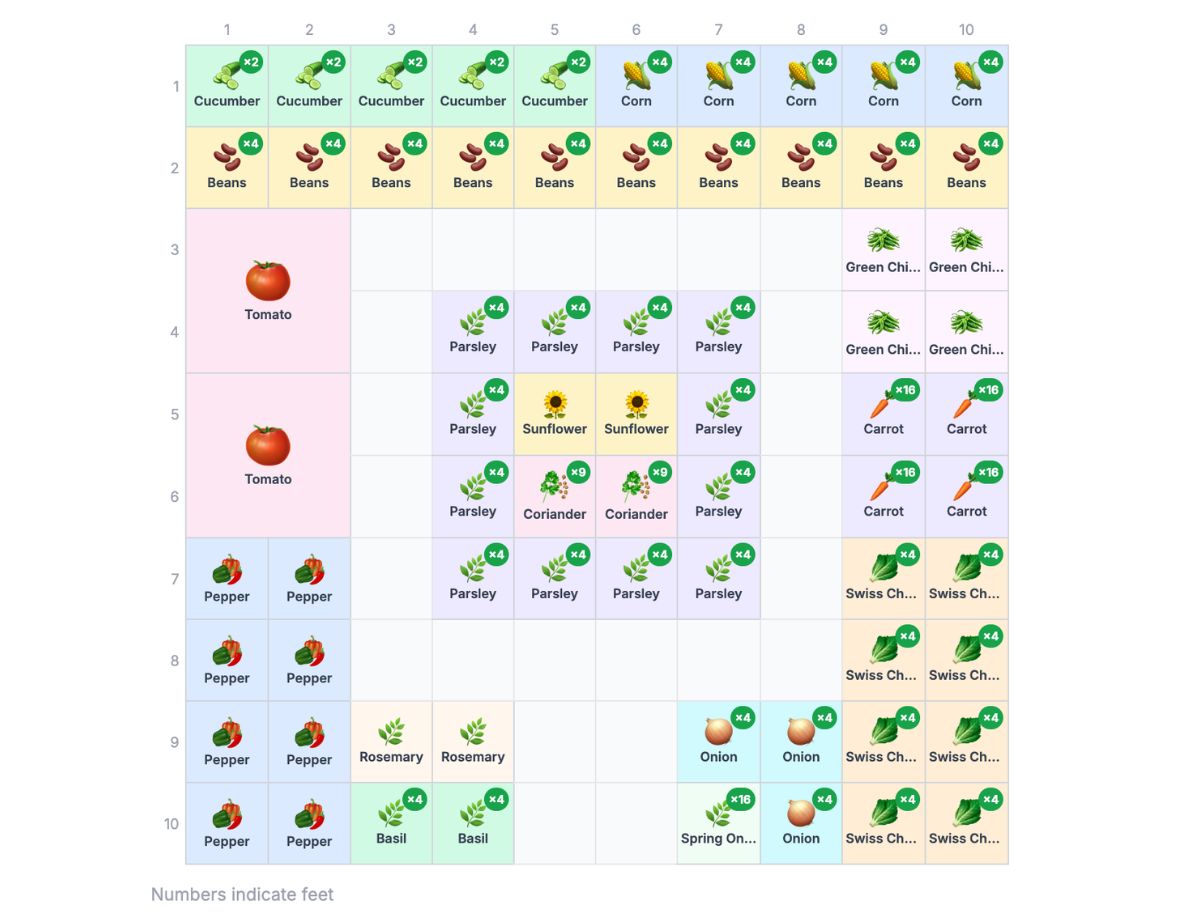
This is a high-variety spring layout designed to make use of the full 100 square feet from the moment the ground warms.
It mixes warm-season producers like tomatoes, peppers, and cucumbers with fast-maturing spring crops — coriander, parsley, spring onion — that finish before the bed heats up. Sunflowers anchor the back row and attract beneficial insects throughout the season.
What's in it: Tomato, Cucumber, Corn, Beans, Carrot, Swiss Chard, Onion, Spring Onion, Green Chillies, Pepper, Basil, Rosemary, Sunflower, Coriander, Parsley
Best for: Growers who want variety across a single bed | Season: Spring into summer
View the full grid layout, see companion pairings, and copy this plan to your account.
View & Copy This Plan → Free account required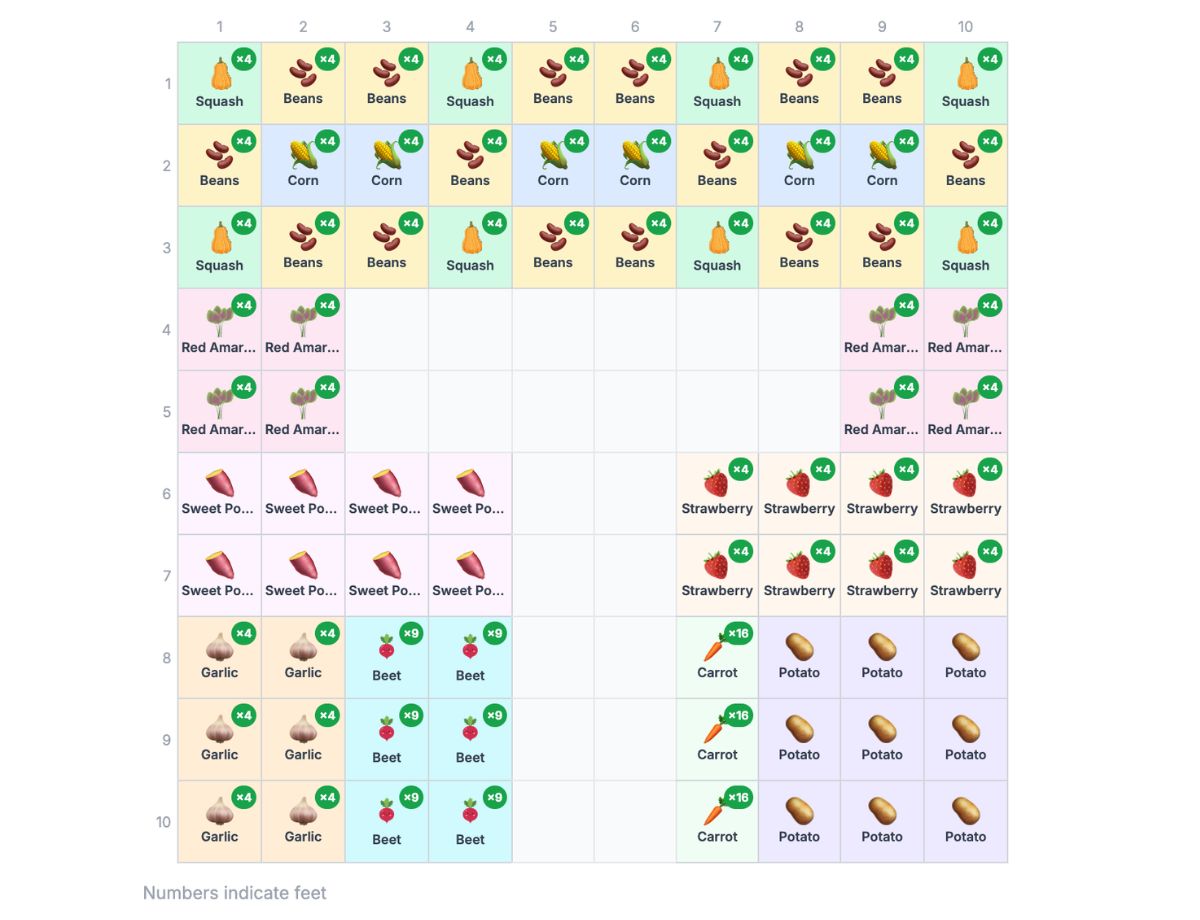
Plan 2 — 10×10 Community Garden Plot
Inspired by the traditional Three Sisters — corn, beans, and squash — this plan adds garlic, potato, sweet potato, beet, carrot, and strawberry to fill out a robust, largely self-sustaining plot. The beans fix nitrogen that feeds the corn and squash.
Garlic deters pests throughout. This is an excellent plan for community garden plots where you want a good yield without heavy inputs.
What's in it: Squash, Beans, Corn, Red Amaranth, Potato, Garlic, Beet, Carrot, Sweet Potato, Strawberry
Best for: Community plots, allotments, low-maintenance growing | Season: Summer through autumn
View the full grid layout, see companion pairings, and copy this plan to your account.
View & Copy This Plan → Free account required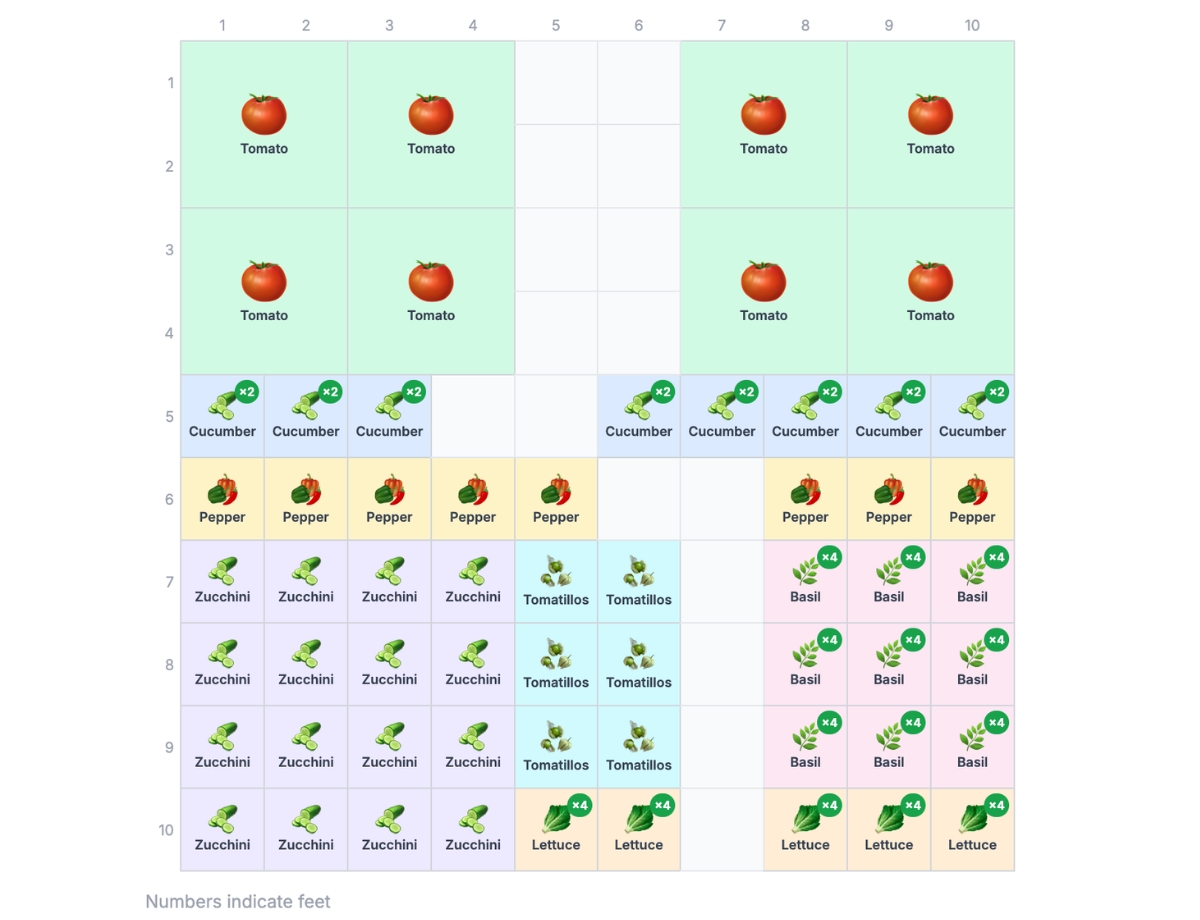
Plan 3 — 10×10 Classic Summer Kitchen Bed
This is the plan you build when you cook. Tomatoes, cucumber, zucchini, pepper, and tomatillos cover the core of summer cooking.
A generous block of basil fills the mid-section as both a companion crop and a constant harvest. Lettuce fills the shadier northern edge once the tall crops establish.
Everything in this bed goes directly from garden to kitchen.
What's in it: Tomato, Cucumber, Pepper, Basil, Zucchini, Lettuce, Tomatillos
Best for: Cooks, kitchen gardeners, families | Season: Peak summer
View the full grid layout, see companion pairings, and copy this plan to your account.
View & Copy This Plan → Free account required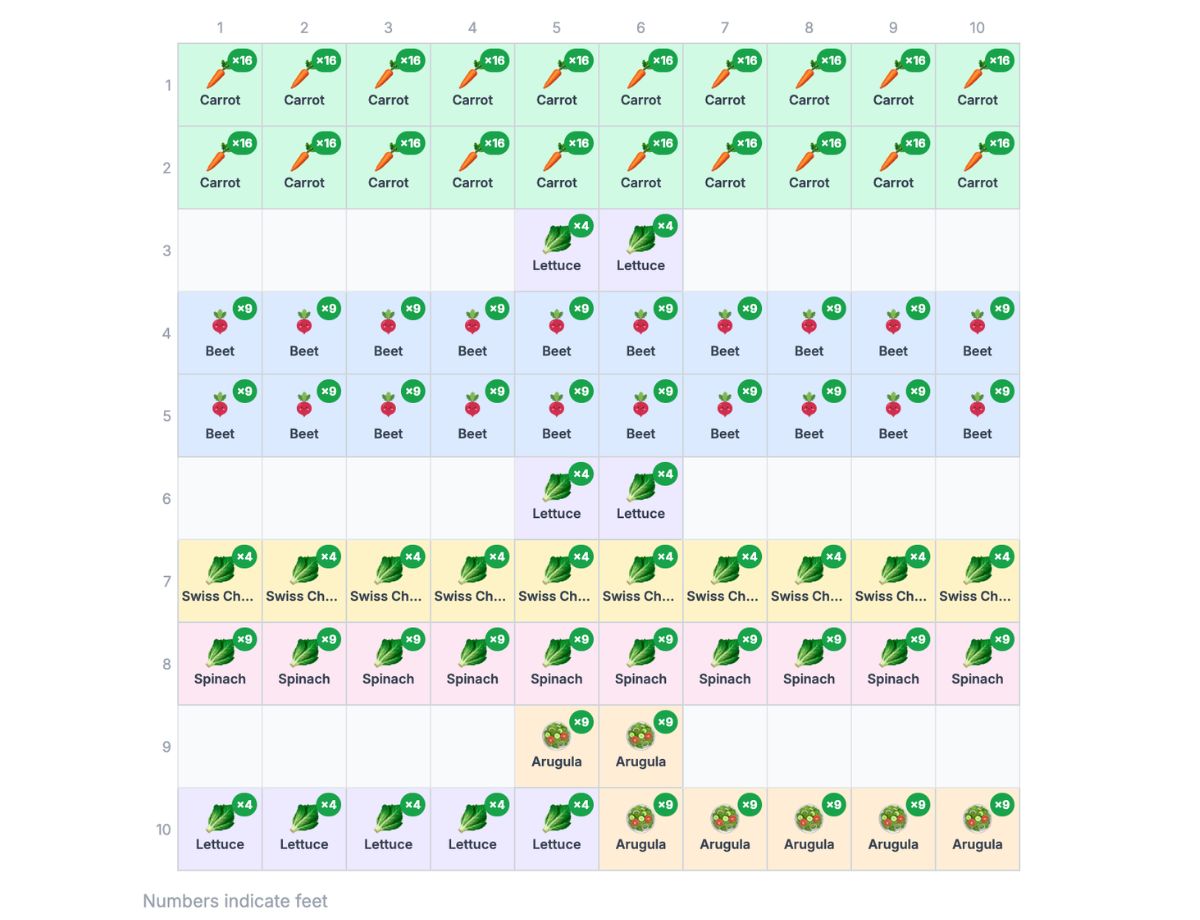
Plan 4 — 10×10 Summer Salad Bed
A hundred square feet dedicated entirely to salad and leafy greens is more productive than it sounds. This plan packs carrot, beet, Swiss chard, spinach, lettuce, and arugula into a dense intensive layout — the kind of bed you harvest from daily.
Because none of these crops grow tall, the entire bed gets full sun and there is no shading problem to manage. It is one of the easiest 10×10 vegetable garden plans to maintain.
What's in it: Carrot, Beet, Swiss Chard, Spinach, Lettuce, Arugula
Best for: Daily salad harvests, low-maintenance growing, families with children | Season: Spring, summer, and autumn (with succession)
View the full grid layout, see companion pairings, and copy this plan to your account.
View & Copy This Plan → Free account required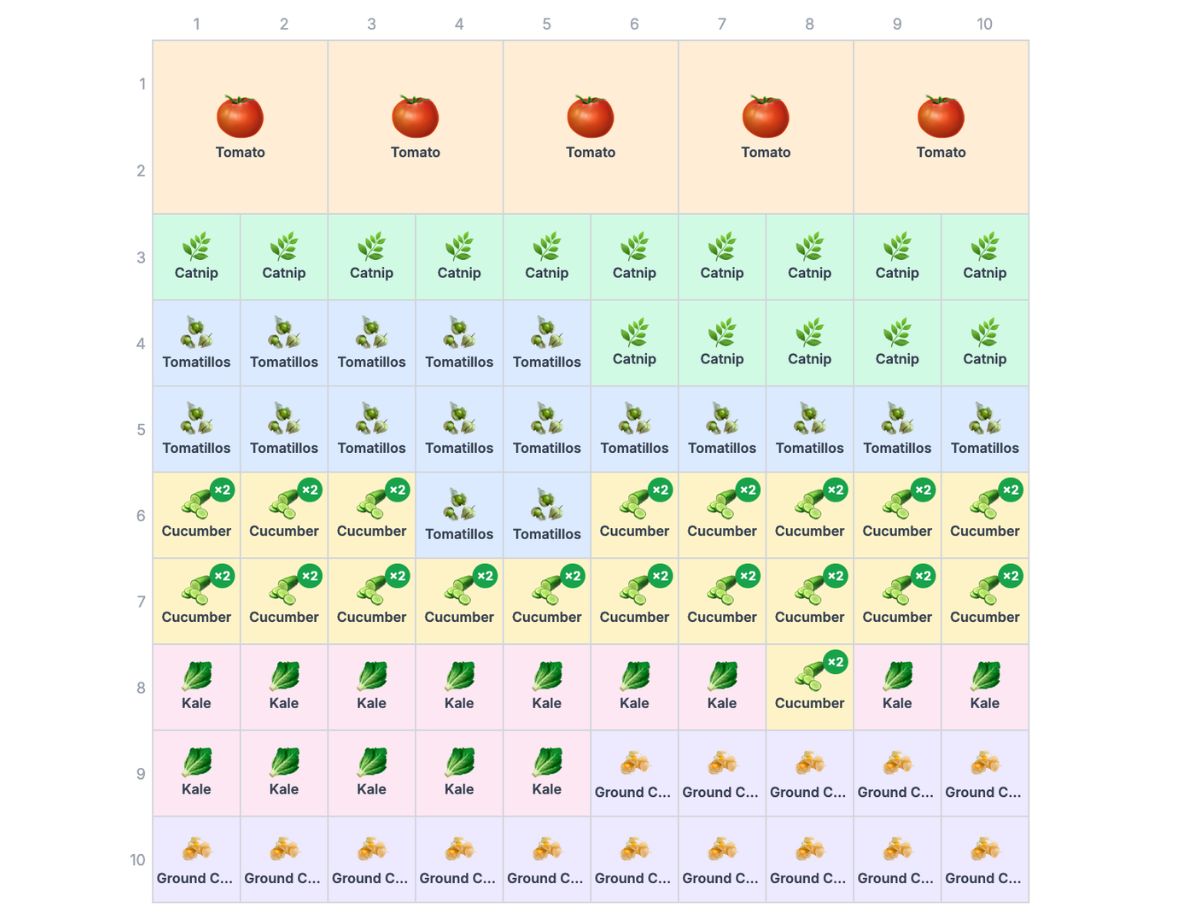
Plan 5 — 10×10 Beginner's Confidence Bed
This plan is deliberately built around forgiving, high-reward crops. Tomatoes, cucumbers, kale, and tomatillos give you reliable summer harvests.
Catnip and ground cherries are the wildcard additions — catnip deters aphids and attracts pollinators, while ground cherries are almost impossible to kill and produce abundantly with minimal care. If you are planting your first proper vegetable garden, start here.
What's in it: Tomato, Cucumber, Kale, Tomatillos, Catnip, Ground Cherries
Best for: First-time gardeners, anyone who wants reliable results | Season: Summer
View the full grid layout, see companion pairings, and copy this plan to your account.
View & Copy This Plan → Free account requiredWant to build your own 10×10 layout from scratch?
EdenVatika's bed designer lets you set a 10×10 grid, drag plants into place, and see spacing, companion suggestions, and incompatibility warnings in real time — free for up to two beds.
Start Planning Free →How to Adapt Any of These Plans to Your Garden
None of these plans need to be followed exactly. They are starting points, not prescriptions.
Swap crops you will not eat. Tomatillos are excellent in plan 3 and 5 but pointless if no one in the house uses them. Replace them with more peppers or a second row of cucumbers. The spacing is the same.
Adjust for your climate. Plans 1 and 3 are written for a long summer season. In a shorter season, trim the corn and heat-loving crops and add more fast-maturing vegetables — radishes, turnips, additional lettuce and spinach. You will get more harvests from a shorter window.
Think about your sun direction. All five plans assume the tall crops (tomatoes, corn, sunflowers) sit on the north side of the bed in the northern hemisphere so they do not shade shorter crops. If your plot faces differently, rearrange accordingly before planting.
Add a succession to the salad plan. Plan 4 works in spring, but lettuce and spinach bolt in summer heat. Replace bolted crops with Swiss chard and beet for midsummer, then sow fast-maturing spinach and arugula again in August for an autumn flush.
The Most Common Mistakes in a 10×10 Vegetable Garden
Planting too many sprawling crops. A single zucchini plant in a 10×10 feels manageable in April. By July it has claimed a quarter of the bed and the vines are in the path. One or two sprawling crops is usually the right number.
Ignoring height when planning companion planting. Two plants that are technically good companions become a problem if one shades the other into the ground. Always check mature height alongside companion compatibility.
Not planning for what follows. Most people plan for summer and leave the bed empty in September. A 10×10 can produce into November with the right crops — kale, chard, late-season lettuce, spinach. Plan the succession before summer starts, not after it ends.
Watering inconsistently. A hundred square feet dries out faster than it looks like it should, especially in the first year when soil structure is not yet developed. Consistent deep watering — less frequent, more water each time — builds deeper roots than daily shallow watering.
Plan the full season, not just summer
EdenVatika's planting calendar connects to your hardiness zone and shows exactly when to sow, transplant, and harvest every crop in your 10×10 bed — including autumn successions. Try it free →
Frequently Asked Questions
How much can you grow in a 10×10 vegetable garden?
Quite a lot. A well-planned 10×10 vegetable garden can produce enough tomatoes, cucumbers, and salad greens to meaningfully reduce a household's grocery spend from late spring through early autumn. Exact yields depend on crops chosen, soil quality, watering, and your climate — but it is common to harvest 50–100 lbs of produce over the course of a season from 100 square feet of intensively planted beds.
What vegetables grow well in a 10×10 garden?
Almost all common vegetables grow well in a 10×10 space. Tomatoes, cucumbers, peppers, beans, carrots, lettuce, spinach, kale, beet, Swiss chard, onions, and herbs all fit without difficulty. The crops to use sparingly are heavy sprawlers — zucchini, squash, and winter squash — which can dominate the space quickly. One or two of these is usually enough.
Do I need raised beds for a 10×10 garden?
No. A 10×10 in-ground plot works perfectly well, and most of the plans above are designed as flat in-ground beds. Raised beds have advantages — better drainage, earlier warming in spring, fewer weeds — but they are not required. If you are starting from lawn or clay soil, raised beds do reduce the workload of soil preparation significantly.
How do I plan a 10×10 vegetable garden?
Start by deciding on your main crops — the ones you actually eat and want to harvest regularly. Place tall crops on the north side of the bed so they do not shade shorter neighbours. Fill the remaining space with medium and compact crops, checking that companions are grouped together and incompatible plants are kept apart.
Use the square foot method for spacing — it prevents the most common mistake of planting too densely or too sparsely. The plans above are a shortcut: copy one and adjust it to your preferences rather than starting from scratch.
How often should I water a 10×10 vegetable garden?
In warm weather, most vegetable gardens need about an inch of water per week — delivered either by rain or irrigation. For a 10×10 bed that is roughly 60 litres (16 gallons) per week.
Deep, infrequent watering is better than shallow daily watering: aim for twice a week during dry spells, enough to wet the soil to six inches depth. Mulching the bed surface significantly reduces moisture loss and cuts watering needs.
Start with a Plan That Already Works
Copy any of these 10×10 plans to your garden — free
Create a free EdenVatika account, copy the plan, edit it to fit your season, and get a full planting calendar with sow and harvest dates for your hardiness zone.
The five plans above cover the most common goals for a simple 10×10 garden layout: a mixed spring bed, a community plot built around the Three Sisters, a summer kitchen garden, a dedicated salad bed, and a beginner-friendly layout built for reliability.
Pick the one that matches what you want to grow, copy it, and adjust from there. The hardest part of a first kitchen garden is usually getting started — and starting with a layout that already handles spacing and companions removes most of the guesswork.