4×8 Raised Garden Bed Planting Layout: 11 Complete Plans You Can Copy
A 4×8 raised bed gives you 32 square feet to grow real food. These 11 complete layouts — split between pure vegetable beds and mixed companion gardens — are ready to copy and plant today.
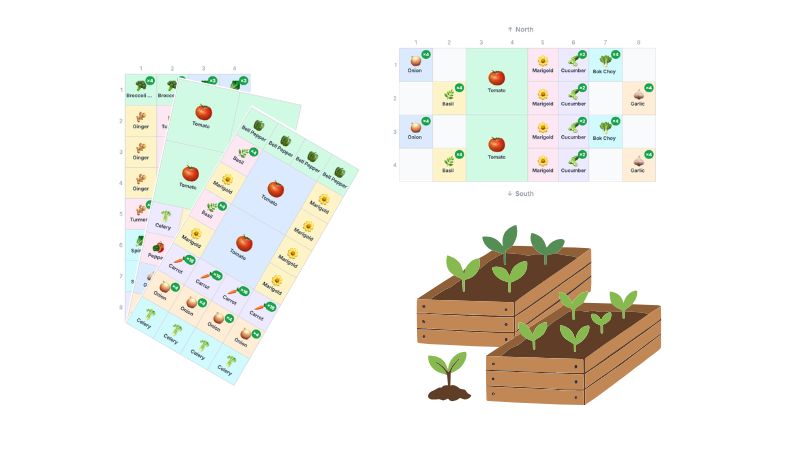
A 4×8 raised bed gives you exactly 32 square feet of growing space — enough to feed a household fresh produce through most of the season, small enough to manage in under 30 minutes a week.
Whether you're picking up a trowel for the first time or scaling up from a few containers, this size hits the sweet spot between ambition and reality.
You can reach the centre from either side without stepping in, standard 8-foot lumber fits the frame with zero waste, and the square foot grid divides cleanly into 32 individual planting zones.
The challenge isn't the space — it's knowing what goes where. Cram the wrong plants together and you'll deal with shade wars, root competition, and pest explosions. Space too generously and half your bed sits empty while the grocery bill stays exactly the same.
These 11 ready-to-copy layouts solve that problem before you plant a single seed. Six are built around maximising food production — pure vegetable beds organised by season and goal.
Five are mixed companion gardens, where herbs, edible flowers, and specialty crops work alongside the vegetables to reduce pests and improve yield.
Pick one, open it in EdenVatika's free planner, and get planting.
Why a 4×8 Raised Bed Is the Perfect Starting Point
The dimensions are practical by design. Four feet wide means you reach the centre from either side without ever stepping in — which keeps raised bed soil loose and uncompacted, exactly where root crops and seedlings need it.
Eight feet long gives you enough room to grow meaningful quantities without the management overhead of a large plot.
- 32 square feet of working space — enough for 2 tomato plants, a full herb section, and two rows of salad greens simultaneously
- Manageable in 30 minutes a week — watering, light weeding, and harvesting once the bed is established
- Square foot gardening ready — the 4×8 grid divides into 32 one-foot squares, the exact unit all 11 plans below use for spacing
- Low material cost — standard 8-foot lumber fits the length exactly, with zero offcut waste on either long side
- Works anywhere — a 4×8 footprint fits on a patio, along a fence, or in a corner that has been empty for years
What Fits in a 4×8 Raised Garden Bed
This table uses square foot gardening spacing — the same system built into all 11 plans below. "Plants per sq ft" is how many of that crop fit into a single one-foot square at correct spacing.
Use the "sq ft for a useful harvest" column to judge whether a crop earns its place in a 32-square-foot bed.
| Crop | Plants per sq ft | Sq ft for a useful harvest | Best season |
|---|---|---|---|
| Tomato | 1 | 2–4 sq ft | Summer |
| Pepper / Bell Pepper | 1 | 2–4 sq ft | Summer |
| Cucumber | 2 | 2–4 sq ft | Summer |
| Zucchini / Squash | 1 | 2–4 sq ft | Summer |
| Eggplant | 1 | 2–3 sq ft | Summer |
| Okra | 1 | 4–6 sq ft | Summer |
| Carrot | 16 | 2–4 sq ft | Spring / Fall |
| Radish | 16 | 1–2 sq ft per batch | Spring / Fall |
| Lettuce | 4 | 2–4 sq ft | Spring / Fall |
| Spinach | 9 | 2–4 sq ft | Spring / Fall |
| Peas | 8 | 4–6 sq ft | Spring |
| Potato | 1 | 4–6 sq ft | Spring |
| Onion / Leek | 4–9 | 2–4 sq ft | Spring / Fall |
| Broccoli / Cabbage / Kale | 1 | 2–4 sq ft | Spring / Fall |
| Basil | 4 | 1–2 sq ft | Summer |
| Garlic | 4–9 | 1–2 sq ft | Fall plant / summer harvest |
| Strawberry | 4 | 2–4 sq ft | Spring–Summer |
Each plan below uses these spacings automatically — you won't need to calculate anything. The EdenVatika planner assigns the right number of plants to every square before you place a single seed.
4×8 Raised Vegetable Garden Layouts
These six plans are built around food production. Every square foot earns its place with an edible crop. They are organised by season and goal so you can pick one that matches your planting window and what you most want to grow.
Plan 1 — The Spring Cool-Season Bed
Best for: Gardeners planting in early spring who want a full, productive bed before summer heat arrives
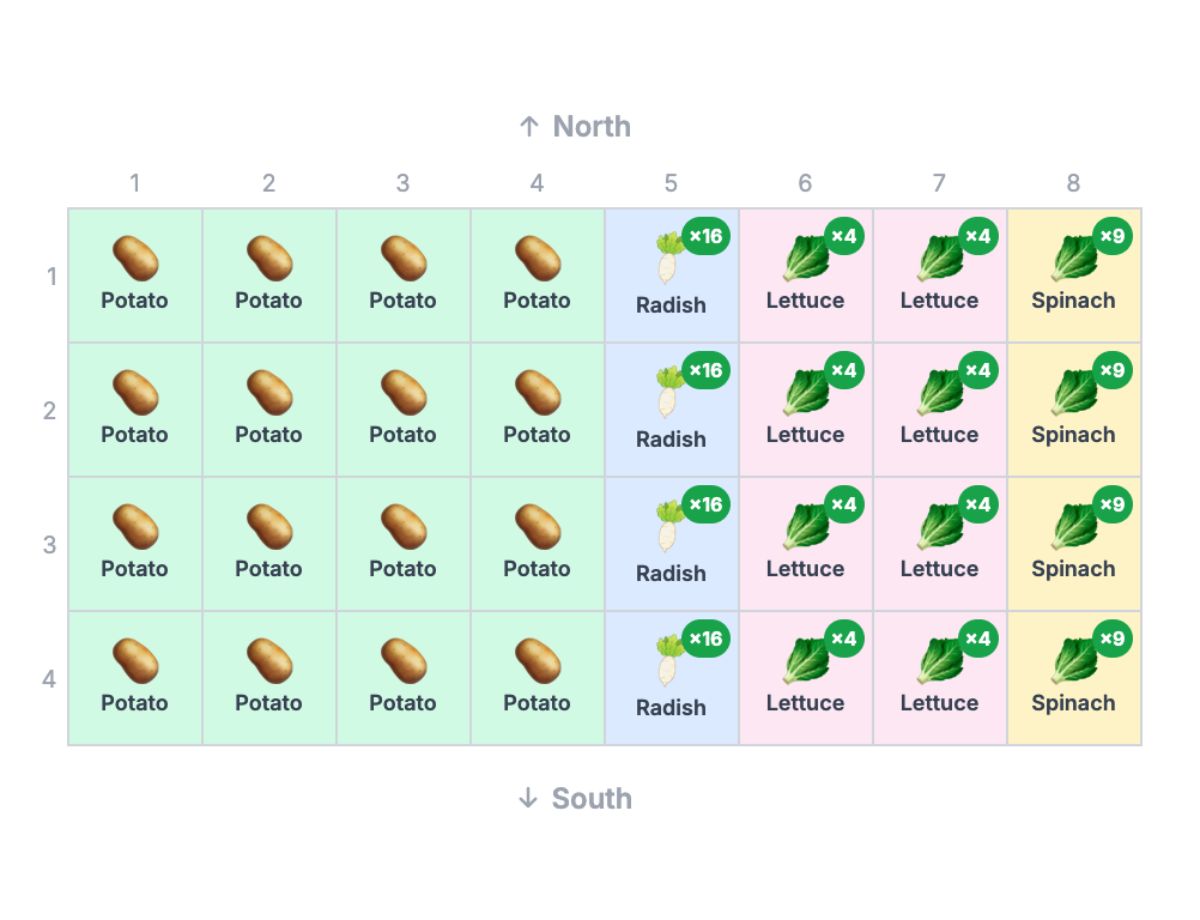
This layout fills all 32 squares with cool-season crops that bolt and turn bitter in summer heat — which means you need to get them in early and harvest before temperatures climb.
Potatoes anchor the western columns with one plant per square, giving each tuber the space it needs to develop properly underground. Radishes act as a sprint crop: they mature in 25–30 days, clearing squares for a second sowing before the season ends.
Spinach and lettuce fill the eastern section with cut-and-come-again planting that keeps producing for weeks if you harvest the outer leaves rather than the whole plant.
The spinach + radish pairing in this plan is intentional — radishes loosen the soil as they grow, benefiting the shallow spinach roots around them.
Run this layout from late February through late May in most climates, or flip it to an August through October autumn planting for a second season.
🌿 View the Spring Cool-Season Bed →
Plan 2 — The Summer Warm-Season Bed
Best for: Gardeners in warm climates who want to squeeze maximum summer production from a single 4×8 bed
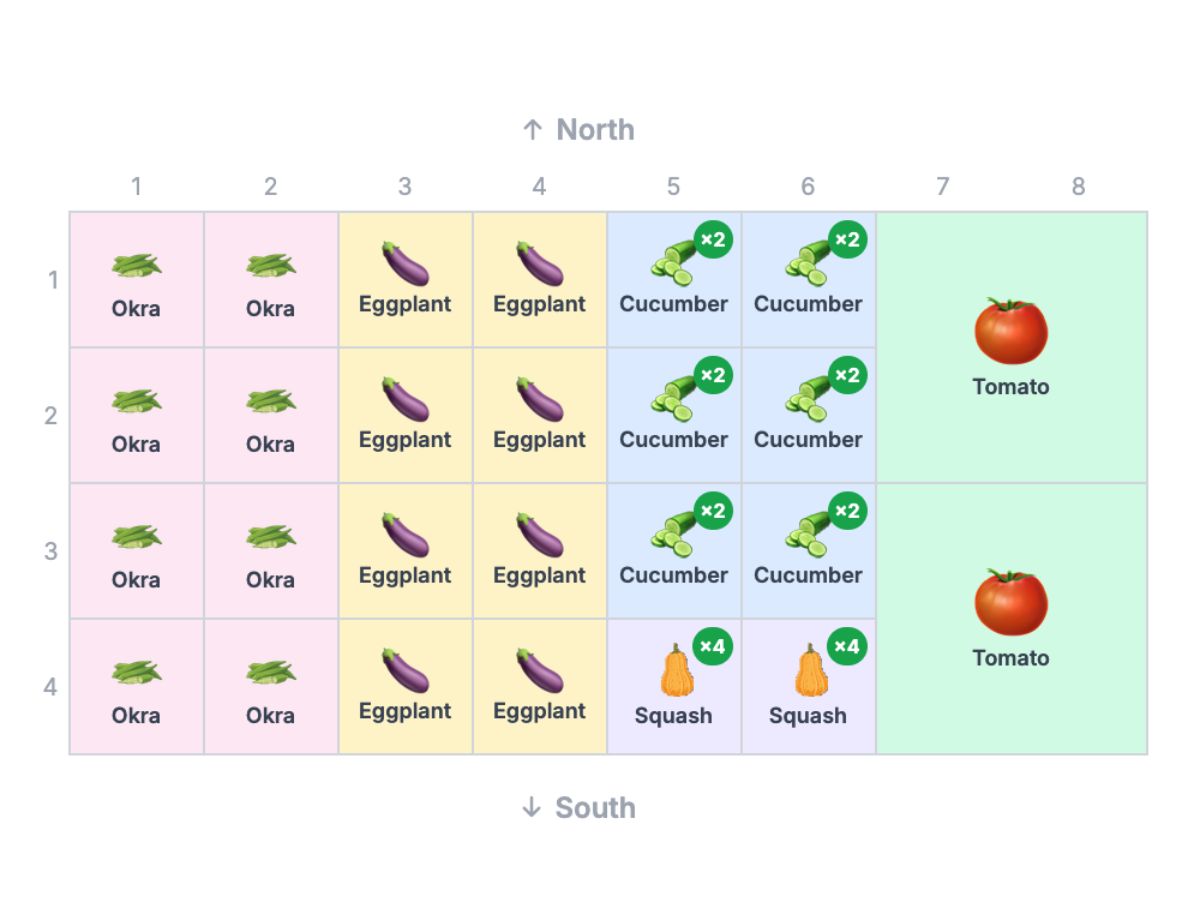
Five warm-season heavy hitters share this bed: tomatoes, cucumbers, eggplant, okra, and squash. Each brings a different harvest window and a different growing habit, which means the bed stays productive from early July right through to first frost.
Okra occupies the west side where it grows tall without shading anything shorter.
Eggplant fills the central columns with dense, well-spaced plants that benefit from reflected heat in a raised bed.
Cucumbers cluster in the middle-right section and reward vertical training — add a simple bamboo trellis along the north edge and they'll climb rather than sprawl, freeing squares below them. Squash dominates the southern row where it can spread slightly beyond the bed edge without crowding its neighbours.
Tomatoes take strategic positions in rows 1 and 3 on the eastern edge. Plant this bed after your last frost date and expect continuous harvests until autumn.
🌿 View the Summer Warm-Season Bed →
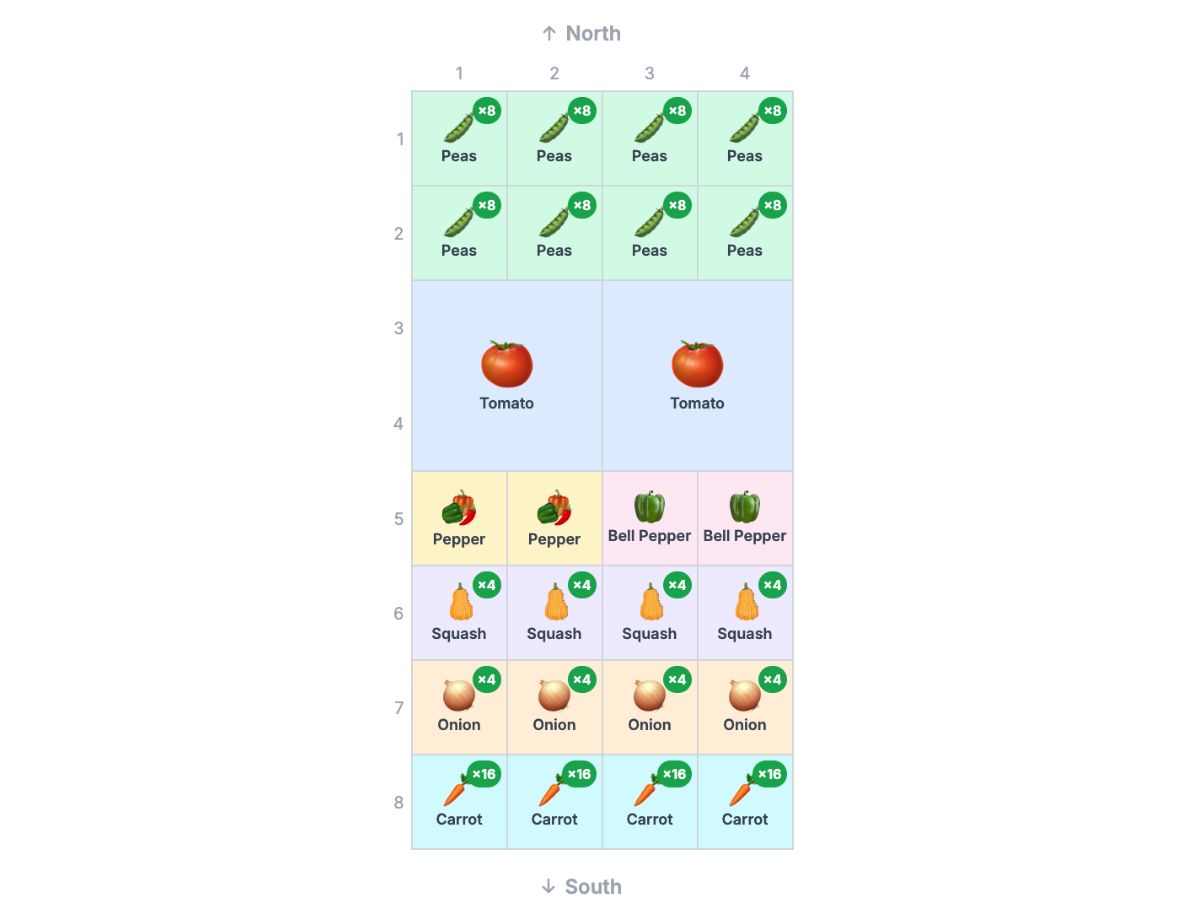
Plan 3 — The Family Vegetable Garden
Best for: Families who want a single bed that covers multiple meals across the full growing season
This plan packs seven vegetables into 32 squares without shortchanging any individual crop's space requirements. Peas take the northern rows — a smart placement, since they are the first crop to go in, the first to finish, and their trellis will not shade anything behind it when oriented with the long axis running north-to-south.
Tomatoes and peppers anchor the middle section for summer's main event. Squash fills a dedicated section, onions form a natural pest-repelling border alongside the peppers, and carrots close out the southern rows at 16 plants per square foot.
The companion pairings here are workhorses, not decorative: tomato + onion repels a broad range of common pests, and bell pepper + onion does the same.
The plan sequences naturally through the season — peas finish as tomatoes and peppers hit their stride, and the carrot section can be succession-sown every three weeks for a continuous harvest rather than one large glut.
🌿 View the Family Vegetable Garden →
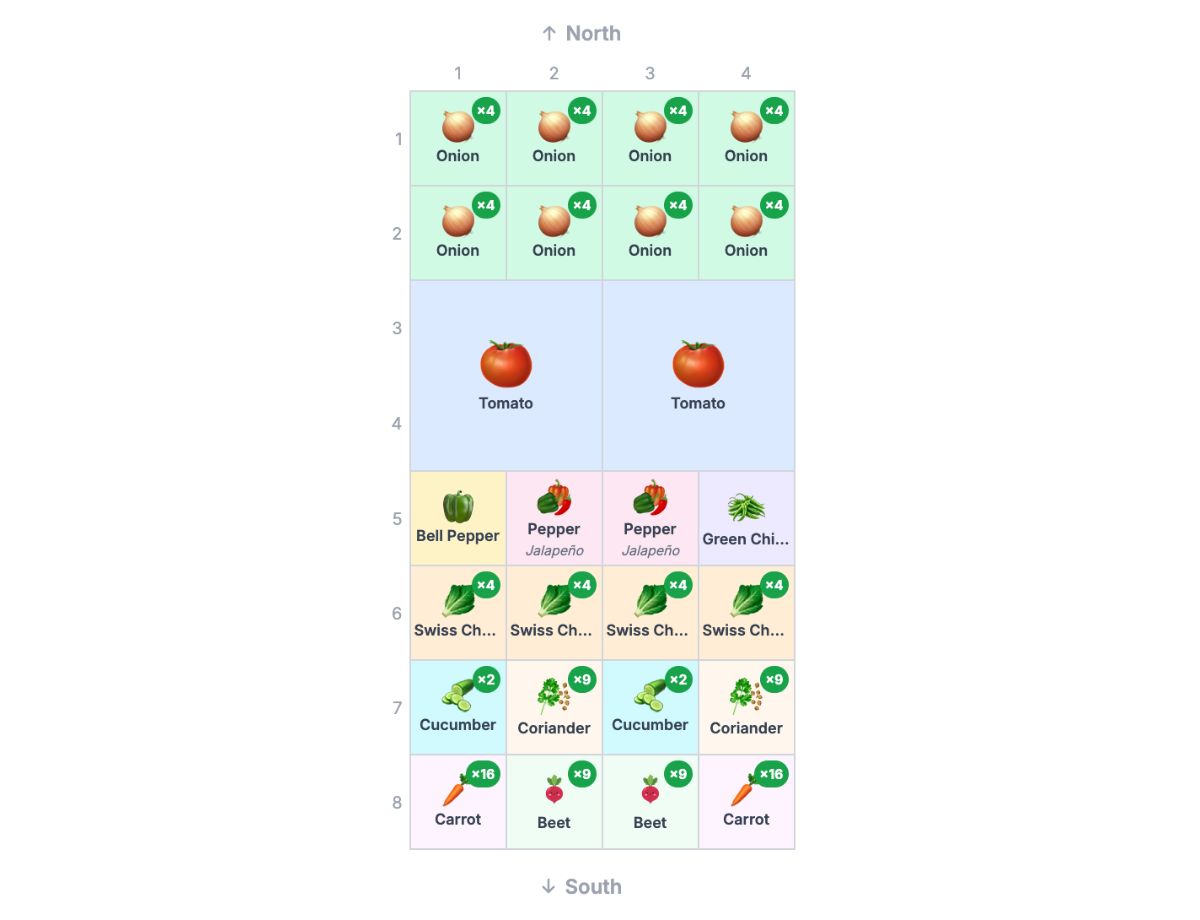
Plan 4 — The Grocery Raised Bed
Best for: Gardeners who want to reduce their grocery bill with a diverse, high-yield bed that replaces regular supermarket purchases
With 10 different crops in one 4×8 bed, this is the most diverse vegetable layout in this collection. Onions fill the first two rows — 32 plants that provide months of fresh alliums without a single supermarket bag.
Rows 3 through 5 hold tomatoes, bell peppers, jalapeños, and green chillies, creating a working salsa garden in the middle of the bed. Swiss chard takes over the following section for cut-and-come-again greens that produce all season without resowing.
The southern rows shift to root crops: beets and carrots planted at proper density give you a serious harvest without the thinning chaos of broadcast sowing.
Coriander fills corner squares where it can self-seed and provide ongoing leaf harvests throughout summer and autumn. The tomato + onion companion pairing appears repeatedly through this plan as a low-maintenance natural pest management strategy.
🌿 View the Grocery Raised Bed →
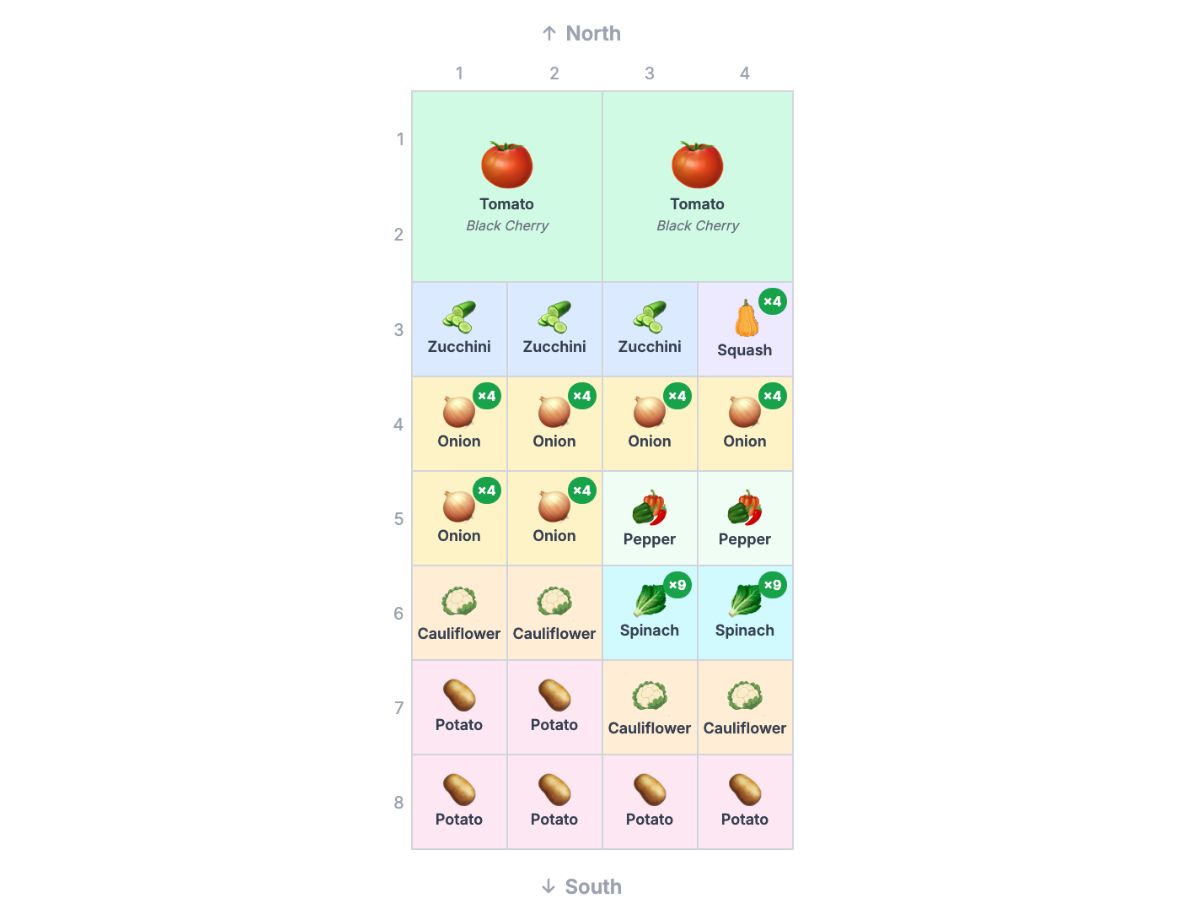
Plan 5 — The Money-Saving Grocery Garden
Best for: Gardeners who want the strongest return on investment — crops that are expensive in stores but straightforward to grow at home
Every crop in this layout was chosen with the receipt in mind. Black cherry tomatoes routinely cost more per pound than almost anything else in the produce section.
Zucchini is a notoriously prolific producer — two or three plants from a single raised bed can outpace a household's consumption by midsummer.
Cauliflower consistently commands two to four dollars per head at retail. Onions fill the central rows with 24 plants — enough for months of cooking without buying a single bag.
Potatoes anchor the southern section with a staple crop that stores well after harvest, extending the bed's value past the growing season.
Spinach fills the remaining squares with reliable cut-and-come-again production. Squash and cauliflower are positioned so each plant has its full space without crowding its neighbours.
When you compare the retail cost of what this plan produces against the cost of seeds and soil amendment, the numbers make a compelling case for raising the bed.
🌿 View the Money-Saving Grocery Garden →
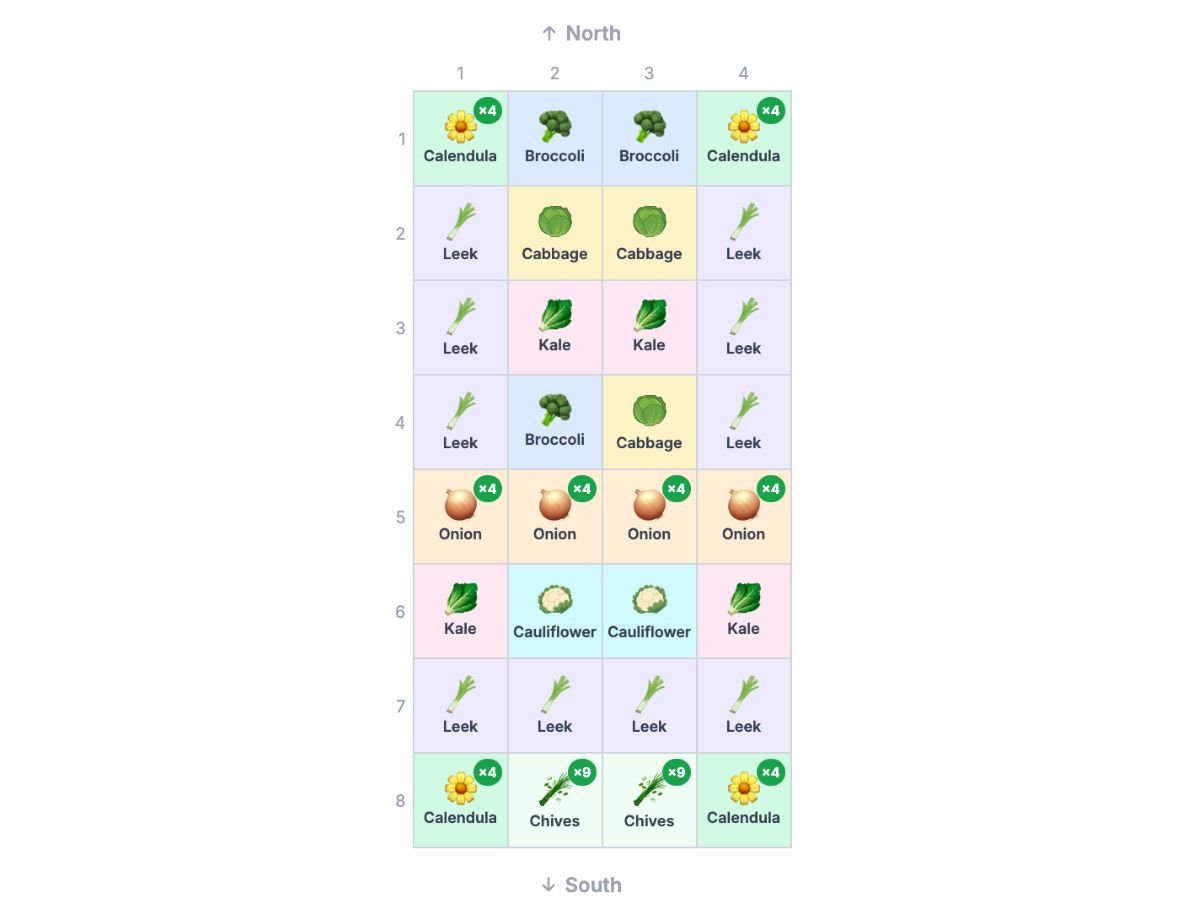
Plan 6 — The Spring Brassica & Allium Bed
Best for: Spring gardeners who want a structured brassica bed with built-in pest management from companion alliums and flowers
Brassicas and alliums are one of the most reliable companion pairings in the vegetable garden, and this layout puts that relationship to work at full scale.
Broccoli, cabbage, kale, and cauliflower fill the upper and middle sections with each plant given its full one-square-foot allocation — enough space for proper head development without competition.
Leeks and onions are distributed throughout the layout, their sulfur compounds actively repelling the cabbage loopers and aphids that decimate unprotected brassica beds.
Calendula edges the corners and outer squares. Its bright flowers attract hoverflies and parasitic wasps — predatory insects that hunt the pest species targeting brassicas — while also making the bed visually striking.
Chives fill the remaining squares, doubling as a harvest crop and an allium companion throughout the season. Plant this bed four to six weeks before last frost and harvest before summer temperatures trigger bolting.
🌿 View the Spring Brassica & Allium Bed →
4×8 Garden Bed Layouts
These five plans mix vegetables with herbs, edible flowers, and specialty crops. They are designed around companion planting principles — meaning the plants actively support each other's growth rather than simply coexisting.
If you want a bed that produces food and requires less intervention to stay healthy, these are the layouts to reach for first.
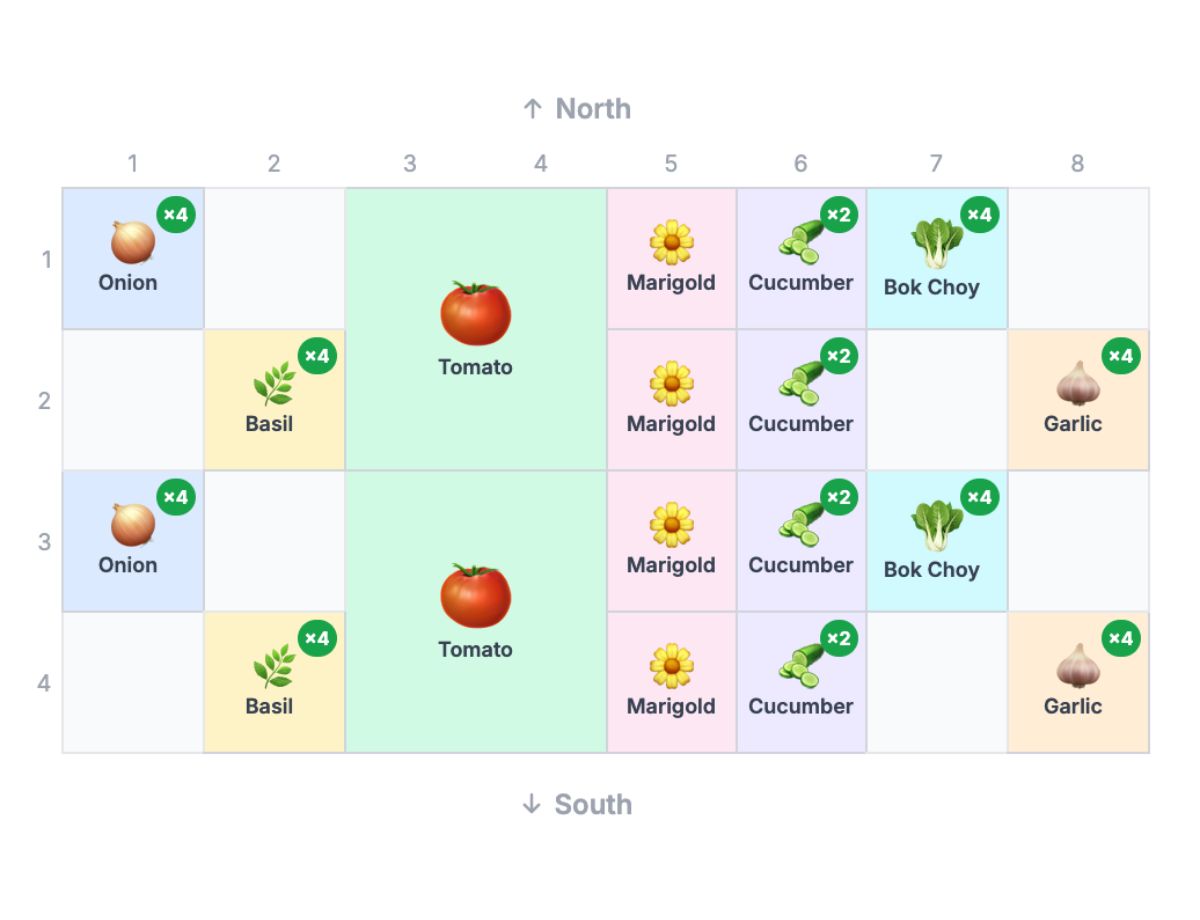
Plan 7 — The Easy Companion Bed
Best for: Beginners who want a low-maintenance bed where plants do some of the pest management work for you
This plan earns its "easy" label through strategic pairing rather than simplified planting.
Tomatoes and basil share one of the most consistently observed companion relationships in the kitchen garden — basil is widely reported to improve tomato flavour and repel thrips and aphids when grown in close contact.
Marigolds are distributed at regular intervals throughout the bed, their root secretions deterring nematodes in the soil below while their flowers confuse and deter flying pests above.
Onions and garlic fill the surrounding squares with allium coverage that rounds out the pest deterrence. Cucumbers take the middle-right section with room to climb if you add a small trellis.
Bok choy occupies the remaining squares with a fast-maturing crop that can be harvested and replaced within a single season, giving you two harvests from those squares in the time tomatoes take to set their first fruit.
This is an ideal first bed for someone who wants to experience companion planting without memorising a compatibility chart — the app does the checking before anything goes in the ground.
🌿 View the Easy Companion Bed →
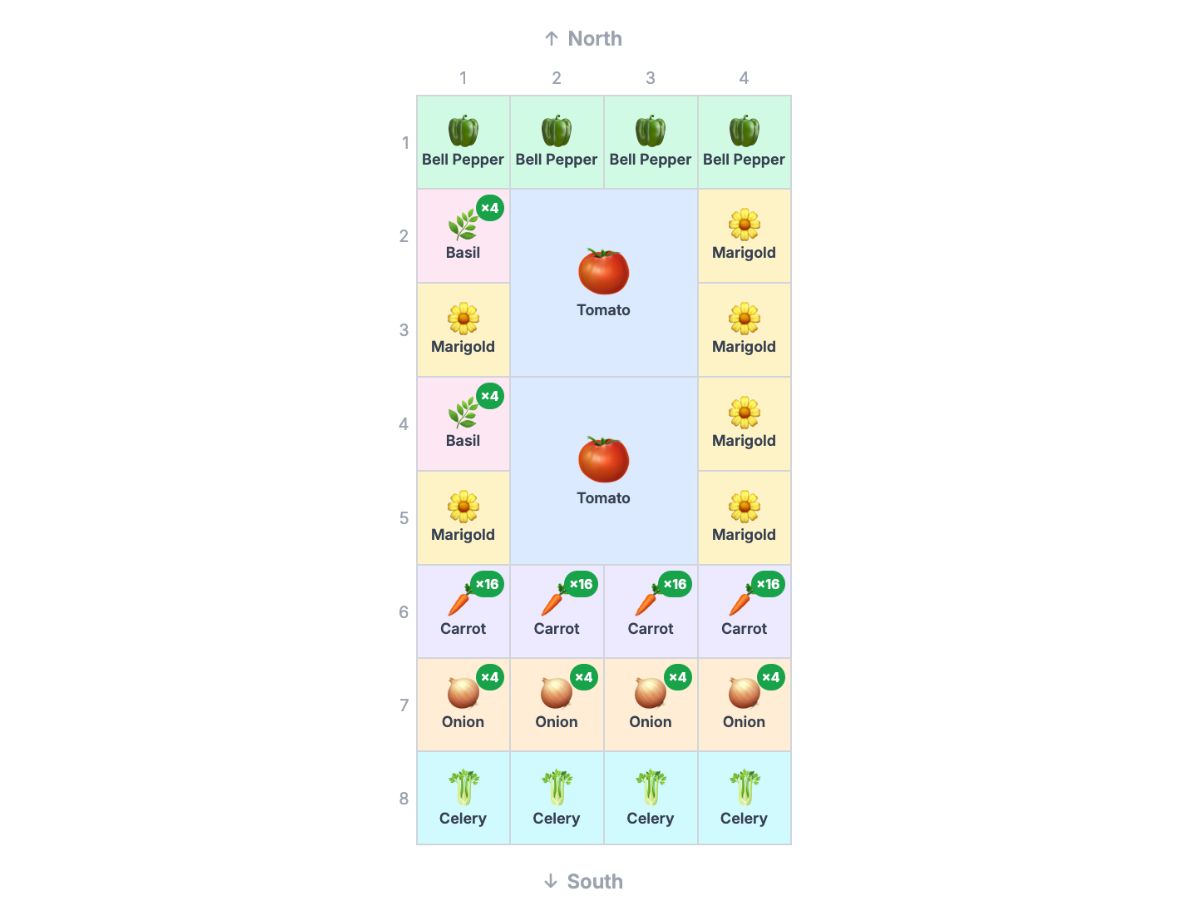
Plan 8 — The Square Foot Garden Layout
Best for: Gardeners who want a textbook square foot gardening example with layered companion relationships and a staggered harvest window
This plan demonstrates the square foot method at its cleanest. Every crop is spaced precisely for its size class: bell peppers get one square each, tomatoes the same, basil gets four plants per square, and carrots fill at sixteen per square foot.
The result is a visually organised grid where nothing is cramped, nothing is wasted, and the harvest window spans three different timings — early summer basil, midsummer tomatoes and peppers, and autumn carrots.
The companion relationships in this bed go four layers deep: tomato + basil improve flavour and repel common pests; tomato + onion repels a separate set of pests; tomato + marigold targets soil nematodes and aphids; basil + marigold double down on pest deterrence independently.
Celery completes the southern row as a general companion that deters cabbage white butterflies. This is particularly useful for gardeners who want to understand exactly why each plant is placed where it is, rather than simply following a layout on faith.
🌿 View the Square Foot Garden Layout →
.jpg)
Plan 9 — The Beginner Bed (Feeds 2 People All Summer)
Best for: First-time gardeners or couples who want fresh food from a single 4×8 bed through the whole summer without a steep learning curve
Feeding two people from one raised bed is a realistic goal with the right crop selection. Strawberries open the season in row 1, producing fruit from late spring through early summer before the summer crops hit their stride.
Basil fills row 2 directly below the strawberries — it benefits from the same warm, sunny conditions and provides constant picking throughout the season.
Cucumbers and peppers take the middle rows, both reward regular harvesting with continuous fruit production, and both are satisfying for first-time growers because the feedback loop is fast.
Radishes sprint through their section in under a month, clearing squares for a second sowing before the end of the season.
Spinach dominates the lower two rows — 72 plants across eight squares — for a serious cut-and-come-again harvest that persists for months when picked correctly.
The companion logic runs through the whole plan: basil repels aphids around the peppers, radishes deter cucumber beetles, and spinach + radish is a confirmed good pairing that improves the growth of both.
This plan is straightforward enough for a complete beginner but productive enough to meaningfully change what is in the refrigerator.
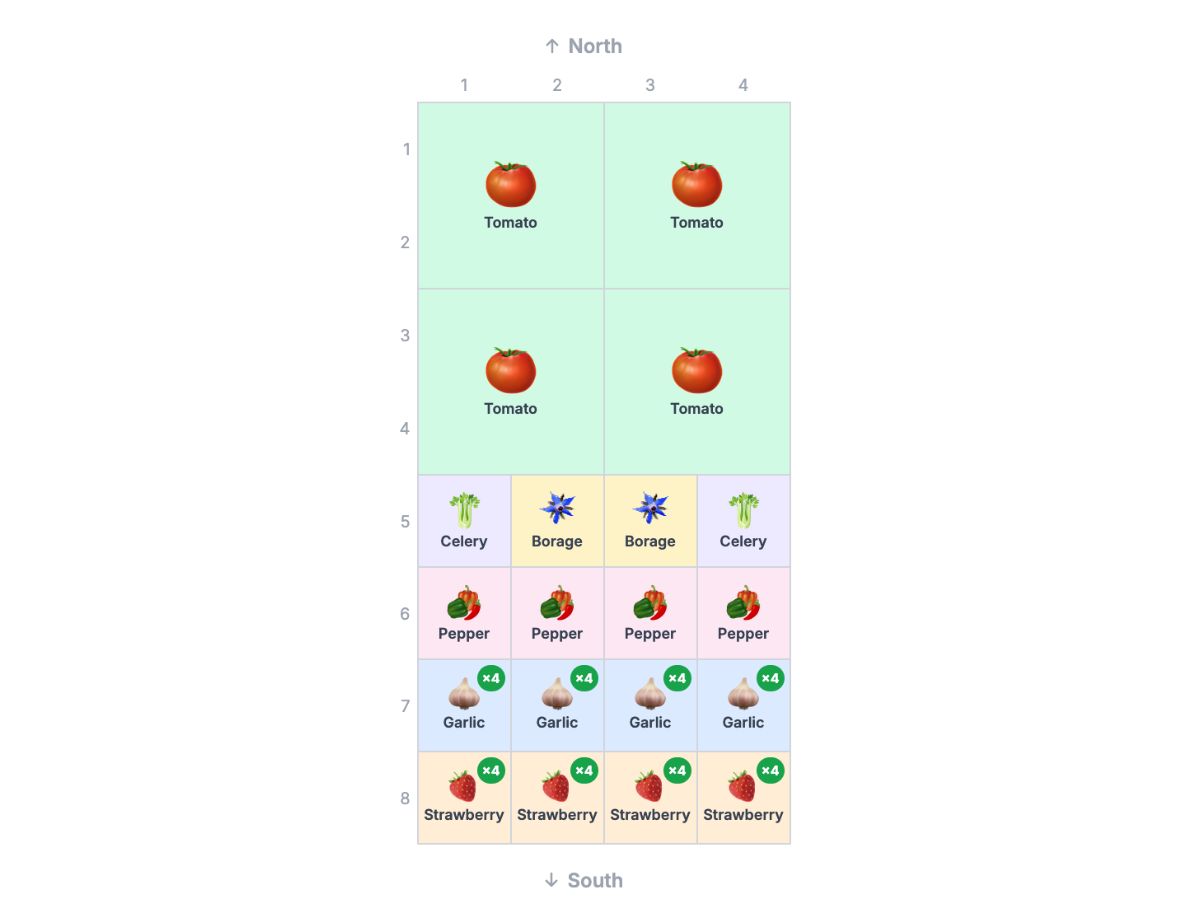
Plan 10 — The Tomato Companion Garden
Best for: Tomato-focused growers who want to maximise tomato health and yield through companion planting rather than interventions
Tomatoes hold four of the bed's central squares in the northern section, and every other plant in this layout was chosen specifically to support them.
Garlic is the most evidence-backed tomato companion: its sulfur compounds repel spider mites — one of the most damaging summer pests on tomato plants — and have been shown to reduce fungal pressure when planted in close proximity.
Borage, a slightly unusual inclusion for a 4×8 bed, deters tomato hornworms and produces flowers that actively attract pollinators, which improves tomato fruit set throughout the season.
Peppers and tomatoes are genuinely compatible companions from the same nightshade family, sharing pest and disease resistance traits when grown together.
Celery in the lower section acts as a broad pest deterrent. The bottom row is strawberries — 16 plants that establish well in the partial shade of a mature tomato canopy and benefit from garlic's antifungal properties in the surrounding soil.
This is a precision bed: every plant has a specific job and a known, positive relationship with the tomatoes at its centre.
🌿 View the Tomato Companion Garden →
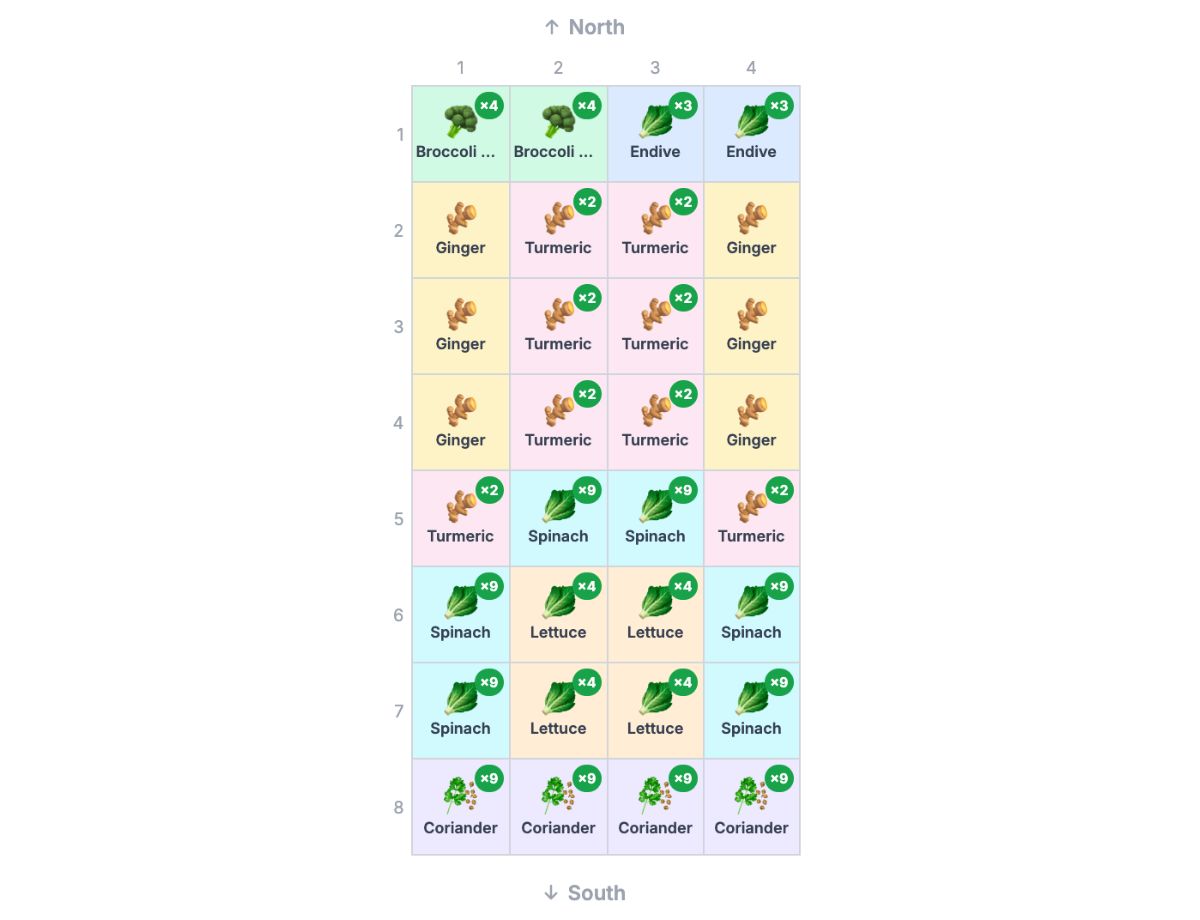
Plan 11 — The Shade Raised Bed Garden
Best for: Gardeners with a bed that receives 3–5 hours of direct light daily who want to grow productive food crops rather than leave the space unused
Not every garden bed gets full sun. This layout is designed specifically for partial shade — the spots under a tree canopy, beside a north-facing fence, or in the shadow of a nearby structure that most gardeners leave bare or plant with flowers out of frustration.
Broccoli rabe and endive anchor the northern edge: both tolerate lower light levels better than most brassicas and add bitter leafy greens to the harvest that are genuinely difficult to source in most grocery stores.
Ginger and turmeric fill the central rows — two root crops that actually prefer filtered light and consistent moisture, conditions that a partially shaded raised bed provides naturally.
Ginger takes 8–10 months to mature and is harvested in autumn; turmeric follows a similar timeline. Spinach dominates the lower section with 54 plants across six squares, and lettuce fills four more. Both crops bolt significantly more slowly in partial shade than in full sun, extending the harvest window by weeks.
Coriander completes the southern row. This plan turns one of the most consistently wasted spaces in a garden into a productive bed of specialty crops.
🌿 View the Shade Raised Bed Garden →
Tips for Making Your 4×8 Raised Bed Actually Work
1. Amend your soil before you plant anything
Raised bed success starts below the surface. Fill with a mix of topsoil, compost, and an aeration material — perlite or coarse horticultural sand — in roughly equal thirds.
This matters more than almost any other single decision because raised bed soil does not have the natural microbial ecosystem of established in-ground beds.
You are building it from the start. Skimp on soil quality and even the most carefully designed layout underperforms throughout the entire season.
2. Orient your bed north-to-south for even light distribution
A 4×8 bed runs long in one direction. Orienting that length north-to-south ensures no single row sits in permanent afternoon shade from the row behind it.
All 11 plans above are designed with this orientation — taller crops sit at the northern end, shorter crops at the southern end, so sunlight moves across the full width of the bed without being blocked as it travels across the sky.
3. Succession-plant your fast crops
Radishes mature in 25 days. Lettuce is done in 45. Rather than leaving those squares empty after the first harvest, put new seed in immediately.
Several plans above include radishes and lettuce specifically because they complete a full lifecycle fast enough to allow two or three successions in a single season — effectively doubling or tripling the yield from those squares without adding any complexity to the plan.
4. Water consistently, not heavily
Raised beds drain faster than in-ground beds — which is generally a benefit, but it also means they dry out faster during heat. Rather than deep, infrequent watering, aim for consistent moisture with lighter, more regular irrigation.
A drip line or soaker hose run along the bed keeps moisture even and avoids the overhead watering that promotes leaf fungal disease, which is the most common problem in densely planted raised beds during warm, humid weather.
5. Run compatibility checks before swapping in new plants
Once your chosen plan is planted, you will inevitably want to add something you saw at the nursery or received as a gift. Before you do, run the companion check in EdenVatika.
Some combinations that appear harmless — fennel near almost anything, for instance — actively inhibit the growth of neighbouring plants.
The app flags incompatible pairings before they cause problems, rather than after you have spent a season wondering why something underperformed.
🌿 All 11 plans above are live in the EdenVatika app.
Open any plan, save a copy to your account, and customise the crops to match your taste, climate, and what's actually available at your local nursery. The app recalculates spacing and flags companion conflicts the moment you make a change — so you never place two incompatible plants next to each other by accident.