Companion Planting Chart for Vegetables: What to Plant Together (and What to Keep Apart)
A scannable, printable companion planting chart for 26 common vegetables — good companions, combinations to avoid, and the reason each pairing works.
Every vegetable garden is a small society. Some plants are good neighbours — they trade favours, cover for each other, keep the pests off. Others quietly feud until one of them sulks and refuses to crop.
Plant basil next to your tomatoes and both do better. Plant onions next to your beans and the beans just... give up.
Below you'll find two tools: an interactive grid to check any two plants at a glance, and a full chart covering 26 vegetables with the reason behind every pairing — printable and ready to pin above the potting bench.
Companion Planting Grid: Check Any Two Plants
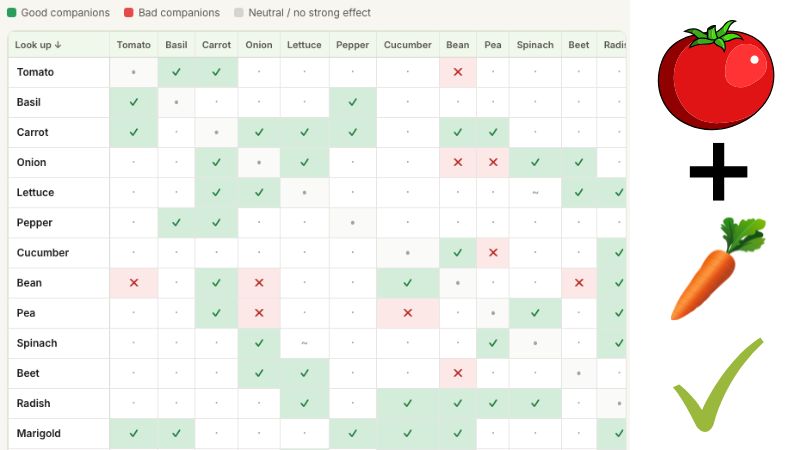
Prefer to look it up visually? Find your crop in the left column and read across — green means plant them together, red means keep them apart. Search or filter to narrow the rows; every plant stays as a column, so you always see a crop's full set of pairings.
Interactive companion planting grid showing which vegetables, herbs and flowers help or hinder each other when grown together.
Hover a cell for the reason behind each pairing. ✓ = plant together · ✕ = keep apart · ~ = neutral
Prefer the reason behind every pairing, or growing something outside the grid? The full chart below covers 26 vegetables in detail.
The Full Companion Planting Chart for Vegetables
Find your crop in the left column. "Plant with" are the good companions; "Keep away from" are the ones that compete, stunt, or share a pest.
| Vegetable | Plant with (good companions) | Keep away from | Why it helps |
|---|---|---|---|
| Tomato | Basil, marigold, carrots, onions, garlic, chives, borage, nasturtium, parsley | Brassicas, fennel, potato, corn | Basil & marigold deter whitefly and hornworm; alliums repel aphids |
| Pepper | Basil, onions, carrots, spinach, marigold, tomatoes | Fennel, kohlrabi, beans | Basil repels aphids; low spinach shades and cools the soil |
| Cucumber | Beans, peas, radishes, corn, dill, nasturtium, lettuce | Potatoes, strong aromatic herbs (sage) | Radishes lure off cucumber beetles; corn gives shade and support |
| Carrot | Onions, leeks, chives, rosemary, sage, lettuce, peas, radishes | Dill, parsnip, fennel | The onion family masks the carrot-fly scent; carrots repel leek moth |
| Onion / Garlic / Shallot | Carrots, beets, lettuce, brassicas, tomatoes, strawberries | Beans, peas, asparagus | Alliums repel many pests — but stunt all legumes, so never pair with beans or peas |
| Bush & Pole Beans | Corn, cucumber, carrots, radishes, cabbage, marigold, potato | Onions, garlic, leeks, fennel | Beans fix nitrogen for heavy feeders; alliums inhibit their growth |
| Peas | Carrots, radishes, cucumber, corn, beans, turnips | Onions, garlic, leeks | Nitrogen-fixing; keep well away from every allium |
| Lettuce | Carrots, radishes, cucumber, strawberries, onions, beets | Few conflicts | Taller neighbours shade lettuce and slow it from bolting |
| Spinach | Strawberries, beans, peas, brassicas, radishes | Few conflicts | Legumes feed it nitrogen; happy in the light shade of taller crops |
| Cabbage, Broccoli, Cauliflower, Kale | Onions, garlic, dill, mint, rosemary, sage, beets, celery, nasturtium, marigold | Tomatoes, peppers, strawberries, pole beans | Aromatic herbs & alliums confuse the cabbage-white butterfly; nasturtium traps aphids |
| Beetroot | Onions, garlic, lettuce, cabbage, bush beans | Pole beans, field mustard | Compact roots share space well; pole beans stunt them |
| Radish | Cucumber, lettuce, peas, carrots, spinach, nasturtium | Hyssop | A fast catch crop that lures cucumber and flea beetles away from the main crop |
| Sweetcorn | Beans, squash, cucumber, peas, melon, pumpkin | Tomatoes | The classic "Three Sisters"; corn and tomato share the same damaging worm |
| Squash / Zucchini / Pumpkin | Corn, beans, nasturtium, marigold, radishes | Potatoes | Sprawling leaves shade out weeds; nasturtium deters squash bugs |
| Potato | Beans, corn, cabbage, horseradish, marigold | Tomatoes, cucumber, squash, sunflower, fennel | Horseradish boosts disease resistance; keep away from other blight-prone crops |
| Aubergine / Eggplant | Beans, peppers, marigold, tarragon, thyme | Fennel | Beans supply nitrogen; marigold roots suppress soil nematodes |
| Strawberry | Lettuce, spinach, beans, onions, borage | Brassicas | Borage pulls in pollinators and is said to improve flavour; brassicas compete hard |
| Celery | Beans, tomatoes, cabbage, leeks, onions | Corn, parsnip | Alliums deter the pests that chew celery stems |
| Leek | Carrots, celery, onions, beets | Beans, peas | Deters carrot fly; like all alliums, stunts legumes |
| Turnip | Peas, beans, mint, radishes | Potatoes, clustered brassicas | Legumes feed it; spacing it from other brassicas breaks the pest cycle |
| Swiss Chard | Beans, brassicas, onions, lettuce | Tall crops that would shade it out | Grows alongside almost anything; a heavy feeder, so give it compost |
| Asparagus | Tomatoes, basil, parsley, marigold | Onions, garlic, potatoes | Tomatoes repel asparagus beetle; alliums compete with the crowns |
| Basil | Tomatoes, peppers, oregano | Rue, sage | Improves tomato flavour and repels flies, aphids and mosquitoes |
| Dill | Cabbage, broccoli, cucumber, onions, lettuce | Carrots, mature tomatoes | Attracts predatory wasps; will cross-pollinate with nearby carrots |
| Marigold | Nearly everything — tomatoes, brassicas, squash, beans | Nothing of note | Roots suppress nematodes; flowers pull in hoverflies and ladybirds |
| Nasturtium | Cucumber, squash, brassicas, beans, tomatoes | Nothing of note | A sacrificial trap crop that draws aphids and blackfly off your vegetables |
Tip: print this page (or save it as a PDF) and keep it with your seed box — companion decisions are far easier to make while you're still planning the bed than once everything's in the ground.
Five Pairings Worth Planning Your Beds Around
If you remember nothing else, remember these. Each one is well-evidenced and pays off in a real, visible way.
- Tomato + Basil — better flavour, and noticeably fewer whitefly and hornworms.
- Carrots + Onions — each one masks the other's pest, confusing both carrot fly and onion fly.
- Corn + Beans + Squash (the Three Sisters) — support, nitrogen, and ground cover from a single block.
- Cabbage + Dill — the tiny wasps dill attracts hunt down cabbage worms for you.
- Lettuce + Radish — radishes break the soil and are harvested before the lettuce needs the room.
Five Combinations to Keep Apart
These are the feuds. Separating them costs you nothing and saves a surprising amount of trouble.
- Beans / Peas + Onions, Garlic or Leeks — alliums stunt legume growth. The single most common mistake.
- Tomatoes + Brassicas — two heavy feeders that compete for the same nutrients and share disease.
- Tomatoes + Corn — both feed the same fruitworm / earworm, doubling your pest pressure.
- Potatoes + Tomatoes — both are blight-prone Solanums, and the disease jumps straight between them.
- Fennel + almost anything — it releases compounds that suppress its neighbours. Give it a pot or an isolated corner.
Why Companion Planting Actually Works
A companion chart isn't folklore — the pairings that hold up do so for four concrete reasons.
Pest confusion and deterrence. Strong-smelling plants mask the scent a pest uses to find its host. Onions hide carrots; basil throws off whitefly.
Nitrogen fixing. Legumes — beans and peas — pull nitrogen from the air into the soil, feeding the hungry crops planted near and after them.
Attracting the good bugs. Marigold, dill, borage and nasturtium bring in pollinators and predatory insects that quietly manage aphids and caterpillars.
Support, shade and ground cover. Corn is a living bean pole; squash leaves shade out weeds; tall crops cool the soil for lettuce below. Good pairings share space instead of fighting for it.
How to Use the Chart in a Real Bed
Don't try to satisfy every rule at once — you'll tie yourself in knots. Work in this order:
- Place your main crop (tomatoes, brassicas, whatever the bed is built around).
- Add its top one or two companions from the "plant with" column.
- Scan the "keep away from" column and move anything that clashes.
- Tuck marigold and nasturtium into the gaps — they help almost everything and ask for nothing.
That's it. A bed doesn't need every pairing to be perfect; it just needs to avoid the obvious fights and land two or three good matches.
Skip the Cross-Referencing — Let the Planner Do It
Reading a chart is one thing; remembering all of it while you design four beds is another.
EdenVatika's bed designer has this whole chart built in. Drop a plant onto the grid and it instantly suggests good companions and flags any conflict — before anything goes in the ground.
Check any two plants in seconds
Use the free Companion Planting checker to look up whether two crops belong together — no signup needed.
Open the Companion Planting Tool →Once your companions are set, the same layout drives your planting calendar and crop-rotation warnings for the season — so the good pairings you planned actually make it into the soil.
Plan a bed with companions built in
Create a free account, drag your crops onto the grid, and let EdenVatika handle the pairing, spacing and rotation for you.
Create Free Account →