Pre-Planned Raised Bed Garden Layouts You Can Use Right Now
Not sure how to lay out your raised bed? These 11 ready-to-use garden plans take the guesswork out — from a compact 2×4 cocktail garden to a full 10×10 summer kitchen bed. Pick your size, copy the layout, and start planting.
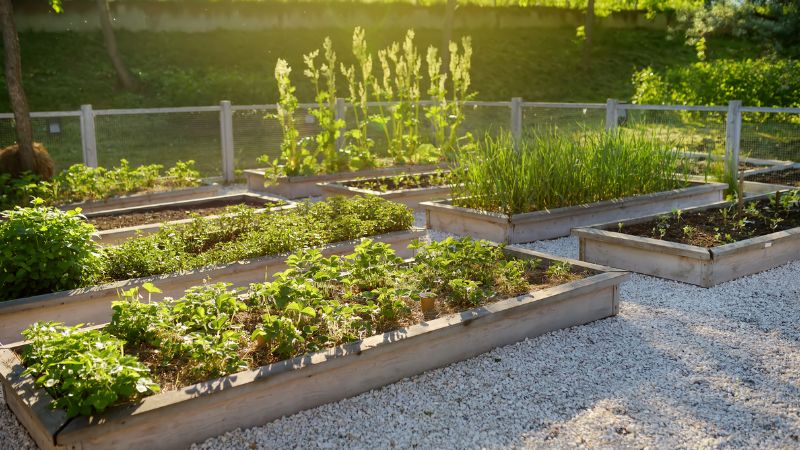
You searched, you pinned, you bookmarked — but somehow your raised bed is still empty or overgrown. The planning part shouldn't be harder than the planting part.
This post gives you 13 ready-to-use raised bed garden layouts — complete with plant lists, spacing, and companion planting — across every garden size and goal.
Each plan is live inside EdenVatika's free garden planner, so you can copy it straight to your own garden and start planting today.
No guessing. No redrawing from scratch. Just pick the plan that fits your space.
What Are Raised Beds?
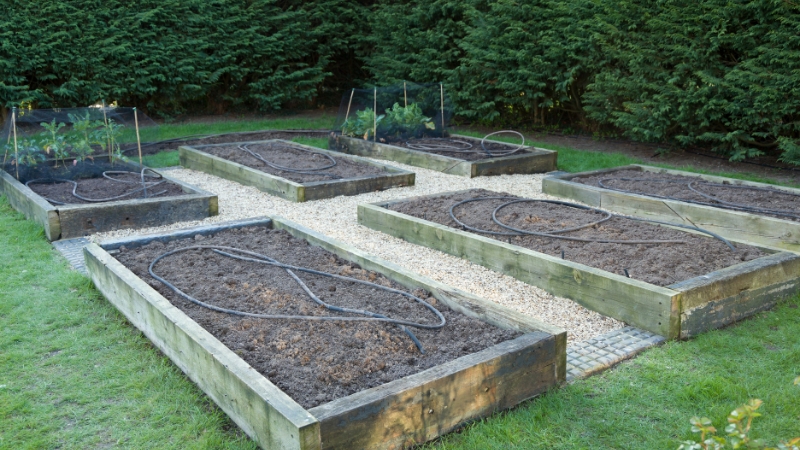
A raised bed is a garden built above ground level — usually a wooden, metal, or stone frame filled with amended soil. Instead of digging into your yard's existing (often poor) ground, you control exactly what goes in the bed: the drainage, the nutrients, the depth.
Why does that matter? Because raised beds:
- Warm up faster in spring — you can start growing weeks earlier
- Drain better — roots don't sit in waterlogged soil
- Stay loose and uncompacted — you never walk in them, so soil stays airy
- Keep weeds out — fewer weeds, less maintenance
- Produce more per square foot — dense planting works because the soil is so good
The most common sizes you'll see are 2×4, 4×4, 4×8, and 4×10 ft — compact enough to reach the center without stepping in, large enough to grow a serious harvest.
What Is Square Foot Gardening?
Square Foot Gardening (SFG) is a planting method where you divide your bed into a grid of 1-foot squares and plant a specific number of plants in each square based on their mature size. A large plant like a tomato gets one full square; compact plants like radishes can share a square with 16 seeds.
The result: you grow more food in less space with less water and almost no weeds. It's the default method used in all the plans below — because it works.
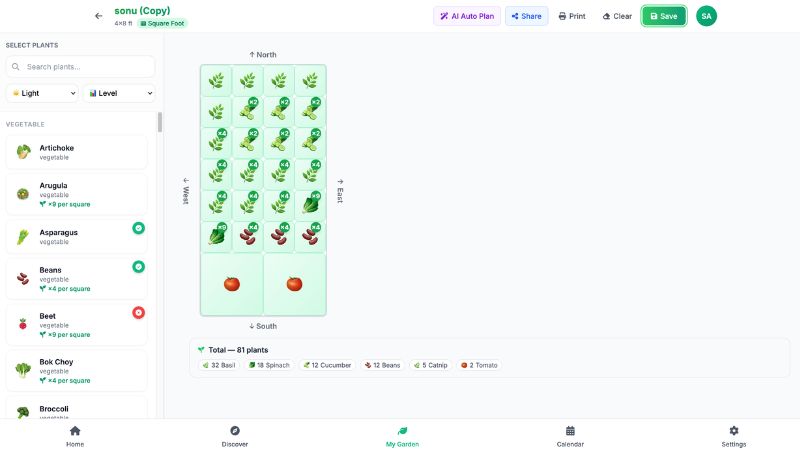
In EdenVatika, the square foot grid is built into the planner. You see exactly how many plants fit where, and the app warns you if you're trying to cram incompatible companions together.
How to Use These Plans
Every layout below links to a live plan inside EdenVatika. Here's what you can do with each one:
- View the full plant list and grid — see exactly what goes where
- Copy it to your free account — one click, and the whole plan is yours to edit
- Swap plants — don't like one variety? Replace it; the companion checker updates instantly
- Print or save as PDF — take it to the garden store or stick it on your fridge
You don't need to redesign anything. These plans are designed to work as-is — though you're welcome to make them your own.
13 Pre-Planned Raised Bed Layouts
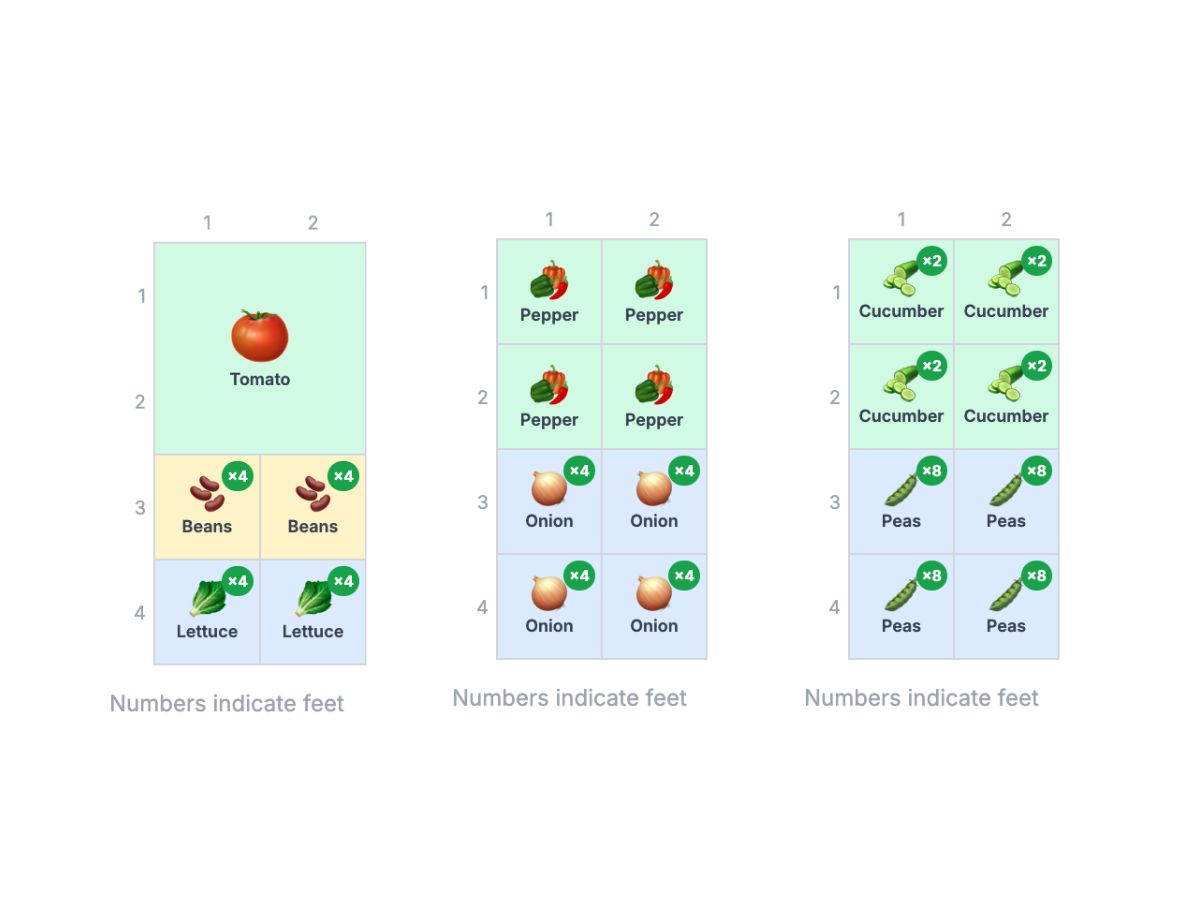
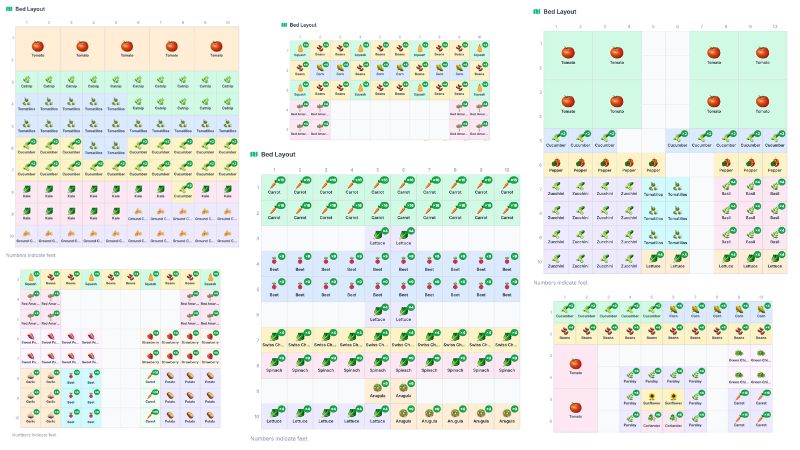
1. 2×4 Compact Money-Saving Grocery Garden (3 Layouts)
Bed size: 2 × 4 ft | Best for: Balconies, patios, tight spaces
A 2×4 raised bed is barely bigger than a coffee table — but planted smartly it replaces a surprising chunk of your weekly grocery bill.
The trick is choosing crops where homegrown wins by the widest margin: cucumbers that stay crisp for weeks vs. going soft in two days at the store.
Fresh herbs that cost $4 a bunch and last three days in the fridge vs. a plant that produces all summer, and onions that you'd otherwise buy every single week.
We've created three separate 2×4 grocery plans, each optimised around a different crop combination. Use one, or rotate all three across different beds in the same season.
Plan 1 — Cucumber & Peas: 8 cucumbers + 32 peas across a 2×4 grid. Peas fix nitrogen in the soil, directly feeding the cucumbers growing alongside them.
Both are crops you buy constantly — and both are dramatically better fresh. Ideal for early summer when peas thrive in cooler temperatures.
🌱 View 2×4 Money-Saving Grocery Garden 1 →
Plan 2 — Peppers & Onions: 4 pepper plants + 16 onions. Onions are one of the single highest-value crops per square foot for grocery savings — you use them in almost every meal, and they cost consistently year-round.
Paired with peppers, which thrive in the same full-sun conditions, this is a two-crop plan that earns its keep all season. The companion pairing is active too: onions repel the soft-bodied pests that attack pepper foliage.
🌱 View 2×4 Money-Saving Grocery Garden 2 →
Plan 3 — Tomato, Beans & Lettuce: 1 tomato (taking 2 squares), 8 beans, 8 lettuces. This is the most varied of the three — a tomato anchor at the top end, beans in the middle that fix nitrogen and produce a steady harvest, and cut-and-come-again lettuce at the base that starts producing in as little as 30 days.
The tomato takes two squares but pays back in bulk; one plant in good soil produces 4–8 lbs of fruit across the season.
🌱 View 2×4 Money-Saving Grocery Garden 3 →
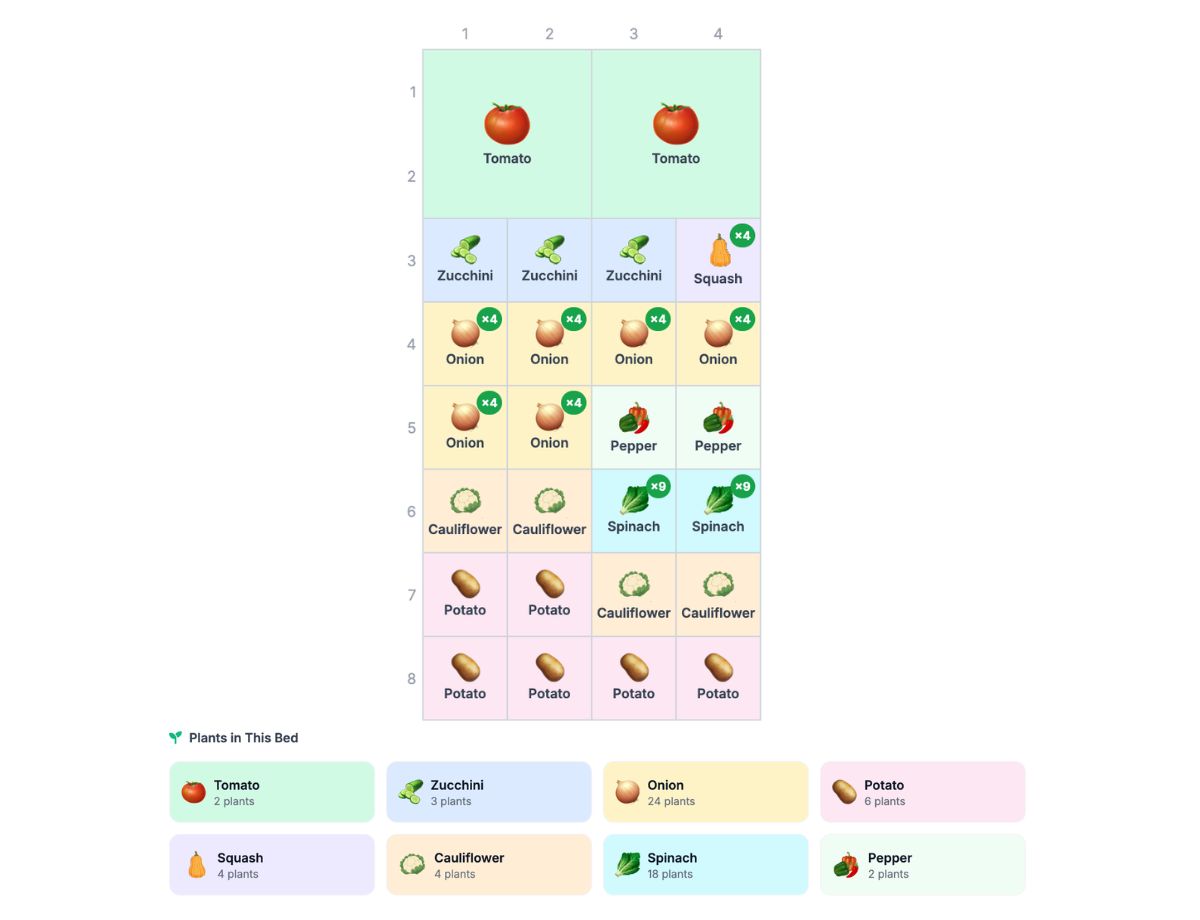
2. 4×8 Money-Saving Grocery Garden Layout
Bed size: 4 × 8 ft | Best for: Most backyards, serious home growers
The 4×8 is the gold standard of raised beds — the size most garden experts recommend when you can only build one. It's the minimum space where you can grow a genuinely varied harvest without any one crop crowding another out.
This version is built specifically around grocery savings, with a wide spread of staple crops that you buy week after week: tomatoes, zucchini, onions, potatoes, cauliflower, spinach, pepper, and squash — 8 varieties across 26 plant squares.
The companion pairings pull double duty on pest control: tomato and onion together repel common pests from both, and pepper and onion do the same.
What's in this bed: Tomato (2), Zucchini (3), Onion (24), Potato (6), Squash (4), Cauliflower (4), Spinach (18), Pepper (2)
Companion highlights:
- 🍅 Tomato + Onion — onions repel pests that attack tomato foliage
- 🌶️ Pepper + Onion — same effect, double the protection
- 🥔 Potatoes fill the bottom two rows, benefiting from the loose raised-bed soil that makes harvest clean and easy
Expected grocery savings: A well-planted 4×8 bed with this mix — staple vegetables used in almost every meal — can realistically save a household $200–$400 across a US or Canadian growing season.
🌱 View the 4×8 Money-Saving Grocery Garden Layout →
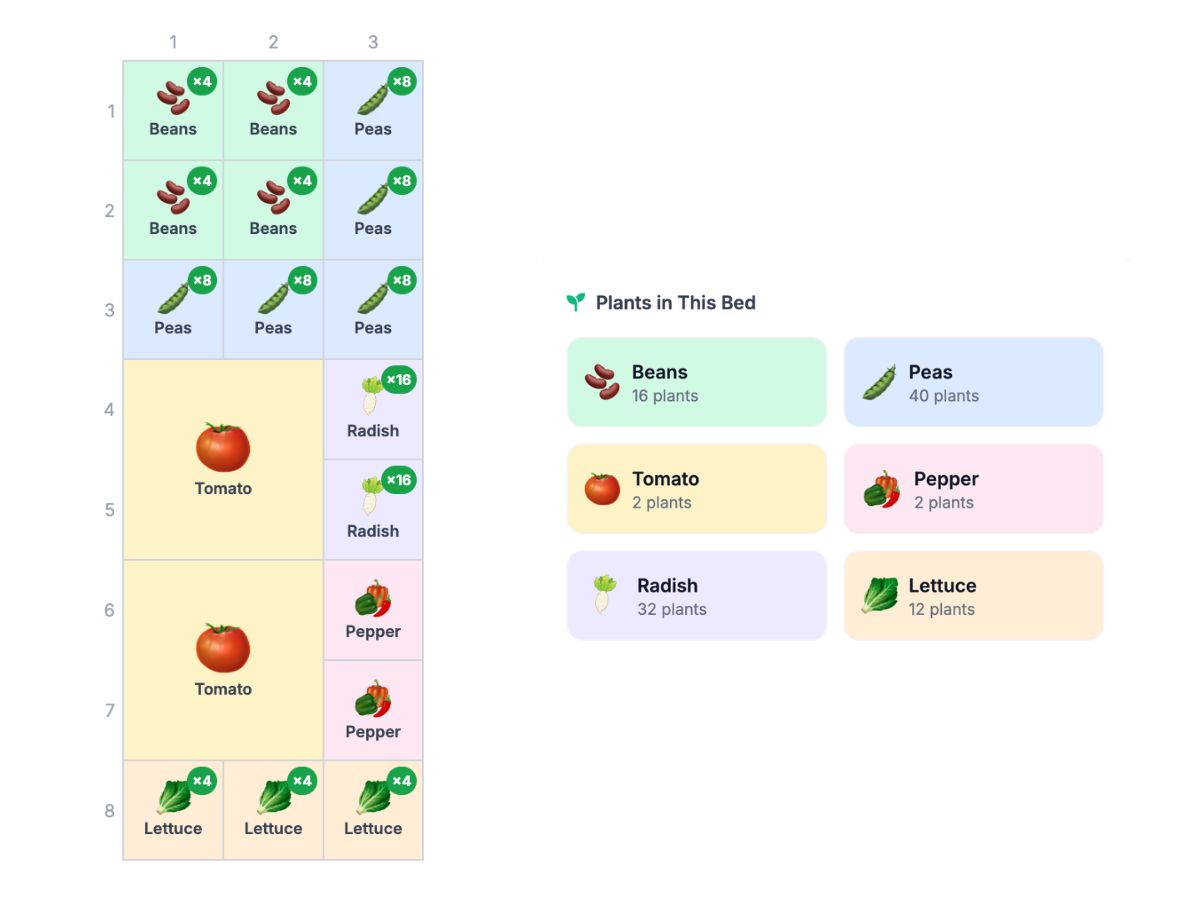
3. 3×8 Family Garden Bed Layout
Bed size: 3 × 8 ft | Best for: Families of 3–5, side yards, narrow spaces
The 3×8 hits a sweet spot that many gardeners overlook. It's wider than a 2-foot bed (so you can genuinely vary your crops) but narrower than a standard 4-foot bed — ideal for a side yard, a fence line, or anywhere 4 feet of depth just doesn't fit.
This family plan is built around fast, reliable producers that cover a full meal: beans and peas fill the top half of the bed — both legumes fix nitrogen in the soil, feeding everything else.
Tomatoes and peppers anchor the middle rows.
Radishes run as a quick-fill crop between the slower producers, and a full row of lettuce closes out the bottom for fresh salad greens through spring and autumn.
What's in this bed: Beans (16), Peas (40), Tomato (2), Pepper (2), Radish (32), Lettuce (12) — 18 plant squares, 6 varieties
Companion highlights:
- 🫛 Peas + Beans — both legumes, they work together without competing and collectively enrich the soil
- 🌱 Radish + Peas — compatible growth, no conflict
- 🌱 Radish + Beans — radishes deter bean beetles naturally
Family tip: Snap peas near the front edge of the bed are a gateway crop for kids — they'll harvest them off the vine themselves.
That kind of hands-on ownership builds garden habits early.
🌱 View the 3×8 Family Garden Bed Layout →
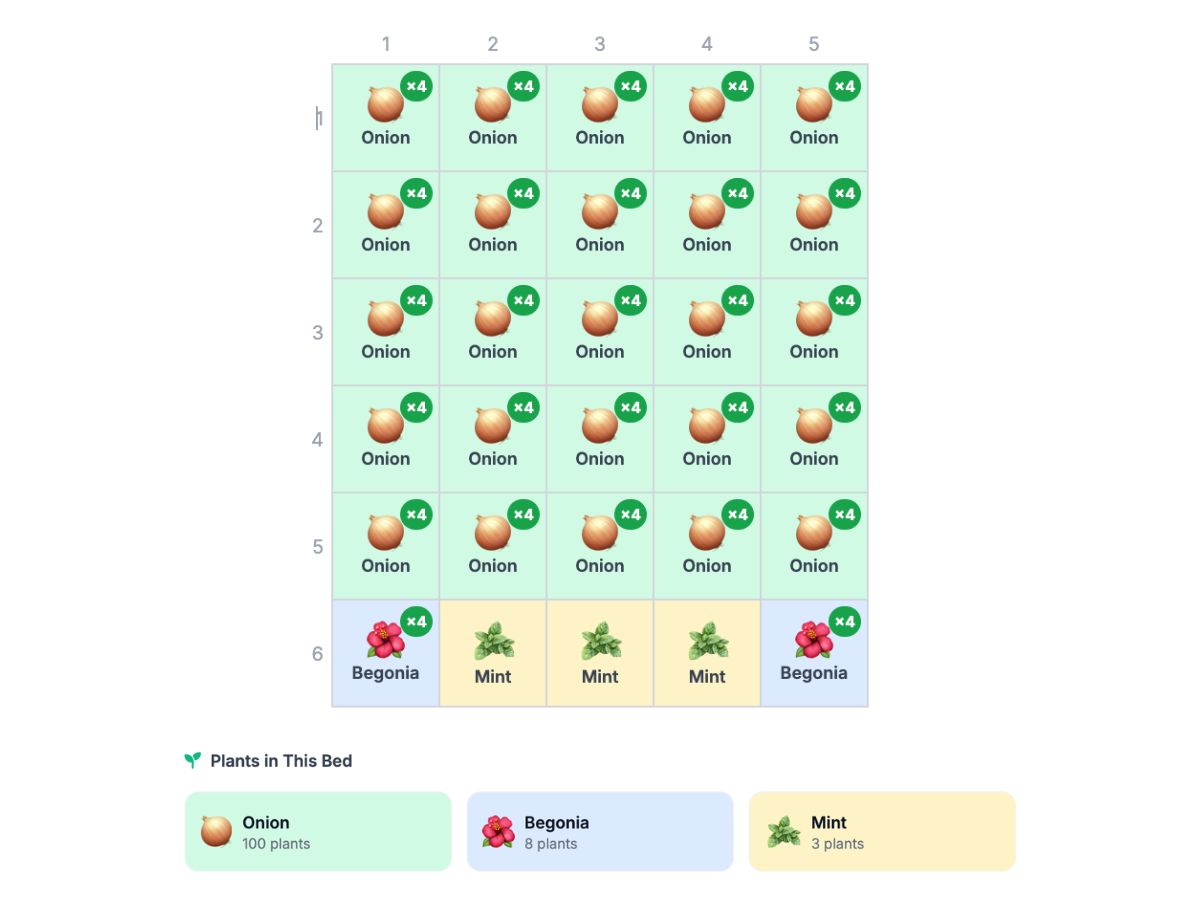
4. Onions + Herbs + Flowers Bed
Bed size: 5 × 6 ft | Best for: Kitchen gardeners, cut-flower growers, pollinators
This is one of the most underrated bed combinations in the collection. Onions, herbs, and flowers might seem like an odd mix — but they are genuinely excellent companions.
Onions repel aphids and carrot flies. Herbs like mint attract predatory insects that hunt garden pests. Begonias pull pollinators in and add a flash of color that makes the whole bed look intentional.
The layout packs 100 onions into the main body of the bed using square foot spacing (4 onions per square foot), with a row of begonias anchoring each corner of the front edge and mint filling the gaps between. It's functional and beautiful — the kind of bed that makes visitors think you know exactly what you're doing.
What's in this bed: Onions (100 plants), Begonia (8 plants), Mint (3 plants)
Why it works:
- Onions deter aphids and soft-bodied pests from neighboring beds
- Mint attracts beneficial insects — but keep it in its square, it spreads fast
- Begonias in the corners signal "well-tended bed" and attract early pollinators
🌱 View the Onions + Herbs + Flowers Bed Layout →
5. 10×10 Community Garden Plot
Bed size: 10 × 10 ft | Best for: Shared community plots, neighborhood gardens, growers who want a diverse, self-supporting bed
Community garden plots are typically larger than most home raised beds — and they come with a different philosophy. You're often growing for a season's worth of food rather than supplementing a weekly shop.
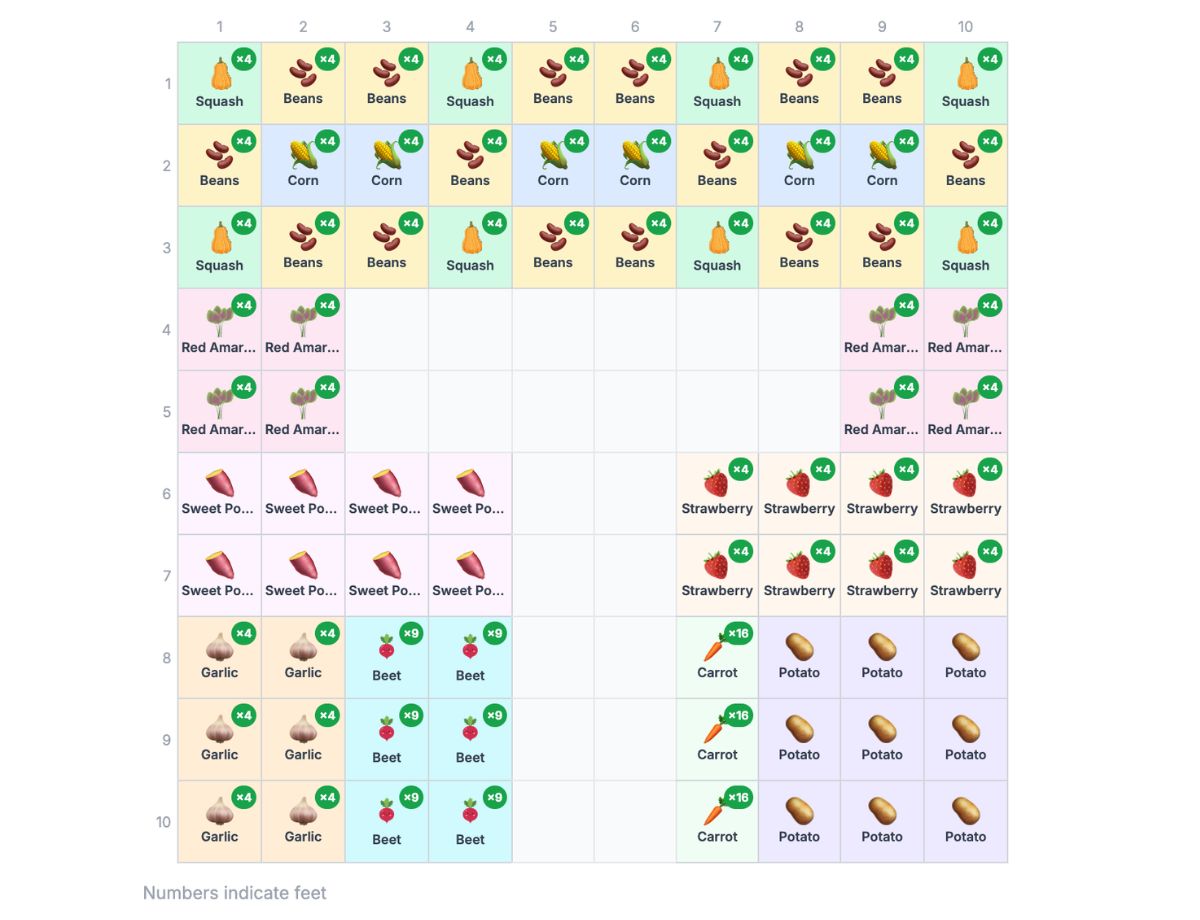
This 10×10 plan takes that seriously: it's one of the most diverse layouts in the collection, with 10 varieties and 78 plants spanning almost every food category — leafy greens, root vegetables, legumes, fruit, and staple crops.
The top third of the bed runs a Three Sisters arrangement: squash, beans, and corn planted in repeating blocks across the width. Beans climb the corn, squash spreads wide to suppress weeds, and the whole section fixes nitrogen for everything below it.
Below that, red amaranth forms a transition border — both edible and a natural visual break. The bottom half divides into sweet potato, strawberries, garlic, beets, carrots, and potatoes — a full root and fruit harvest in half the bed.
What's in this bed: Squash (32), Corn (24), Beans (64), Red Amaranth (32), Sweet Potato (8), Strawberry (32), Garlic (24), Beet (54), Carrot (48), Potato (9) — 327 plants across 100 squares
Companion highlights:
- 🌽 Squash + Corn + Beans — classic Three Sisters, each supporting the others
- 🍓 Strawberry + Garlic — garlic prevents fungal disease on strawberry plants
- 🫘 Beans + Beet — nitrogen-fixing beans enrich the soil around beets
- 🧄 Beet + Garlic — garlic deters pests from beet rows
- 🥔 Potato + Corn — reliable companions with no competition
Community garden tip: Red amaranth along the inner border is a conversation starter — it's striking, edible (used like spinach), and signals to neighbouring plot holders that you know what you're doing.
🌱 View the 10×10 Community Garden Plot Layout →
6. Cocktail Garden 2×4
Bed size: 2 × 4 ft | Best for: Patios, deck gardens, entertaining spaces
A cocktail garden is exactly what it sounds like: a small raised bed planted entirely with herbs and edibles that end up in drinks.
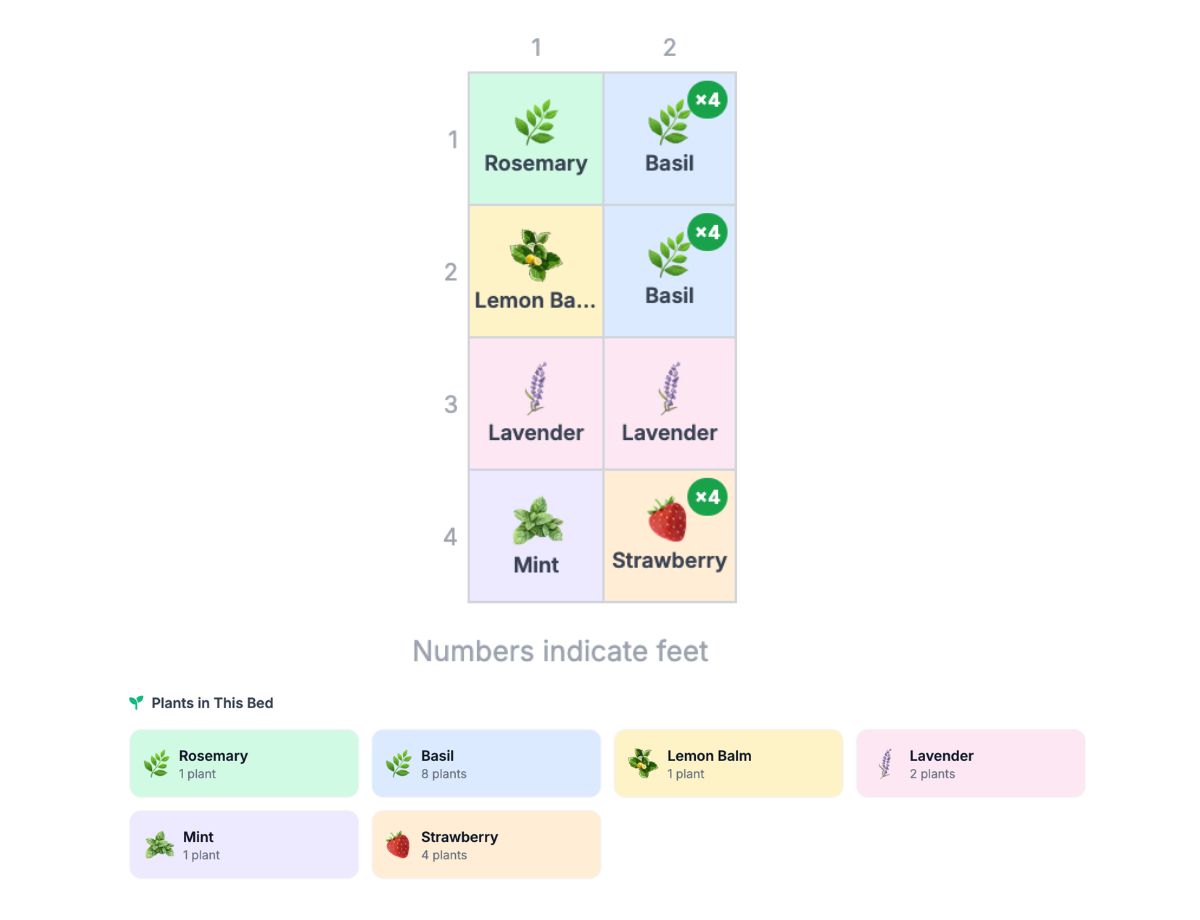
This 2×4 plan has all the classics covered — rosemary for gin and roasted citrus cocktails, basil for vodka infusions and summer spritzers, lemon balm for gin and tonics and mocktails, lavender for lemonade and prosecco, mint for mojitos and juleps, and strawberries for wine, sparkling water, and anything that needs a garnish.
The 2×4 format keeps it compact enough to sit right on a deck or patio — next to wherever you actually entertain. That proximity matters: you're far more likely to use fresh herbs if you can clip them from three feet away rather than walking to the back of the garden.
What's in this bed: Rosemary (1), Basil (8), Lemon Balm (1), Lavender (2), Mint (1), Strawberry (4) — 6 varieties across 8 plant squares
Planting note: Mint is in its own square for a reason — it spreads aggressively if it gets loose. Keep it contained and it's one of the most productive plants in the bed. Lavender prefers well-drained soil, so make sure your raised bed mix has enough grit or perlite in the bottom half.
Host tip: Plant this bed near your back door or outdoor seating area. Snipping fresh garnishes mid-party — a sprig of rosemary, a few basil leaves, a handful of strawberries — makes any gathering feel considered. And it takes you about 30 seconds.
🌱 View the Cocktail Garden 2×4 Layout →
7. Peppers: Sweet & Hot Bed
Bed size: 4 × 4 ft | Best for: Pepper lovers, hot sauce makers, growers in warm climates
A dedicated pepper bed is one of the most productive single-crop setups you can plant.
Peppers are warm-season, full-sun plants that want the same conditions all season — which makes them ideal for a dedicated bed where you don't have to compromise on positioning or watering schedule for the sake of other crops.
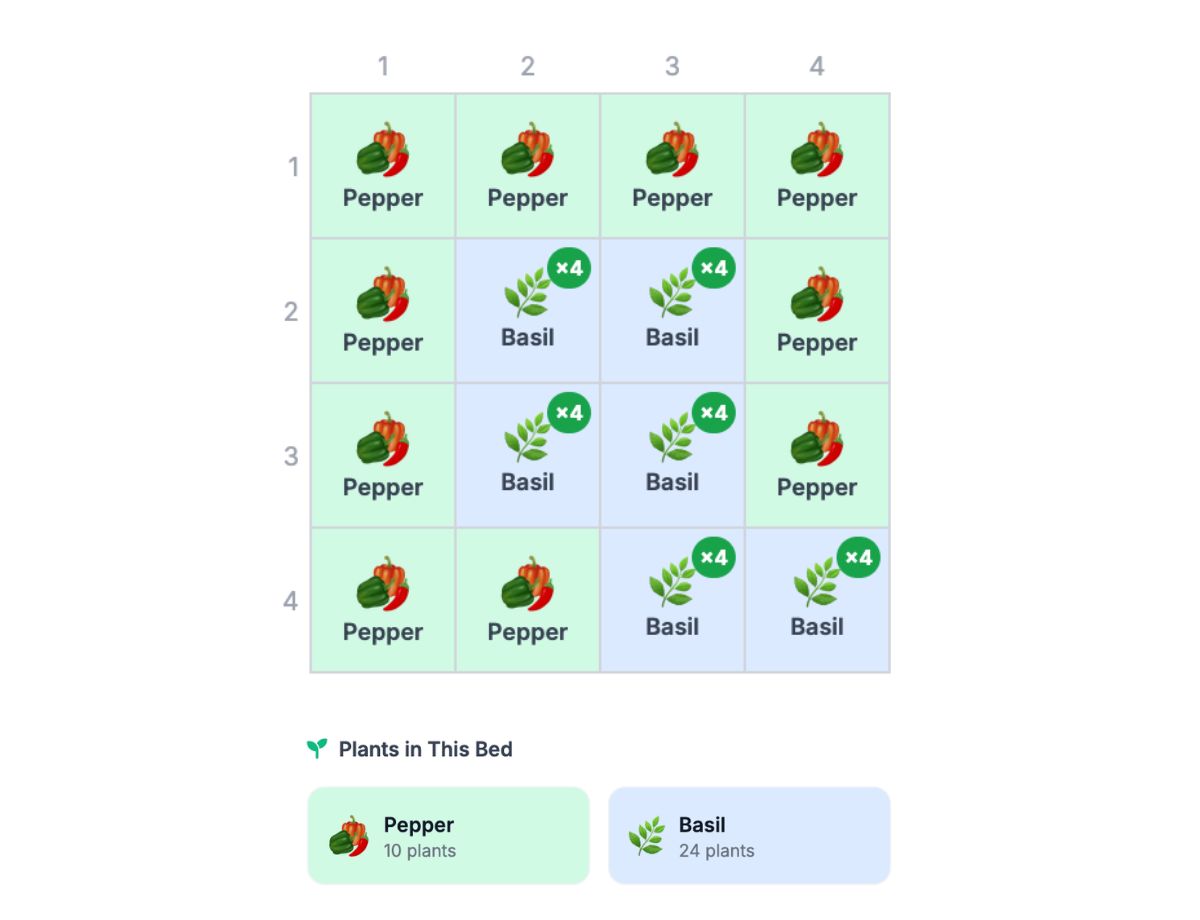
This 4×4 plan keeps it focused: 10 pepper plants fill the outer rows and corners, with 24 basil plants woven through the centre squares.
The basil isn't decoration — it's the single best companion for peppers in any bed. Basil repels aphids, which are the primary pest that attacks pepper foliage.
A dense basil block in the middle of a pepper bed acts as a living, fragrant aphid deterrent. You also get an enormous basil harvest as a side benefit.
What's in this bed: Pepper (10), Basil (24) — 2 varieties, 16 plant squares
Companion highlight:
- 🌿 Basil + Pepper — basil repels aphids from pepper plants; proven companion pairing
Growing tip: Peppers are slow starters. In growing zones 5 or 6, start seeds indoors 8–10 weeks before last frost, or buy transplants. Once in the ground and established in a full-sun raised bed, they produce heavily until first frost with very little attention.
The variety you grow at home — from sweet bells to jalapeños to cayenne — is also simply not available in most grocery stores.
🌱 View the Peppers: Sweet & Hot Bed Layout →
8. Potato Bed
Bed size: 4 × 8 ft | Best for: Staple crop growers, large families, fall harvest planners
Growing potatoes in a raised bed changes the entire experience of growing potatoes.
You fill the bed with loose, airy soil, plant your seed potatoes, and hill (add soil) as the plants grow upward. At harvest time — instead of digging blindly through compacted clay and stabbing half your crop with a fork — you simply open the bed or tip it out.
Every potato rolls out clean and intact.
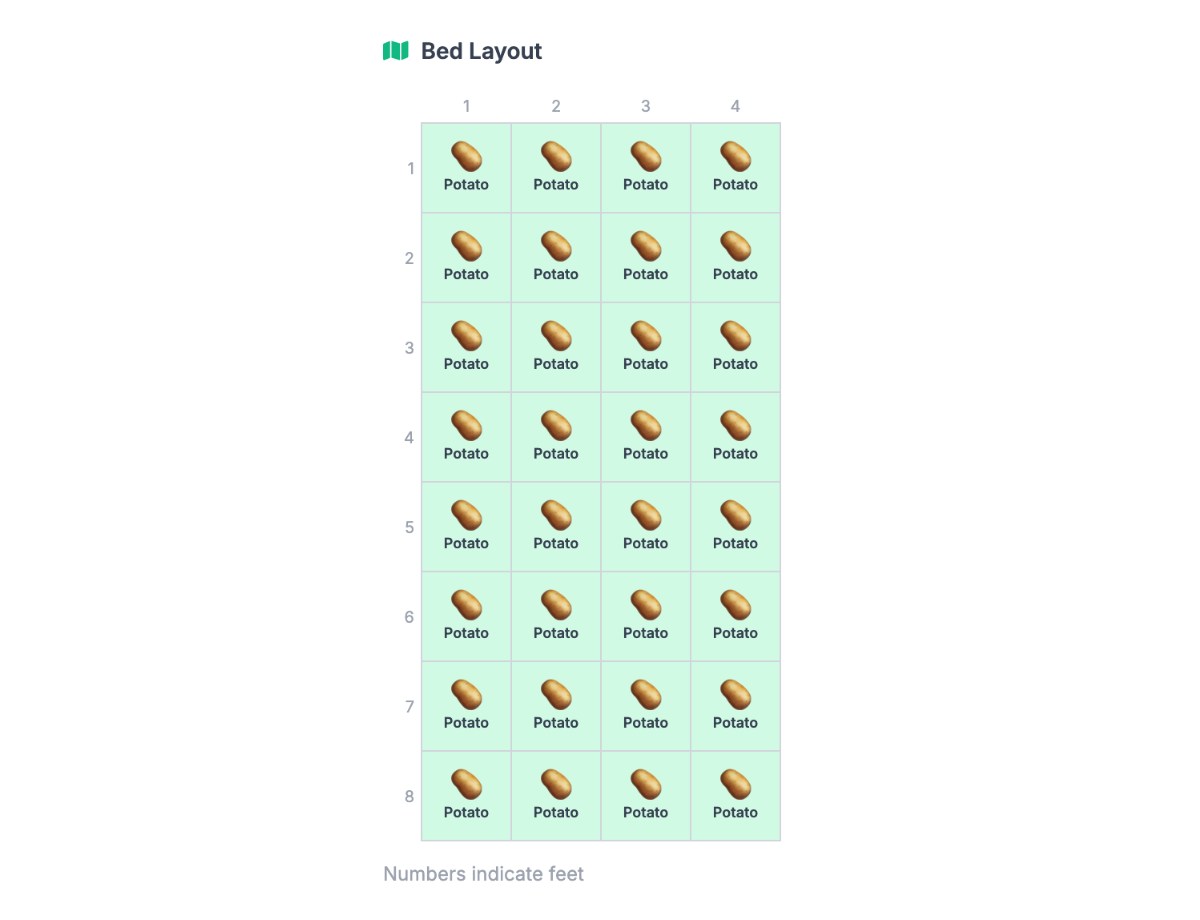
This plan is straightforward and uncompromising: 32 potato plants across a full 4×8 grid, one plant per square foot, filling every available space. That simplicity is intentional.
Potatoes are heavy feeders and moderately large plants — mixing them with other crops in the same bed means one plant always gets outcompeted. A dedicated potato bed produces a much more consistent, harvestable yield.
What's in this bed: Potato (32 plants) — a single-variety or mixed-variety planting across 32 square feet
Variety tip: Use the full 4×8 to run two variety stripes side by side — 16 squares of a starchy baking variety (Russet) on one half, 16 squares of a waxy boiling potato (Yukon Gold or red potato) on the other. You end up with two harvest types — one for roasting and baking, one for salads and soups — from a single bed.
Harvest tip: Stop watering 1–2 weeks before planned harvest date. Let the foliage die back naturally — that's how you know the skins have cured properly and the potatoes will store through winter without going soft.
🌱 View the Potato Bed Layout →
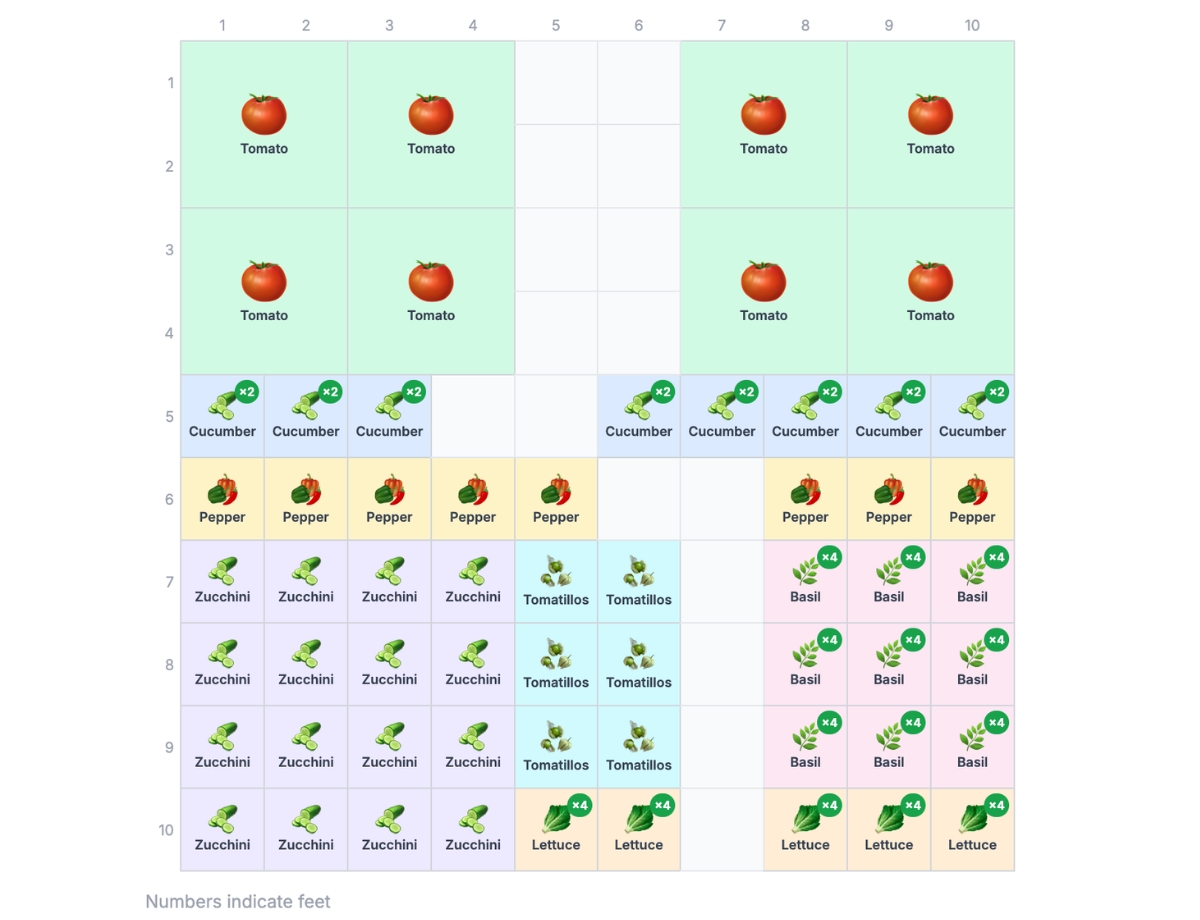
9. 10×10 Classic Summer Kitchen Bed
Bed size: 10 × 10 ft | Best for: Dedicated kitchen gardeners, large backyards, serious food producers
This is the most ambitious plan in the collection — and the one that will change the way you think about buying groceries from June through September.
A 10×10 raised bed, planted well, produces more than most families can eat fresh. You'll be giving zucchini to neighbors by August (it's a rite of passage).
The layout is a genuine summer kitchen: tomatoes, cucumbers, zucchini, peppers, tomatillos, basil, and lettuce — everything you need to make a fresh salsa, a caprese, a grilled veggie plate, or a green salad without buying a single thing at the store.
The basil is deliberately planted near the tomatoes and peppers because it improves tomato flavor and repels aphids from pepper plants — that's not folklore, it's a well-documented companion pairing.
What's in this bed: Tomato (8), Cucumber (16), Pepper (8), Basil (36), Zucchini (16), Lettuce (20), Tomatillos (6) — 110 plants total
Companion highlights:
- 🍅 Tomato + Basil — improves flavor and repels common pests
- 🌿 Basil + Pepper — repels aphids from pepper foliage
- 🥒 Zucchini and tomatillos share the south end of the bed, giving each enough space to sprawl
🌱 View the 10×10 Classic Summer Kitchen Bed Layout →
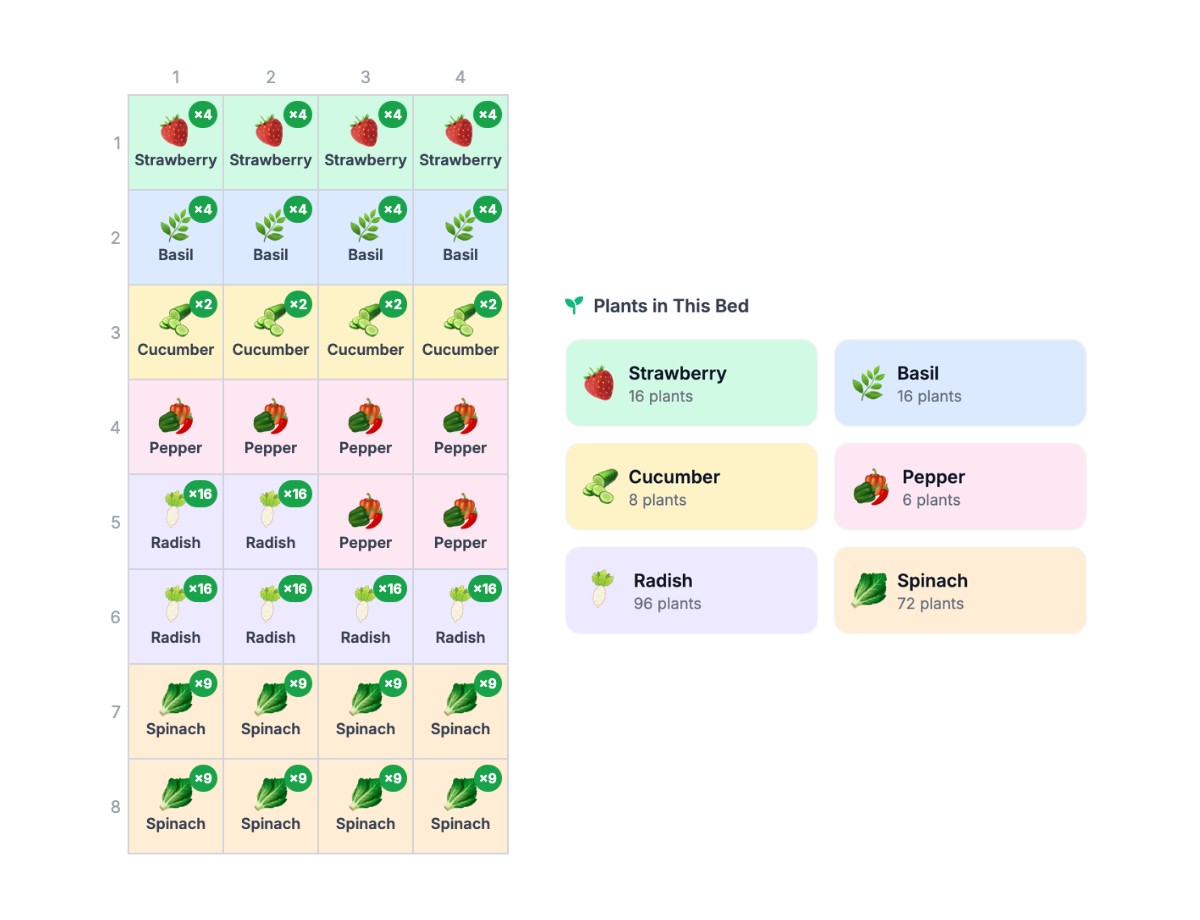
10. Beginner 4×8 Garden Plan (Feeds 2 People All Summer)
Bed size: 4 × 8 ft | Best for: First-time gardeners, couples, anyone starting from zero
If you've never grown food before, this is the plan to start with. It's not a beginner plan because it's dumbed down — it's a beginner plan because every single plant in it was chosen for reliability, forgiving growth habits, and proven companion pairings.
There are no high-maintenance crops, no plants that need daily attention, and no combinations that fight each other.
The layout produces a full season of fresh food for two people: strawberries in early summer, cucumbers and peppers through July and August, spinach in spring and fall, basil all season, and radishes as a quick-fill crop between slower producers. The companion pairings are all positive:
- 🍓 Strawberry + Spinach — compatible growth, no competition
- 🌿 Basil + Pepper — repels aphids
- 🥒 Cucumber + Radish — radishes repel cucumber beetles
- 🥬 Spinach + Radish — classic good companions
What's in this bed: Strawberry (16), Basil (16), Cucumber (8), Pepper (6), Radish (96 seeds), Spinach (72) — across 32 plant squares
First-timer tip: Start with transplants for tomatoes, peppers, and basil. Direct-sow radishes, spinach, and beans. You'll save time and avoid the frustration of slow-germinating seeds when you're just learning what a healthy seedling looks like.
🌱 View the Beginner 4×8 Garden Plan →
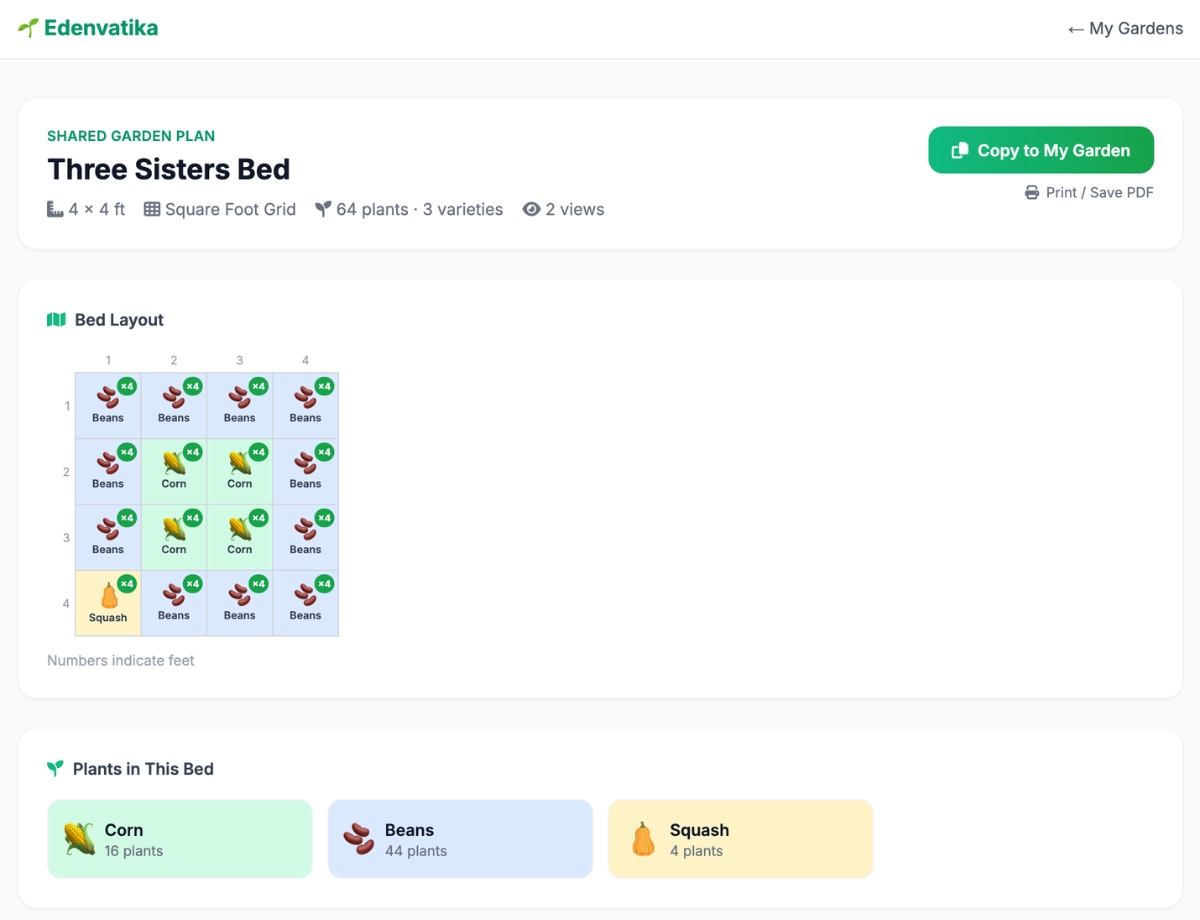
11. Compact Three Sisters Bed
Bed size: 4 × 4 ft | Best for: History buffs, sustainable growing enthusiasts, small-space staple growers
The Three Sisters is one of the oldest companion planting systems in agricultural history — a method developed by Indigenous peoples of North America that has been feeding communities for thousands of years.
Corn, beans, and squash grown together create a self-sustaining micro-ecosystem: the corn grows tall and gives the beans a pole to climb.
The beans fix nitrogen in the soil, feeding the corn and squash. The squash spreads wide across the ground, its large leaves blocking sunlight from weeds and keeping the soil moist.
This compact version fits the classic system into a 4×4 raised bed using square foot spacing.
Corn fills the center four squares in a 2×2 block (required for pollination — corn pollinates by wind, so you need mass, not a single row). Beans surround the corn to climb the stalks. A squash plant anchors one corner and spreads outward.
What's in this bed: Corn (16), Beans (44), Squash (4) — 64 plants total in a 16-square grid
Growing note: Plant corn first, let it reach 4–6 inches, then add beans around it. Plant squash last. Staggered planting gives each sister the head start she needs.
🌱 View the Compact Three Sisters Bed Layout →
Which Plan Is Right for You?
| Your Situation | Best Plan |
|---|---|
| First time gardening, small space | Beginner 4×8 Garden Plan |
| Tiny patio or balcony | 2×4 Compact Grocery Garden or Cocktail Garden |
| Family with kids | 3×8 Family Garden Bed |
| Shared community plot | Community Garden Bed Layout |
| Serious kitchen gardener | 10×10 Classic Summer Kitchen Bed |
| Pepper lover / hot sauce maker | Peppers: Sweet & Hot Bed |
| Hosting / entertaining outdoors | Cocktail Garden 2×4 |
| Traditional / sustainable growing | Compact Three Sisters Bed |
| Growing staple crops | Potato Bed or Three Sisters |
| Want herbs, onions, and flowers | Onions + Herbs + Flowers Bed |
5 Things That Make Any Raised Bed Layout Work Better
Whatever plan you choose, these five habits will make a measurable difference in your harvest:
- Fill with the right mix — not just topsoil. The standard recommendation is 60% topsoil, 30% compost, and 10% coarse sand or perlite. Straight topsoil compacts; straight compost dries out too fast. The blend drains well, holds moisture, and feeds your plants through the season.
- Never walk in your bed. Compacted soil kills the airy structure you built. Design your bed so you can reach every square from the edge — that's why 4 feet is the maximum standard width (2 feet from each side gets you to the center).
- Water consistently, not abundantly. Most vegetables want consistent moisture more than lots of water. A drip irrigation line or soaker hose on a timer is the single best upgrade you can make to a raised bed — more than any fertilizer.
- Respect companion planting. It's not gardening folklore — the science behind plant allelopathy and insect deterrence is well-documented. Basil near tomatoes, marigolds near everything, onions near carrots. The plans in this post already handle the pairing for you.
- Succession plant your quick crops. Radishes, lettuce, and spinach are done in 3–6 weeks. When they come out, something else goes in. A raised bed with succession planting runs nearly year-round in most US/Canadian climates — spring salads, summer tomatoes, fall brassicas.
🌱 Ready to Plant? Your Garden Plan Is One Click Away.
Every layout in this post is inside EdenVatika — free to copy, customize, and print. You see the full grid, the plant counts, and the companion pairings before anything goes in the ground. Your work is always saved. We never delete your plans.
Copy a Free Garden Plan →Free account. No credit card. Plans stay yours forever.