What Not to Plant Together: The Vegetable Pairings That Sabotage Each Other
Thirty vegetable pairings that quietly cost you a harvest — from onions strangling beans to tomatoes trading blight with potatoes — every one pulled straight from EdenVatika's own companion database.
Not every plant makes a good neighbor.
Some pairs share a fence line all season without a cross word. Others move in next to each other and immediately start fighting over dinner, trading diseases across the bed, throwing shade at exactly the wrong hour, and inviting the same pests to the party.
You water them, you feed them, you do everything right — and they still crop half as well as they should, for no reason you can see.
Picture it: a row of beans that never quite fills out, a tomato that browns and collapses a week after the potatoes did the same, a patch of beets that stays stubbornly small in the shadow of something taller. None of it looks like your fault.
Most of the time, it isn't — it's who you sat next to whom. The reason is usually right there in the soil beside them.
Below are 30 combinations worth keeping apart — every one pulled straight from the antagonist list inside EdenVatika's companion database.
Read them once and you'll start to spot the handful of culprits behind nearly all of them.
Why a Bad Pairing Costs You a Crop
A clash almost always comes down to one of five things.
Two plants compete for the same food, water and root space, and the greedier one wins. One plant chemically suppresses the other, releasing compounds that stunt its neighbor's roots.
Two crops share a disease, so an infection in one races straight into the other. Both feed the same pest, doubling the pressure on a single patch of ground. Or one simply overwhelms the other — shading it out, or spreading until there's no room left to grow.
Keep those five in mind and the list below stops being something to memorize and starts being something you can predict.
You'll notice, too, that trouble tends to run in families: plants that are closely related usually want the same nutrients and catch the same diseases, which is exactly why so many of these pairings are cousins that should never have been seated together.
Onions & Garlic vs the Legume Bed
The single most common mistake in the vegetable garden, and the one gardeners are most surprised by.
Alliums — onions, garlic, shallots, leeks — release compounds that stunt the growth of beans and peas. The legumes are busy doing you a favor, pulling nitrogen out of the air and fixing it back into the soil, and the onions repay them by slowing that whole process to a crawl.
You end up with thin, sulky plants and a fraction of the pods you expected.
- 1. Onions + Beans — the classic. EdenVatika flags it plainly: onions inhibit bean growth.
- 2. Garlic + Beans — same story, stronger. Garlic is the most concentrated allium of the lot.
- 3. Onions + Peas — peas take the hit just as hard as beans.
- 4. Garlic + Peas — a quiet growth-stunter that shows up as a thin, disappointing crop.
- 5. Shallots + Beans — the same allium chemistry, just in a milder-tasting package.
Plant instead: give your alliums the company of carrots, beets, lettuce or brassicas, all of which actually benefit from an onion neighbor. Keep the beans and peas in their own bed with corn, cucumbers or squash, and let them get on with feeding the soil.
When Alliums Overstep Elsewhere
Beans and peas aren't the only crops onions and garlic bully. A couple more get stunted just for growing too close.
- 6. Onions + Asparagus — asparagus is a long-lived perennial you plant once and keep for years, so a stunting neighbor does lasting damage. Onions do exactly that to the crowns.
- 7. Garlic + Asparagus — garlic inhibits asparagus the same way, only more so. Keep the whole allium family out of the asparagus patch for good.
- 8. Onions + Sage — one of those pairings that simply sulks. Two strong personalities, neither improved by the other.
Plant instead: asparagus loves tomatoes, parsley and basil as permanent companions. Sage is happiest near rosemary and other Mediterranean herbs, well away from the onion rows.
The Potato Problem
Potatoes are demanding tenants. They sprawl underground, feed heavily, and carry blight — which is exactly why so many crops belong nowhere near them.
- 9. Tomatoes + Potatoes — both are nightshades, both catch the same blight, and the disease jumps straight from one to the other. The most important pairing on this list to break up.
- 10. Potatoes + Cucumbers — they compete hard for space and water, and cucumbers become more blight-prone in a potato's company.
- 11. Potatoes + Squash or Pumpkin — two sprawlers wrestling for the same ground. Something always loses.
- 12. Potatoes + Sunflowers — sunflowers release growth-inhibiting compounds that stunt the tubers below.
- 13. Potatoes + Raspberries — they trade soil-borne diseases, and a raspberry cane is a permanent resident you can't rotate away.
- 14. Peas + Potatoes — planted side by side, the app flags them for spreading disease down the rows.
Plant instead: potatoes are happiest next to beans, corn, cabbage and horseradish, and they appreciate a border of marigolds to keep beetles down.
Keep them well clear of anything else in the nightshade family, and never follow potatoes with tomatoes in the same soil the next year.
Tomatoes Play Favorites
Tomatoes are the divas of the summer bed. They reward a good companion generously and punish a bad one just as hard.
- 15. Tomatoes + Corn — both feed the same fruitworm (the corn earworm and tomato fruitworm are the same insect). Grow them together and you hand it a double portion.
- 16. Tomatoes + Cabbage & the Brassica Clan — cabbage, broccoli, kale, cauliflower and collards are all heavy feeders that fight tomatoes for the same nutrients. Nobody wins that argument.
- 17. Tomatoes + Brussels Sprouts — a brassica that squats in the bed for months on end, quietly draining the very nutrients tomatoes need all season.
- 18. Tomatoes + Kohlrabi — the swollen-stemmed cousin, same greedy roots; the app simply notes it stunts tomato growth.
- 19. Tomatoes + Fennel — fennel actively inhibits tomato growth. More on fennel in a moment.
- 20. Tomatoes + Dill — young dill is a friend; mature dill turns on the tomato and stunts it. Harvest it early or plant it elsewhere.
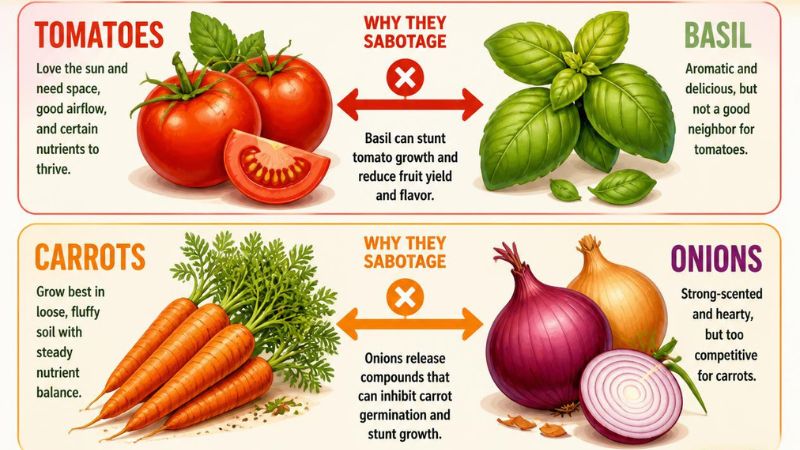
Plant instead: basil, marigold, carrots and onions are all classic tomato allies — basil deters whitefly and hornworm, marigold works the soil against nematodes. Give the brassicas their own patch entirely; two heavy feeders in one bed will always leave both hungry.
Peppers Are Picky Too
Quieter than tomatoes, but no less particular about the company they keep.
- 21. Peppers + Beans — beans inhibit pepper growth, and the two have quite different nutrient appetites. An awkward match all around.
- 22. Peppers + Fennel — fennel suppresses peppers exactly as it does tomatoes.
- 23. Peppers + Kohlrabi — a poor pairing that leaves both plants sulking.
Plant instead: peppers thrive alongside basil, which fends off aphids while handing you a second harvest, and they get along well with tomatoes and onions. Just keep them out of the legume bed and away from the brassicas.
Fennel's Other Victims
Fennel is such a repeat offender it earns a section of its own. Beyond the tomatoes and peppers above, it turns on two more staples.
- 24. Beans + Fennel — the app doesn't mince words: fennel is toxic to beans, suppressing them outright.
- 25. Cabbage + Fennel — same story for cabbage, which fennel inhibits just as readily.
A word about fennel
Count them up and fennel appears on this list four times — against tomatoes, peppers, beans and cabbage. That's not a coincidence. Fennel releases compounds that suppress almost everything around it, which is why the oldest advice still holds: give fennel a pot of its own, well away from the vegetable bed.
Bullies, Spreaders & Shade-Throwers
Some plants don't poison or starve their neighbor — they just overwhelm it. Too aromatic, too vigorous, or too tall.
- 26. Cucumbers + Mint — mint isn't malicious, just relentless. Its runners colonize a bed and crowd everything else out. Grow it in a pot, always.
- 27. Cucumbers + Sage — strongly aromatic sage stunts cucumber growth. Keep it in the herb corner.
- 28. Beets + Pole Beans — bush beans and beets are friends, but pole beans (Kentucky Wonder, Rattlesnake, Yard Long) climb up and shade the beets out, stunting the roots below. A perfect example of getting the variety, not just the crop, wrong.
- 29. Corn + Celery — celery draws in the corn earworm, so it quietly undermines the very crop it's sitting beside.
- 30. Cabbage + Strawberries — planted together they suppress each other's growth, and both end up smaller for the company.
Plant instead: keep mint and any other running herb in a container, sunk into the bed if you like the look but never planted free. Pair beets with bush beans, onions or lettuce rather than climbers, and give cucumbers the company of dill, radishes or nasturtiums.
The One Rule That Covers Most of the List
If you only remember one thing, make it this: keep families apart, and keep heavy feeders apart. Most of the disasters above are relatives seated too close.
Tomatoes, potatoes and peppers are all nightshades, so they swap blight and squabble over food. Cabbage, kale, broccoli and their cousins are all brassicas, all ravenous, all draining the same bed dry. Onions, garlic and shallots are all alliums, and all of them lean on the legumes.
Space those groups out — physically across the garden, and across the seasons with a simple rotation — and you sidestep most of the trouble before it starts.
The rest is spacing and manners: don't let a climber shade a root crop, don't turn a running herb loose in a shared bed, and don't sit a pest magnet next to the crop it magnetizes. That's genuinely most of companion planting's bad half, handled.
Have to grow a clashing pair anyway? Put distance between them.
Almost none of these effects — the root chemistry, the shared pests, the competition for food — reach across the whole garden. They're close-range problems. Sit two antagonists at opposite ends of the bed, with ample space in between, and the harm all but disappears. It's the exact logic EdenVatika's bed designer uses when it live-flags a harmful pair: it only raises a warning when the two are actually near each other — roughly four feet apart in a square-foot bed, a row or two in row mode. Move one to the far corner and the flag clears, because at that distance the conflict barely registers. If you genuinely can't separate two crops, maximize the gap and you'll take most of the sting out of the pairing.
Want the other side of the coin? Our most successful companion planting combinations covers the pairings that actively help each other, and the full companion planting chart for vegetables maps good and bad neighbors for 26 crops on one page.
The Easiest Way to Catch a Clash
Nobody remembers every one of these while they're kneeling in the dirt with a tray of seedlings. That's exactly the moment a tomato ends up next to a potato.
EdenVatika's bed designer keeps the whole antagonist list in the background so you don't have to. Drop a plant onto the grid and it suggests good companions and flags the conflicts before anything goes in the ground — the same relationships this article is built on.
Check any two plants in seconds
Use the free Companion Planting tool to look up whether two crops belong together — no signup needed.
Open the Companion Planting Tool →Get the neighbors right and most of gardening's mysterious disappointments — the stunted beans, the blighted tomatoes, the crop that just never came good — quietly stop happening. Half of a healthy bed is simply knowing who to seat apart.