Zone 8 Fall Garden Layout: 9 Plans to Copy + Planting Dates
Zone 8 fall gardening is squeezed from both ends — real summer heat into September, a real frost by mid-November. Here are the sowing windows that actually work, plus nine complete fall bed layouts you can copy today.

Zone 8 has the most misunderstood fall garden in the country.
Gardeners north of you treat autumn as the wind-down. Gardeners south of you in Zone 9 treat it as a long, forgiving second spring that runs to March. Zone 8 is neither.
You get a genuine summer that holds into September and a genuine frost that arrives in the middle of November — which means your fall window is squeezed from both ends at once.
Get the timing right and it's the best growing season you have: sweeter carrots, cleaner brassicas, a third of the watering, and beds that keep producing until Christmas. Get it wrong by three weeks and you spend October watching cabbages that will never head.
This guide gives you both halves of the answer: the sowing windows that actually work in Zone 8, and nine complete fall bed layouts — from a 2×4 corner bed to a 302-plant 4×8 — that you can copy straight into EdenVatika's free planner and plant this week.
Why Zone 8 Fall Is a Timing Problem, Not a Weather Problem
Zone 8 runs across a lot of very different-looking country: the Pacific Northwest west of the Cascades, most of Georgia, South Carolina, Alabama and Mississippi, central and east Texas, coastal Virginia and the Carolinas, and pockets of the Southwest.
Seattle and Savannah are both Zone 8.
What they share isn't rainfall or humidity. It's a growing season of roughly 270–285 days that ends with a real freeze — and that combination is what makes fall here a scheduling exercise:
- Cool-season crops finally taste right. Lettuce, spinach and brassicas grown in your spring get maybe six usable weeks before the heat turns them bitter. Grown in September and October they sweeten instead — cool nights convert starch to sugar, and carrots, beets, turnips and kale all improve after a light chill.
- Pest pressure collapses — but later than you'd like. Aphids, squash vine borers and stink bugs thin out fast once nights cool. Cabbage white butterflies do not: in Zone 8 they stay active into October, which is exactly why dill, nasturtium and onions turn up in the layouts below.
- You water a third as much. Shorter days, lower evaporation and returning autumn rain mean a fall bed asks for a fraction of what a July bed does.
- The season really does end. This is the difference from Zone 9. Your first frost lands around November 10–20 in 8a and November 15–25 in 8b, and 8a winters can touch 10°F. Established greens and roots stand through it. Anything you started late does not.
The practical upshot: your fall bed will out-produce your spring bed, and it will do it with less work. You just have to start it earlier than feels natural.
Zone 8 Fall Planting Dates
Every fall date works backwards from one number: your average first frost.
| Zone | Average first frost | Winter low range | What that means for fall |
|---|---|---|---|
| Zone 8a | November 10–20 | 10–15°F | Warm-season crops must finish by early November; hardy greens and roots carry through winter under cloth |
| Zone 8b | November 15–25 | 15–20°F | Roughly a week of extra slack on everything, and the hard freezes are shorter and fewer |
These are averages, not guarantees — your own frost date can swing two weeks either way, and a bed against a south-facing wall runs warmer than one in the open. Treat the table below as a window, then watch the ten-day forecast.
Sowing windows by crop
The rule for anything that must finish before frost is: count the days to harvest back from your frost date and add two weeks.
Because growth slows as days shorten. For hardy crops that will simply keep standing through winter — kale, chard, carrots, spinach, spring onions — the frost date barely matters. What matters is getting them germinated before the soil cools below about 50°F.
| Crop | Days to harvest | Zone 8 sowing window | How to start it |
|---|---|---|---|
| Radish | 25–30 | Aug 15 – Oct 20 | Direct sow; resow every 2 weeks |
| Arugula | 30–40 | Aug 20 – Oct 15 | Direct sow; cut-and-come-again |
| Mustard greens | 40–50 | Aug 15 – Oct 1 | Direct sow; the most heat-tolerant brassica here |
| Bok choy | 45–55 | Aug 15 – Sept 30 | Direct sow or transplant; bolts if sown into hot soil |
| Broccoli rabe | 40–50 | Aug 20 – Sept 30 | Direct sow; the fast brassica — half the time of broccoli |
| Lettuce | 45–55 | Aug 15 – Oct 15 | Start in trays in Aug heat; direct sow from mid-Sept |
| Spinach | 40–50 | Sept 1 – Nov 1 | Direct sow — will not germinate above ~75°F soil |
| Swiss chard | 50–60 | Aug 1 – Sept 20 | Direct sow; one sowing picks all winter |
| Kale | 55–65 | Aug 1 – Sept 20 | Sow or transplant; the hardiest thing in the bed |
| Turnip | 45–60 | Aug 15 – Oct 1 | Direct sow; eat the tops as greens while you wait |
| Beet | 55–65 | Aug 15 – Sept 30 | Direct sow; thin to one seedling per cluster |
| Carrot | 70–80 | Aug 1 – Sept 25 | Direct sow only; keep the surface damp for 14 days |
| Peas | 60–70 | Aug 25 – Oct 5 | Direct sow at a trellis; they shrug off light frost |
| Spring onion | 60–80 | Aug 15 – Nov 15 | Direct sow or sets; harvest as you need them |
| Broccoli & cauliflower | 65–85 from transplant | Start indoors Jun 20 – Aug 1; set out Aug 10 – Sept 15 | Transplant only — direct sowing into hot soil causes buttoning |
| Cabbage | 70–100 from transplant | Start indoors Jun 15 – Jul 20; set out Aug 1 – Sept 5 | Transplant; the slowest crop here — start it first |
| Celery | 100+ from transplant | Set out Aug 1 – Aug 25 | Transplant only; needs steady water or the stalks go stringy |
| Parsley & dill | 40–90 | Aug 1 – Sept 25 | Direct sow; parsley is slow to germinate, dill is not |
| Coriander (cilantro) | 45–60 | Sept 1 – Oct 31 | Direct sow; anything sown before September bolts |
| Bush beans | 50–55 | Jul 1 – Aug 10 | Direct sow; must finish before frost, no second chances |
| Cucumber & summer squash | 50–65 | Jul 1 – Aug 5 | Direct sow; the last warm-season crop of the year |
| Garlic & onion sets | Harvest May–June | Oct 15 – Nov 30 | Plant cloves/sets; short-day or intermediate-day onions in Zone 8 |
The Zone 8 fall calendar, month by month
June–July — the invisible month. Nothing goes in the ground, but this is when the fall garden is actually decided. Start cabbage in trays by mid-July and broccoli and cauliflower by the first of August, somewhere shaded. Sow one last round of bush beans and cucumbers if you want a warm-season crop to close out the year.
August — the busiest month. Direct sow carrots, chard, kale, beets, turnips and mustard greens. Start lettuce in trays; the soil is still too warm to sow it directly. Set out your cabbage transplants at the start of the month and broccoli and cauliflower from mid-month. Pull anything finished and get compost in.
September — the sweet spot. Soil has finally cooled. Sow spinach, lettuce, arugula, bok choy, broccoli rabe, peas, coriander and spring onions directly. Finish setting out brassica transplants by mid-month — after that, a cabbage will not head before frost.
October — the filling-in month. Keep sowing radishes, lettuce, arugula and spinach into any square that comes free. Plant garlic and onion sets from mid-month. Harvest the August sowings. Have frost cloth in the shed by the last week.
November — first frost lands. Mostly harvest now. Cover on nights forecast below 28°F. Everything established keeps standing; the sweetness in your carrots and kale arrives right about here.
9 Zone 8 Fall Garden Layouts
Each plan below is live inside EdenVatika. Click through to see the full square-foot grid, exact plant counts, and the companion notes for that bed. You can copy any of them to your free account and edit them to fit your own space.
They're ordered by size — two 2×4 corner beds first, then four 4×4s, then the three big 4×8s — so you can jump to whatever you actually have room for.
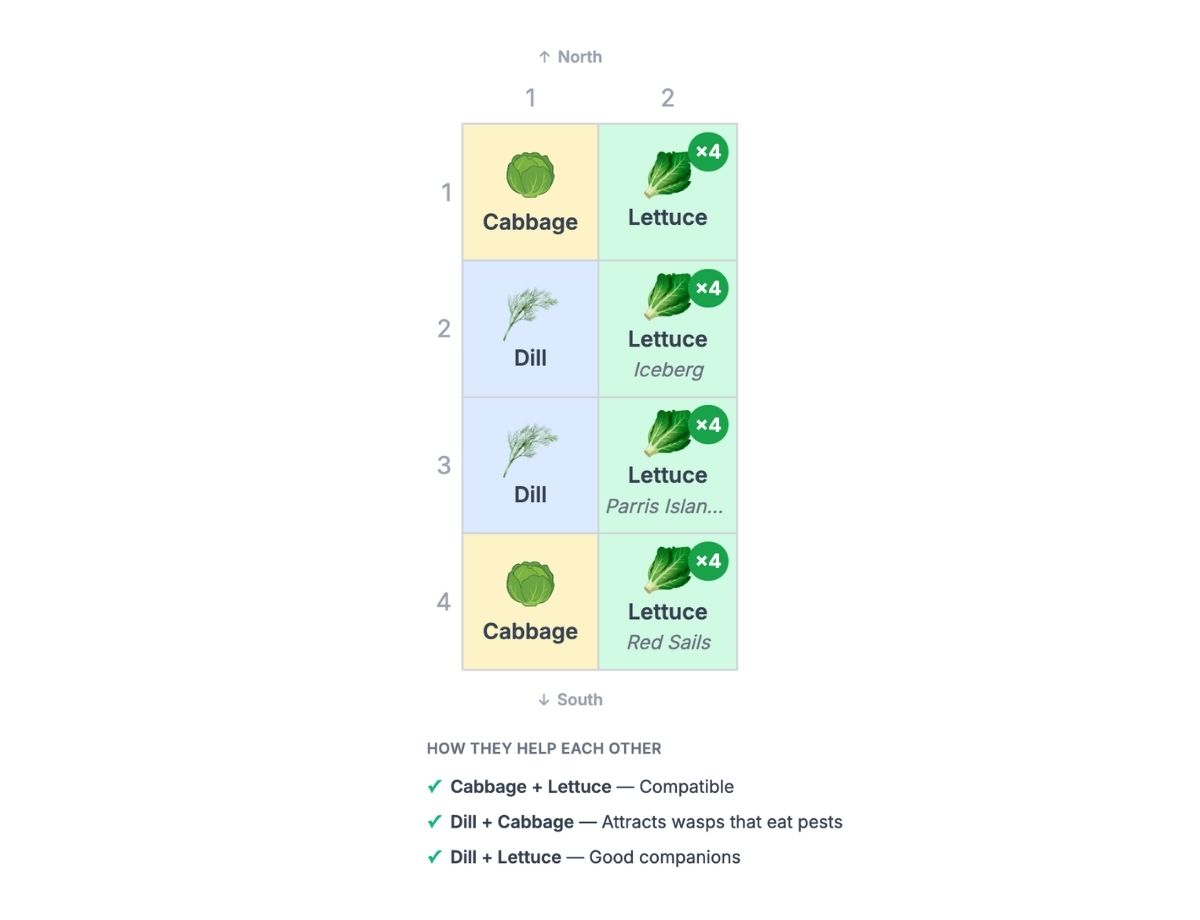
Plan 1 — Lettuce & Dill Corner Bed (2×4)
Best for: A first bed, a balcony planter, or the leftover corner nobody knew what to do with
Bed: 2 × 4 ft · 20 plants · 6 varieties · ~$44 of groceries
Eight square feet, twenty plants, and it is essentially a salad bar. The entire east column is lettuce — four squares, four different varieties: a loose-leaf, Iceberg, Parris Island Cos and Red Sails. That variety choice is doing real work. The four types mature at slightly different rates and hold differently in the bed, so you get staggered picking from one sowing instead of sixteen heads that are all perfect on the same Tuesday.
The west column is two cabbages at the corners with two dill between them, and that's the pest strategy for the whole bed. Dill attracts the parasitic wasps that hunt cabbage worms — which matters more in Zone 8 than almost anywhere, because cabbage white butterflies stay active here well into October while your brassicas are still soft and edible.
Set the cabbage out in early August and direct sow the lettuce and dill from mid-September. If you have never grown a fall garden, start here.
🌿 View the Lettuce & Dill Corner Bed →
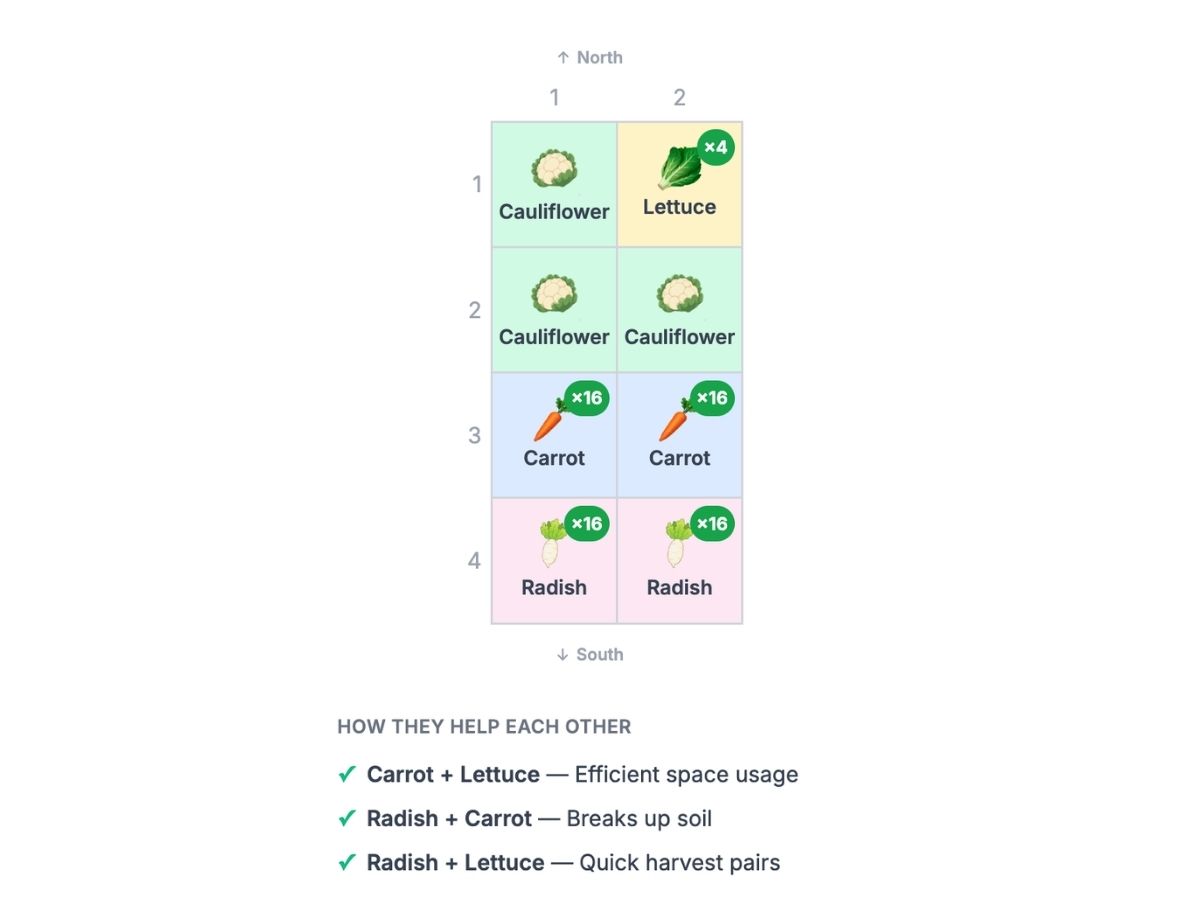
Plan 2 — Compact 2×4 Fall Bed
Best for: Getting the most food out of the least space and the least money
Bed: 2 × 4 ft · 71 plants · 4 varieties · ~$27 of groceries
Four crops, eight square feet, and 71 plants — the highest plant-per-square-foot ratio of any small bed here. The bottom half is 32 carrots and 32 radishes, the top half is three cauliflower and a square of lettuce.
The radish-over-carrot pairing is the oldest trick in square-foot gardening and it is genuinely useful in Zone 8, where carrots sown into warm August soil can take three weeks to show. Radishes are up in four days. They mark the row so you don't disturb it, they break the soil crust as they swell, and they're pulled and eaten long before the carrots need the space. Lettuce sits next to both because it uses the surface while the roots go down.
This is the cheapest bed in the guide to plant and the fastest to fill. Direct sow the carrots in early August, set the cauliflower out mid-August, and start resowing radishes every fortnight from then on.
🌿 View the Compact 2×4 Fall Bed →
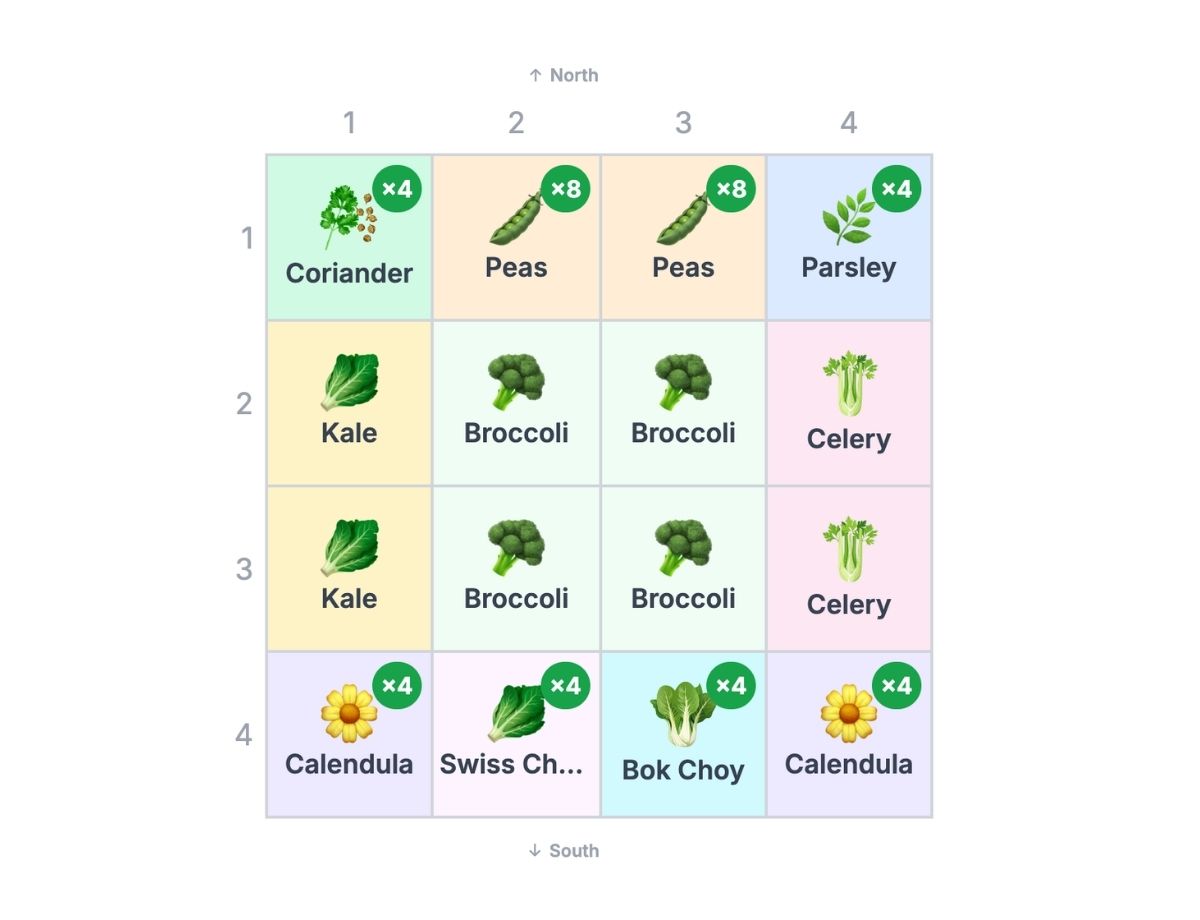
Plan 3 — Peas, Broccoli & Herbs Bed (4×4)
Best for: Cooks who want nine things to pick from sixteen square feet
Bed: 4 × 4 ft · 48 plants · 9 varieties · ~$94 of groceries
Nine crops in a 4×4 is the widest variety in this guide, and the layout is built in four clean bands. Sixteen peas run along the north row on a trellis, flanked by coriander and parsley in the corners. The middle two rows are the slow block — four broccoli in the centre with two kale to the west and two celery to the east. The south row is four Swiss chard and four bok choy between two squares of calendula.
The design logic is harvest tempo rather than pest control. Bok choy and coriander are gone in six weeks, the chard and kale stand all winter, and the celery is the marathon — 100 days from transplant, so it needs to be in the ground by the end of August or it won't be worth the space.
The calendula at the two south corners is not decoration. It pulls hoverflies and lacewings into a bed that is otherwise nearly all brassica, and it keeps flowering here until the first hard freeze.
🌿 View the Peas, Broccoli & Herbs Bed →
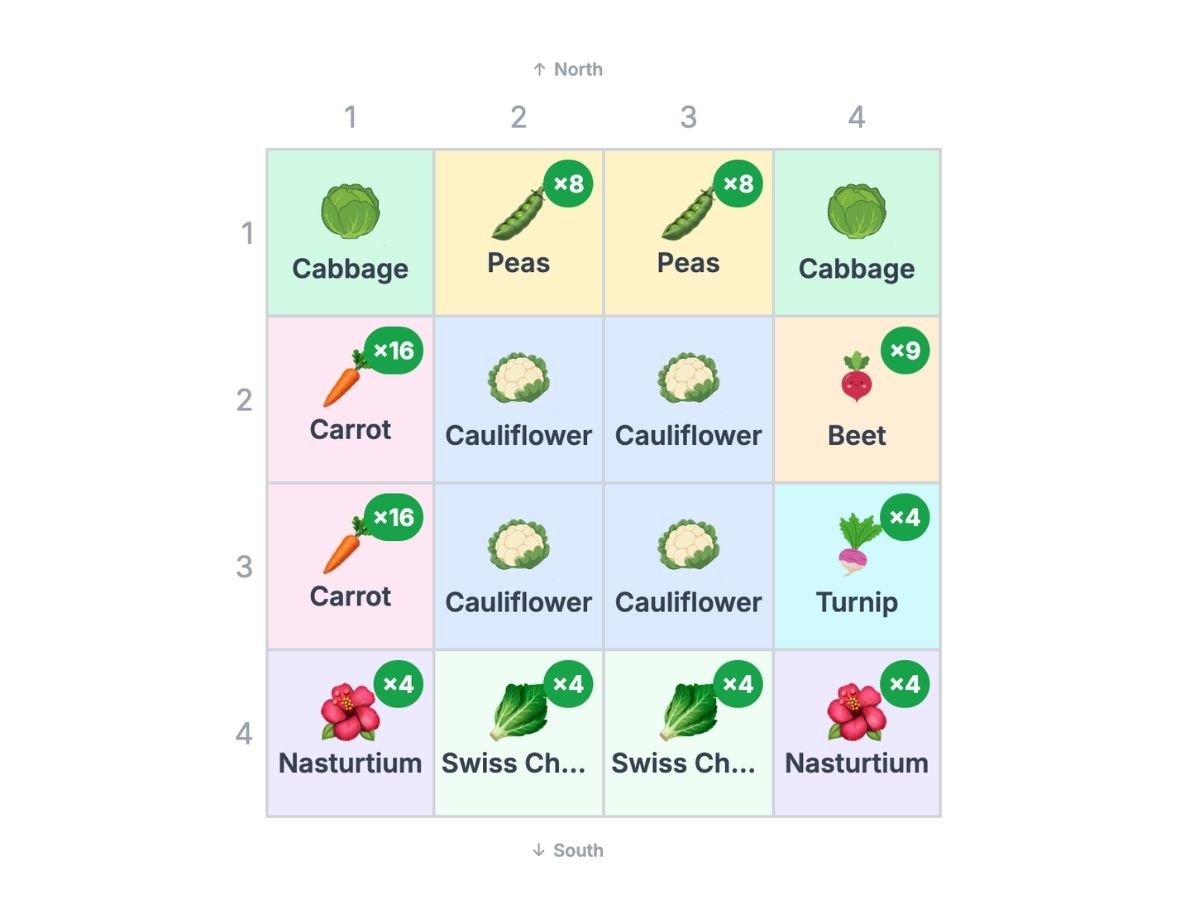
Plan 4 — Cool Season Plan 2 Bed (4×4)
Best for: Learning how companion planting actually works, in one small bed
Bed: 4 × 4 ft · 83 plants · 8 varieties · ~$94 of groceries
If you want to see the whole companion-planting idea working in one square, this is it — six beneficial pairings across eight crops in sixteen square feet.
Sixteen peas sit along the north row between two cabbages, fixing nitrogen for the cabbages beside them and for the 32 carrots running down the west column. The centre block is four cauliflower. A beet square and a turnip square hold the east side, with beets sitting comfortably next to the cabbage as a same-family neighbour and the turnips paired with the peas.
The south row is where the pest work happens: two squares of Swiss chard flanked by eight nasturtiums at the corners. Nasturtium is a trap crop — aphids go to it in preference to your brassicas, and you leave them there. It is a deliberate sacrifice, not a failure, so don't spray it.
Start the cabbage and cauliflower in trays in July, set them out in August, and direct sow the peas, carrots, beets and turnips from mid-August through early September.
🌿 View the Cool Season Plan 2 Bed →
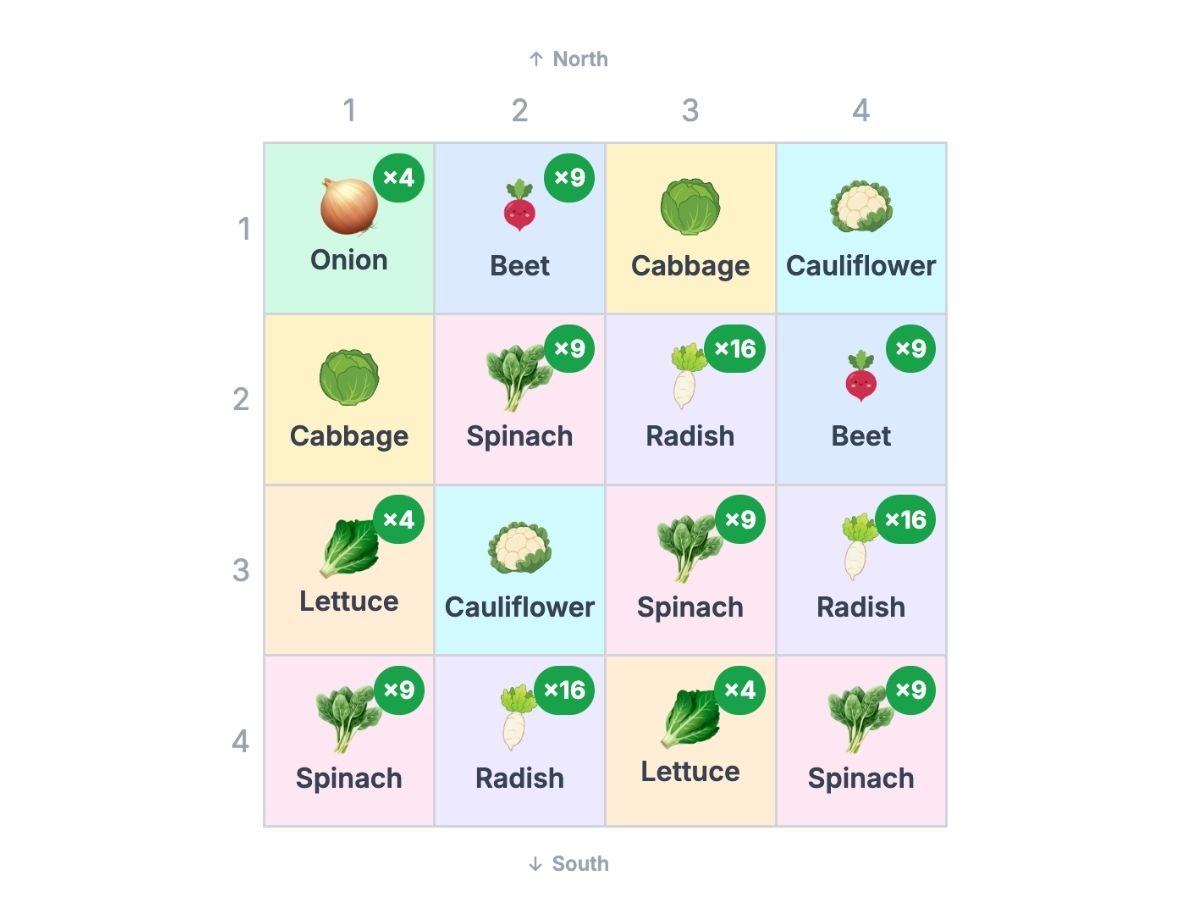
Plan 5 — Compact Fall Garden Grid (4×4)
Best for: Anyone who has lost brassicas to cabbage loopers before
Bed: 4 × 4 ft · 118 plants · 7 varieties · ~$92 of groceries
Look at the grid on this one and you'll notice it isn't banded like the others — it's checkerboarded. Spinach, radish, beet and lettuce squares alternate across all sixteen cells, with the two cabbages, two cauliflower and one onion square scattered into the pattern rather than blocked together.
That scattering is the whole point, and it produces eleven beneficial pairings — more than any other 4×4 here. The onion square in the north-west corner is the key piece: onions repel cabbage loopers from the cabbage next to it and deter pests around the cauliflower, and they still get along with the beets and lettuce on their other sides. In a Zone 8 fall, where loopers are active into October, that one square earns its place several times over.
The rest is volume: 48 radishes, 36 spinach, 18 beets and 8 lettuce. Resow the radish squares as they empty and this bed feeds you from late September into February.
🌿 View the Compact Fall Garden Grid →
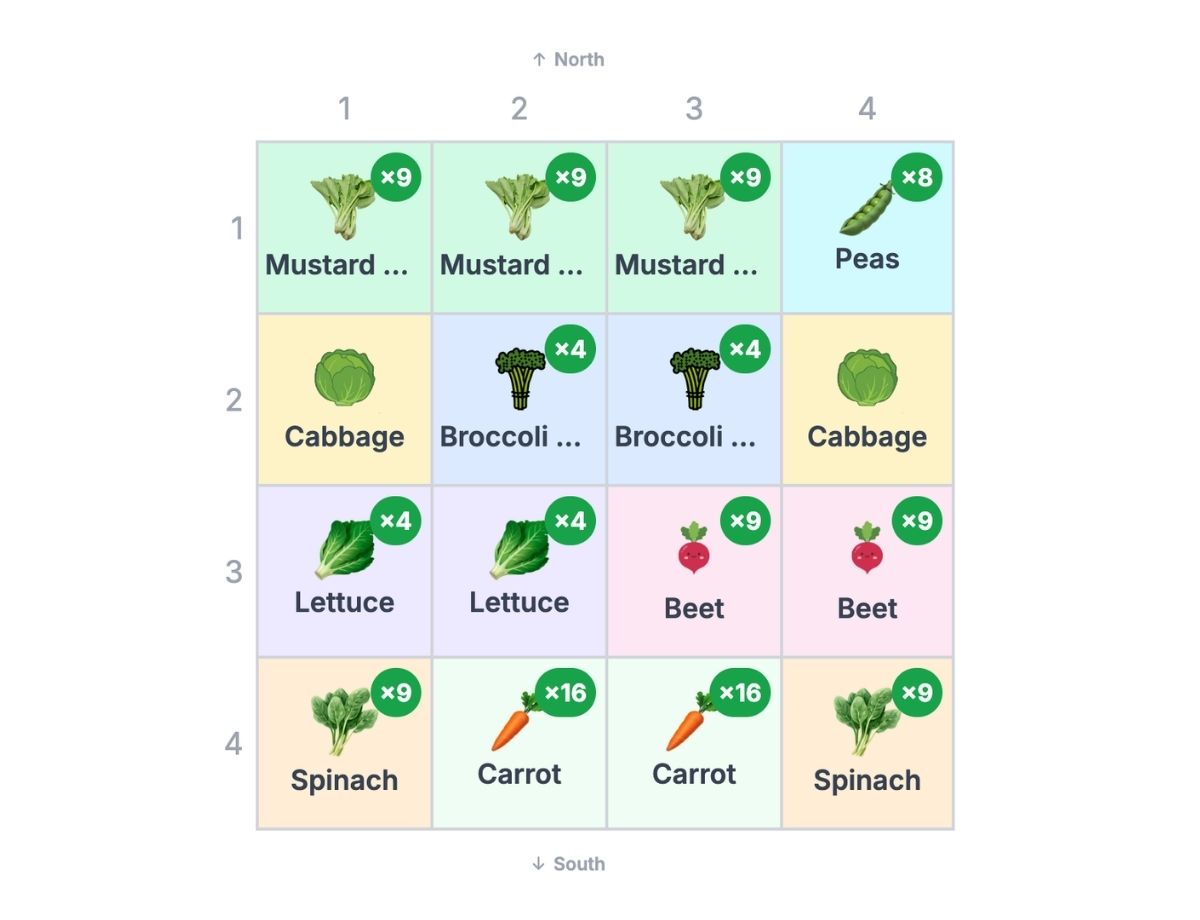
Plan 6 — Zone 8b Fall Sampler (4×4)
Best for: The best all-round 4×4 in this guide, and the richest companion network
Bed: 4 × 4 ft · 121 plants · 8 varieties · ~$78 of groceries
Thirteen beneficial pairings across eight crops — the densest companion network of any plan here — and it's laid out in four simple north-to-south bands so it stays easy to manage.
The north row is 27 mustard greens with eight peas at the trellis corner. Row two is two cabbages flanking eight broccoli rabe. Row three splits into lettuce and beets, and the south row is 32 carrots between two squares of spinach.
The broccoli rabe is the smart inclusion. It's a brassica that finishes in 40–50 days from seed instead of 85 from transplant, which means you can direct sow it in late August and still cut it in October — no trays, no July planning, no buttoning risk. If you missed the cabbage window this year, rabe is how you still get a brassica harvest.
The name says 8b, but this works just as well in 8a with every date pulled forward about a week.
🌿 View the Zone 8b Fall Sampler →
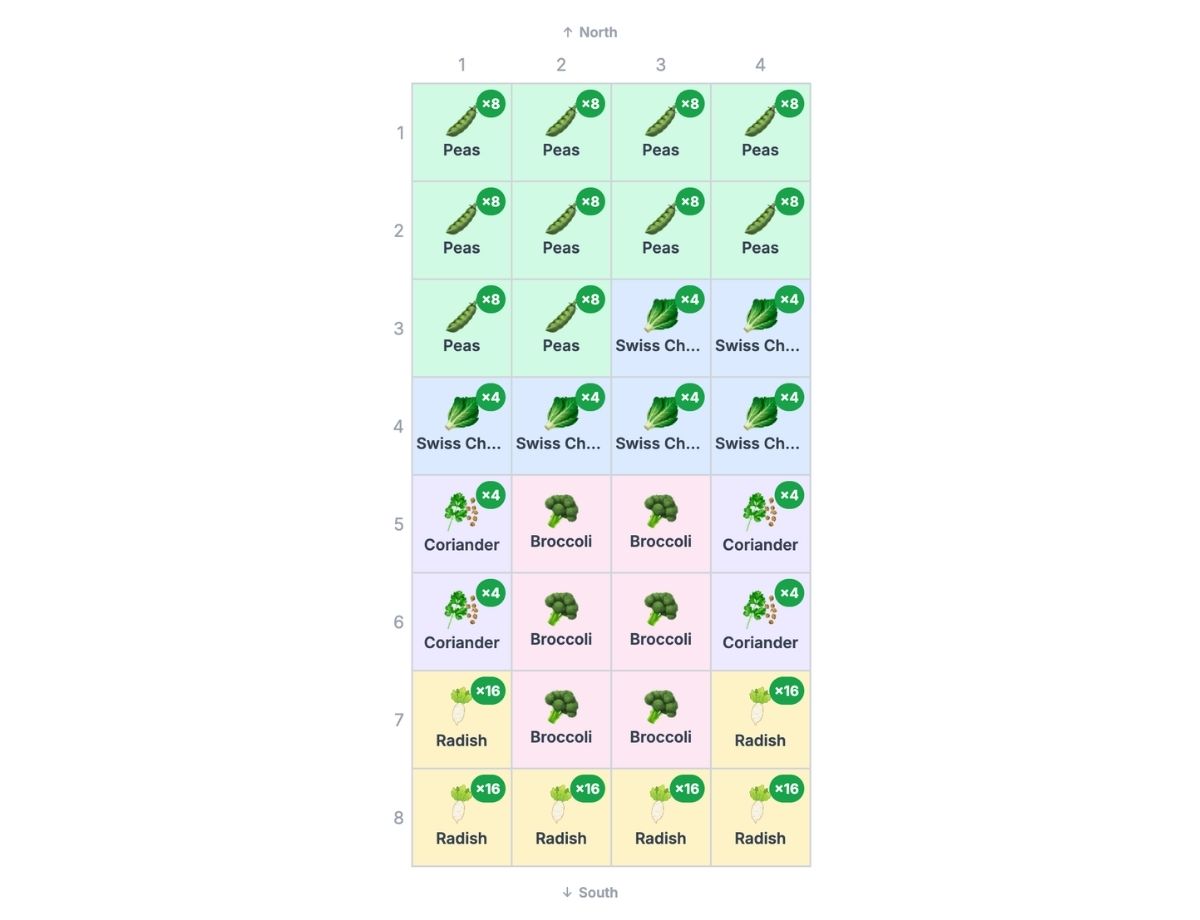
Plan 7 — Five-Crop Cool Season Companion (4×8)
Best for: The biggest grocery saving per square foot of anything here
Bed: 4 × 8 ft · 222 plants · 5 varieties · ~$318 of groceries
$318 is the highest value in this guide, from only five crops — and the reason is the ten squares of peas across the top third of the bed. Eighty pea plants is a real crop rather than a garnish, and fresh shelling peas are among the most expensive things per pound you can put on a supermarket conveyor belt. Grow enough to freeze and this one bed pays for the whole season.
Under the peas: 24 Swiss chard filling the middle band, then six broccoli down the centre with 16 coriander flanking them, and 96 radishes across the bottom two rows.
Two practical notes. First, you need eight feet of trellis along the north end before you sow — peas at this density will pull down anything improvised. Second, the coriander squares are timed for September, when it finally stops bolting in Zone 8 and gives you cut-and-come-again leaves through winter.
🌿 View the Five-Crop Cool Season Companion →
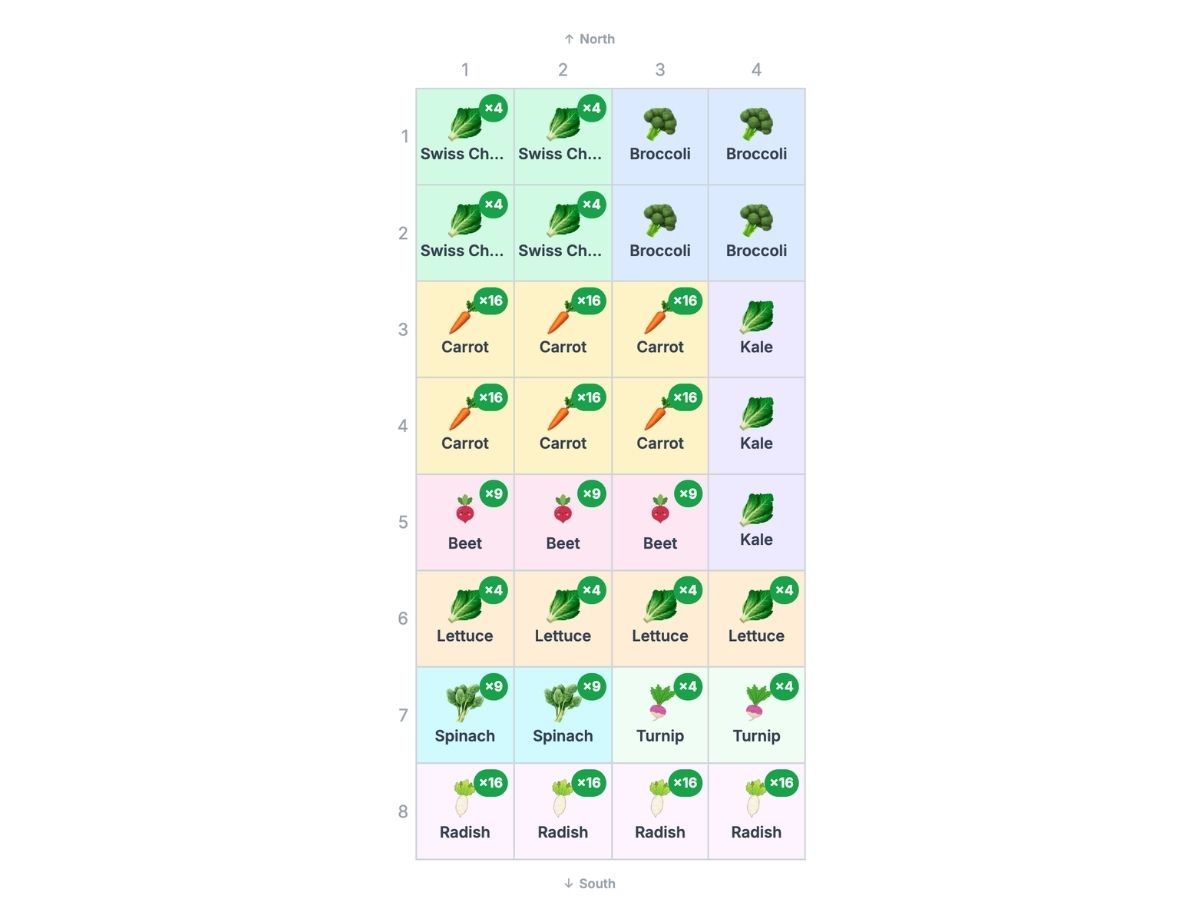
Plan 8 — Nine-Crop Fall Powerhouse Bed (4×8)
Best for: A main bed that gives you something different to pick every week
Bed: 4 × 8 ft · 252 plants · 9 varieties · ~$188 of groceries
Nine crops, 252 plants, and the cleanest row structure of any plan here — eight bands running west to east, so you can weed, water and harvest a whole row at a time without stepping anywhere awkward.
The headline number is 96 carrots across rows three and four. That is a serious carrot crop, and Zone 8 is the right place for it: sown in August and pulled after the first frosts in November, they come out noticeably sweeter than anything you'll grow in spring.
Around them: 16 Swiss chard and four broccoli at the north end, three kale down the east edge, then 27 beets, 16 lettuce, 18 spinach, eight turnips, and a full bottom row of 64 radishes. The chard and kale are the winter standers — they'll still be feeding you in February when everything else is finished.
Treat the radish row as a rotation, not a planting. Sow a quarter of it every fortnight from late August.
🌿 View the Nine-Crop Fall Powerhouse Bed →
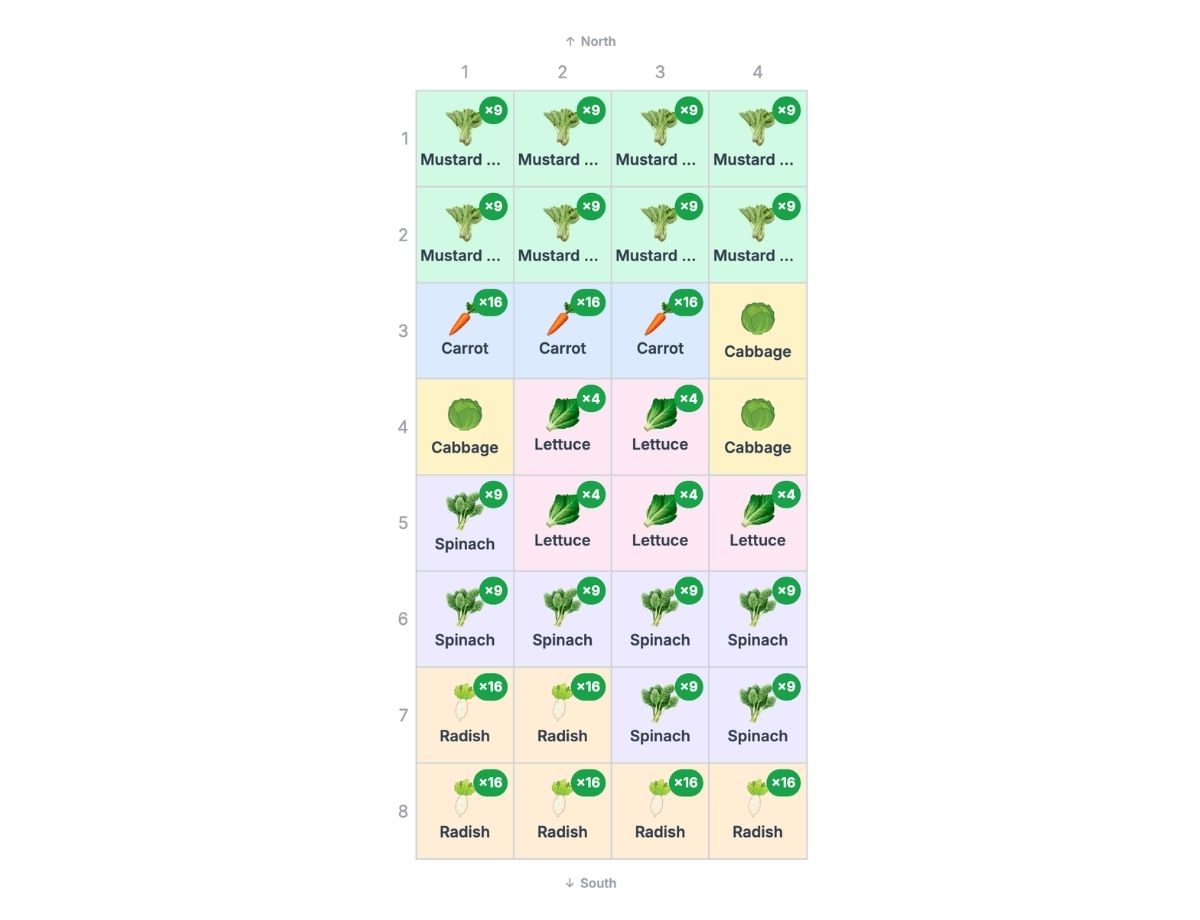
Plan 9 — Zone 8a Autumn Harvest Bed (4×8)
Best for: The flagship bed — the one that actually replaces grocery trips
Bed: 4 × 8 ft · 302 plants · 6 varieties · ~$154 of groceries
302 plants makes this the densest bed in the guide, and it is deliberately built for the shorter end of Zone 8. Only six crops, and five of them are fast: 72 mustard greens filling the entire north quarter, 96 radishes across the bottom two rows, 63 spinach, 20 lettuce and 48 carrots, with three cabbages as the only slow crop in the bed.
That crop list is the design. In 8a your frost lands around November 10–20, which is not enough runway for a bed full of broccoli and cauliflower unless you were organised in June. Mustard, radish, spinach and lettuce all finish inside 50 days and most of them are cut-and-come-again, so a bed sown in late August is producing by late September and still producing in January.
Eight companion pairings hold it together — spinach next to mustard and lettuce for matching conditions, radish breaking soil ahead of the carrots, lettuce beside the cabbage.
If you only build one fall bed this year and you're in 8a, build this one. Set the cabbage out in early August and direct sow everything else from mid-August through mid-September.
🌿 View the Zone 8a Autumn Harvest Bed →
Five Things That Make or Break a Zone 8 Fall Garden
1. Your real deadline is July, not September
This is the mistake that costs Zone 8 gardeners their fall brassicas. Cabbage needs 70–100 days from transplant and cauliflower 65–85, and growth slows through October — so a cabbage set out in late September in 8a is being asked to head in December, and it won't.
Work backwards: to set transplants out on August 1 you need to sow them in trays around June 15. Nothing else in the fall garden requires that much lead time, which is exactly why it's the thing people forget.
2. Germinate in the shade, not in the bed
August soil in full sun across most of Zone 8 sits above 90°F, and lettuce, spinach and most brassicas simply will not germinate in it. Start them in trays somewhere shaded — the north side of the house, under a bench, indoors — and transplant once they're up.
For crops that must be direct sown, like carrots and radishes, sow them and then lay a board or a strip of shade cloth over the row until you see green. Check daily; leave the board on a day too long and you'll get leggy seedlings.
3. Count backwards, then add two weeks
The days-to-harvest number on a seed packet assumes long summer days. From early October onward, growth in Zone 8 slows noticeably as daylight shortens — and you lose light faster here than Zone 9 does.
A 60-day crop sown in October behaves like a 75-day crop. Build that buffer in or you'll be waiting on a harvest that never quite arrives.
4. Succession sow the fast blocks
Several of these plans lean on 64- and 96-radish blocks, and on mustard and lettuce that go from sowing to finished in a month. Sowing 96 radishes at once gives you 96 radishes in one week and an empty bed afterwards.
Sow a quarter of the block every two weeks instead and the same square footage feeds you for four months. This single habit changes a fall garden more than any other on this list.
5. Know what actually needs covering
Unlike Zone 9, you get a real frost — and in 8a, real freezes down to 10–15°F. But most of what's in these beds doesn't care. Established kale, chard, spinach, carrots, beets, turnips, radishes and peas all take Zone 8 winter lows without protection once they have some size on them, and several of them taste better for it.
What needs the frost cloth is anything young, anything heading, and any warm-season holdovers: seedlings sown in late October, cauliflower and broccoli with curds forming, lettuce, coriander, celery and bok choy. Buy the roll in October, not on the night it's forecast.
Frequently Asked Questions
When should I start my fall garden in Zone 8?
Earlier than you think. Start cabbage seed in trays by mid-July and broccoli and cauliflower by the first of August. Direct sow carrots, chard, kale, beets and turnips through August, and sow spinach, lettuce, arugula, peas, bok choy and coriander in September once the soil has cooled below about 75°F.
What is the first frost date in Zone 8?
Zone 8a averages a first frost around November 10–20 and Zone 8b around November 15–25, with typical winter lows of 10–15°F and 15–20°F respectively. Both dates vary by a week or two year to year, so confirm against your local forecast before planting anything frost-sensitive.
Is it too late to start a fall garden in Zone 8 in September?
Not at all — you've just lost the brassica option. Mustard greens, radishes, spinach, lettuce, arugula, bok choy, broccoli rabe, peas, turnips and coriander can all still go in during September and will crop before or through the frost. Plan 9, the Zone 8a Autumn Harvest Bed, is built almost entirely from crops in that list for exactly this reason.
Can I grow tomatoes in a Zone 8 fall garden?
Only if you set out transplants by early July. Tomatoes need roughly 60–80 days from transplant and fruit set stops once nights drop below about 55°F, so an August planting won't ripen. Most Zone 8 gardeners get better results treating fall as a cool-season window and saving tomatoes for a spring crop started indoors in January.
Do I need a raised bed for a fall garden in Zone 8?
No — every plan here works equally well as an in-ground block. Raised beds help most where drainage is poor or autumn rain is heavy, which describes a good deal of Zone 8 from the Gulf states to the Pacific Northwest. In drier parts of Zone 8, in-ground beds actually hold moisture better through a dry September.
Will my fall garden survive the winter in Zone 8?
Most of it will. Kale, chard, spinach, carrots, beets, turnips, spring onions, radishes and peas all handle Zone 8 winter lows once established, and the roots and brassicas sweeten after a frost. Lettuce, coriander, celery, bok choy and anything with a developing cauliflower head will want a frost cloth on the coldest nights.
What's the difference between planting in Zone 8a and 8b?
About a week on either end, and roughly five degrees of winter low. Every date in this guide works for both — in 8a, pull them forward by about seven days and be a little quicker to cover. The bigger difference is in the crop choice: 8b has enough runway for a full brassica bed, while 8a rewards the fast crops.
Plant Your Zone 8 Fall Garden This Week
The window is open right now, and in Zone 8 it doesn't stay open long.
Every plan above is live in EdenVatika with the square-foot spacing already calculated, the companion pairings already checked, and the plant counts already worked out — so the only decision left is which bed size fits your space.
Copy one, adjust it for what your family actually eats, and get seed in the ground this weekend.
🍂 Your Zone 8 Fall Garden Plan Is One Click Away.
All nine layouts in this post are free to copy, customise, and print. You see the full grid, the plant counts, and the companion pairings before anything goes in the ground. Your work is always saved. We never delete your plans.
Copy a Free Garden Plan →Free account. No credit card. Plans stay yours forever.