Zone 9 Fall Garden Layout: 8 Plans to Copy + Planting Dates
In Zone 9, fall is the best growing season of the year — but it fails from heat, not frost. Here are the sowing windows that actually work, plus eight complete fall bed layouts you can copy today.
In Zone 9, autumn is not the end of the growing year. It's the start of the best part of it.
While gardeners in Zone 5 are pulling up spent tomato vines and covering their beds for winter, you are sowing carrots, lettuce, peas, and brassicas into soil that will stay workable until March. Your first frost is somewhere around the second week of December — and in a lot of years it never really arrives at all.
The catch is that a Zone 9 fall garden fails for the opposite reason a northern one does. It isn't cold that kills your first sowing. It's heat.
Lettuce seed sown into 90°F September soil simply refuses to germinate, spinach bolts before it makes a leaf worth picking, and the broccoli you set out too early buttons into a golf ball instead of a head.
This guide gives you both halves of the answer: the sowing windows that actually work in Zone 9, and eight complete fall bed layouts — from a 4×4 starter to an 8×4 brassica-and-roots bed — that you can copy straight into EdenVatika's free planner and plant this week.
Why Fall Is the Real Growing Season in Zone 9
Zone 9 runs across the Gulf Coast, central and northern Florida, coastal Texas, the low deserts of Arizona, and much of California's Central Valley. What those places share is a summer that's too hot for a lot of vegetables and a winter that's too mild to stop them.
That flips the northern calendar on its head:
- Cool-season crops finally taste right. Lettuce, spinach, and brassicas grown in your spring get about six usable weeks before the heat turns them bitter and sends them to seed. Grown in October and November, they sweeten instead — cool nights convert starch to sugar, and carrots, beets, and kale all improve after a light chill.
- Pest pressure collapses. The aphids, squash vine borers, whiteflies, and stink bugs that made August miserable thin out dramatically once night temperatures drop. Fall brassicas are far easier to grow clean than spring ones.
- You water a third as much. Shorter days, lower evaporation, and (in most of Zone 9) returning rainfall mean a fall bed asks for a fraction of the irrigation a July bed does.
- The season is genuinely long. With a first frost around December 10 in 9a and December 20 in 9b — and typically only a handful of freezing nights all winter — a bed planted in September can keep producing into February with nothing more than a frost cloth on the coldest nights.
The practical upshot: your fall bed will out-produce your spring bed, and it will do it with less work. You just have to get the timing right.
Zone 9 Fall Planting Dates
Every fall date works backwards from one number: your average first frost.
| Zone | Average first frost | Winter low range | What that means for fall |
|---|---|---|---|
| Zone 9a | ~December 10 | 20–25°F | Warm-season crops must finish by early December; hardy greens and roots carry through winter under cloth |
| Zone 9b | ~December 20 | 25–30°F | Roughly ten extra days on everything; many winters pass with no hard freeze at all |
These are averages, not guarantees — your own frost date can swing two weeks either way, and a bed against a south-facing wall runs warmer than one in the open. Treat the table below as a window, then watch the ten-day forecast.
Sowing windows by crop
The rule for anything that must finish before frost (beans, cucumbers, squash) is: count the days to harvest back from your frost date and add two weeks.
Because growth slows as days shorten. For hardy crops that will simply keep standing through winter (kale, chard, carrots, spring onions), the frost date barely matters — what matters is getting them germinated before the soil cools below about 50°F.
| Crop | Days to harvest | Zone 9 sowing window | How to start it |
|---|---|---|---|
| Radish | 25–30 | Sept 1 – Nov 30 | Direct sow; resow every 2 weeks |
| Arugula | 30–40 | Sept 15 – Nov 30 | Direct sow; cut-and-come-again |
| Mustard greens | 40–50 | Sept 15 – Nov 15 | Direct sow; very heat-tolerant for a brassica |
| Lettuce | 45–55 | Sept 15 – Nov 30 | Start in trays in Sept heat; direct sow from mid-Oct |
| Spinach | 40–50 | Oct 1 – Dec 15 | Direct sow — will not germinate above ~75°F soil |
| Swiss chard | 50–60 | Sept 1 – Oct 31 | Direct sow; one sowing picks all winter |
| Beet | 55–65 | Sept 15 – Nov 15 | Direct sow; thin to one seedling per cluster |
| Carrot | 70–80 | Sept 1 – Nov 15 | Direct sow only; keep the surface damp for 14 days |
| Peas | 60–70 | Oct 1 – Dec 1 | Direct sow at a trellis; they shrug off light frost |
| Spring onion | 60–80 | Sept 15 – Dec 31 | Direct sow or sets; harvest as you need them |
| Broccoli & cauliflower | 65–85 from transplant | Start indoors Aug 1 – Sept 15; set out Sept 15 – Oct 31 | Transplant only — direct sowing into hot soil causes buttoning |
| Cabbage | 70–100 from transplant | Start indoors Aug 1 – Sept 1; set out Sept 15 – Oct 15 | Transplant; the slowest crop here — start it first |
| Coriander (cilantro) | 45–60 | Oct 1 – Jan 31 | Direct sow; anything sown before October bolts |
| Bush beans | 50–55 | Aug 1 – Sept 15 | Direct sow; must finish before frost, no second chances |
| Cucumber | 50–65 | Aug 1 – Sept 10 | Direct sow on a trellis; the last warm-season crop of the year |
| Okra, gourds, chillies | 50–70 | Set out by Aug 15 | Transplants only this late; they crop until the first frost kills them |
| Garlic & onion sets | Harvest May–June | Oct 15 – Nov 30 | Plant cloves/sets; short-day onion varieties only in Zone 9 |
The Zone 9 fall calendar, month by month
August — the transition month. Direct sow bush beans and cucumbers for one last warm-season crop. Start broccoli, cauliflower, and cabbage in trays somewhere shaded — a tray on the north side of the house germinates far better than one in the bed. Pull anything that's finished and get compost into the soil.
September — the busiest month. Direct sow carrots, beets, chard, mustard greens, and the first radishes. Start lettuce in trays; the soil is still too warm to sow it directly. Set out your first brassica transplants from mid-month.
October — the sweet spot. Soil has cooled enough for everything. Sow spinach, arugula, lettuce, coriander, peas, and spring onions directly. Finish setting out brassicas. Plant garlic and short-day onions from mid-month.
November — the filling-in month. Keep sowing radishes, spinach, lettuce, and peas in any square that comes free. Harvest the September sowings. Have frost cloth ready by the end of the month.
December — mostly harvest. Cover on nights forecast below 30°F. Anything already established will sit through a light freeze and keep going once it warms.
8 Zone 9 Fall Garden Layouts
Each plan below is live inside EdenVatika. Click through to see the full square-foot grid, exact plant counts, and the companion notes for that bed. You can copy any of them to your free account and edit them to fit your own space.
They're ordered by when you'd plant them — the late-August transition bed first, then the September and October beds — and they get bigger as you go down.
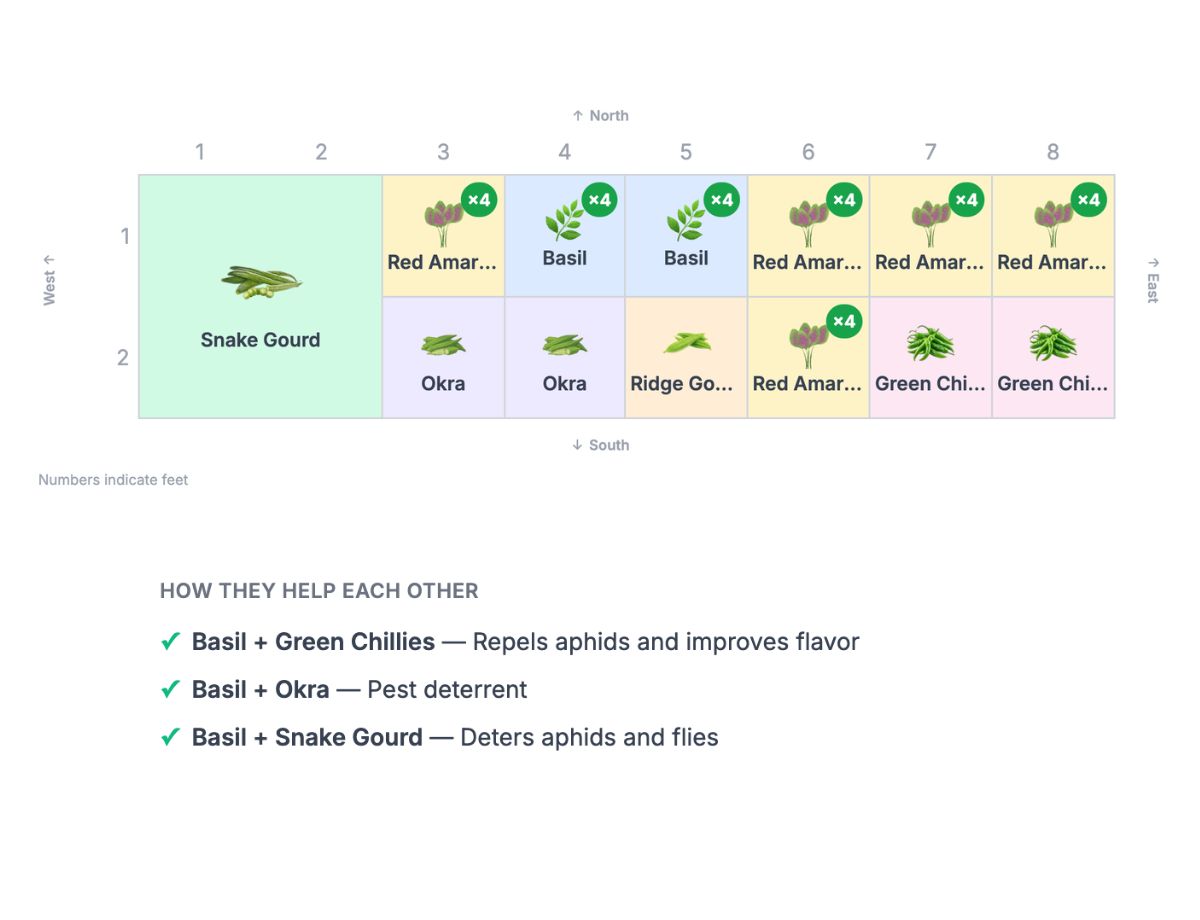
Plan 1 — 8×2 Late August / Early Fall Bed
Best for: Squeezing one more warm-season harvest out of a narrow bed before the season turns
Bed: 8 × 2 ft · 34 plants · 6 varieties · ~$118 of groceries
This is the only plan here that's still a summer bed, and that's the point. In Zone 9 you have until roughly mid-August to set out heat lovers and still get a crop before December.
This narrow strip carries a snake gourd and a ridge gourd (one plant each — both are vigorous vines that need a fence or trellis behind the bed), two okra, and two green chillies, with 20 red amaranth and 8 basil filling the gaps.
The basil is doing real work rather than just occupying squares: it's paired with the snake gourd to deter aphids and flies, with the okra as a general pest deterrent, and with the green chillies where it both repels aphids and improves flavour.
Red amaranth is the fastest thing in the bed — you'll be cutting leaves within a month while the gourds are still climbing.
Plant this in late July or the first half of August and it will crop until your first frost, at which point the whole bed comes out and you sow a cool-season plan in its place.
🌿 View the 8×2 Late August / Early Fall Bed →
Plan 2 — Small-Space Fall Garden Bed (4×4)
Best for: A first fall bed, or anyone who wants a big harvest from three easy crops
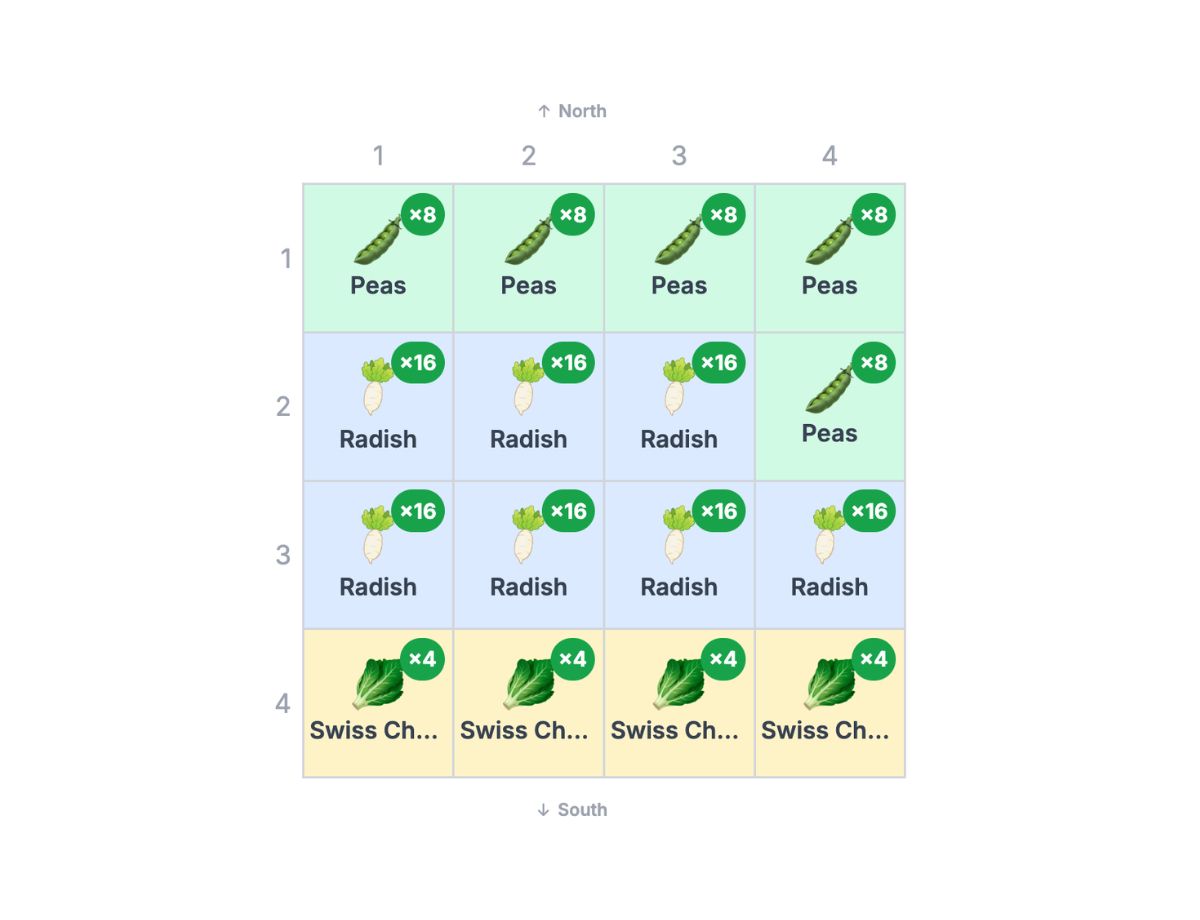
Bed: 4 × 4 ft · 168 plants · 3 varieties · ~$162 of groceries
Three crops, 16 square feet, and 168 plants. This is the highest ratio of food to effort in the whole guide, and it's deliberately simple: 40 peas across the north row, 112 radishes filling the middle, and 16 Swiss chard along the south edge.
The logic is speed. Radishes are up in four days and pulled in four weeks, so the middle of this bed turns over twice before the peas have finished climbing.
Radishes and peas are compatible neighbours, and the radishes' quick roots break up the soil surface. The chard row is the long game — one October sowing will keep producing leaves through the whole winter and into spring.
Sow the peas and radishes in October and put the chard in during September so it's established first. If you've never grown a fall garden, start here.
🌿 View the Small-Space Fall Garden Bed →
Plan 3 — The Everyday Fall Kitchen Bed (4×4)
Best for: Cooks who want salad, roots, and herbs from one small bed
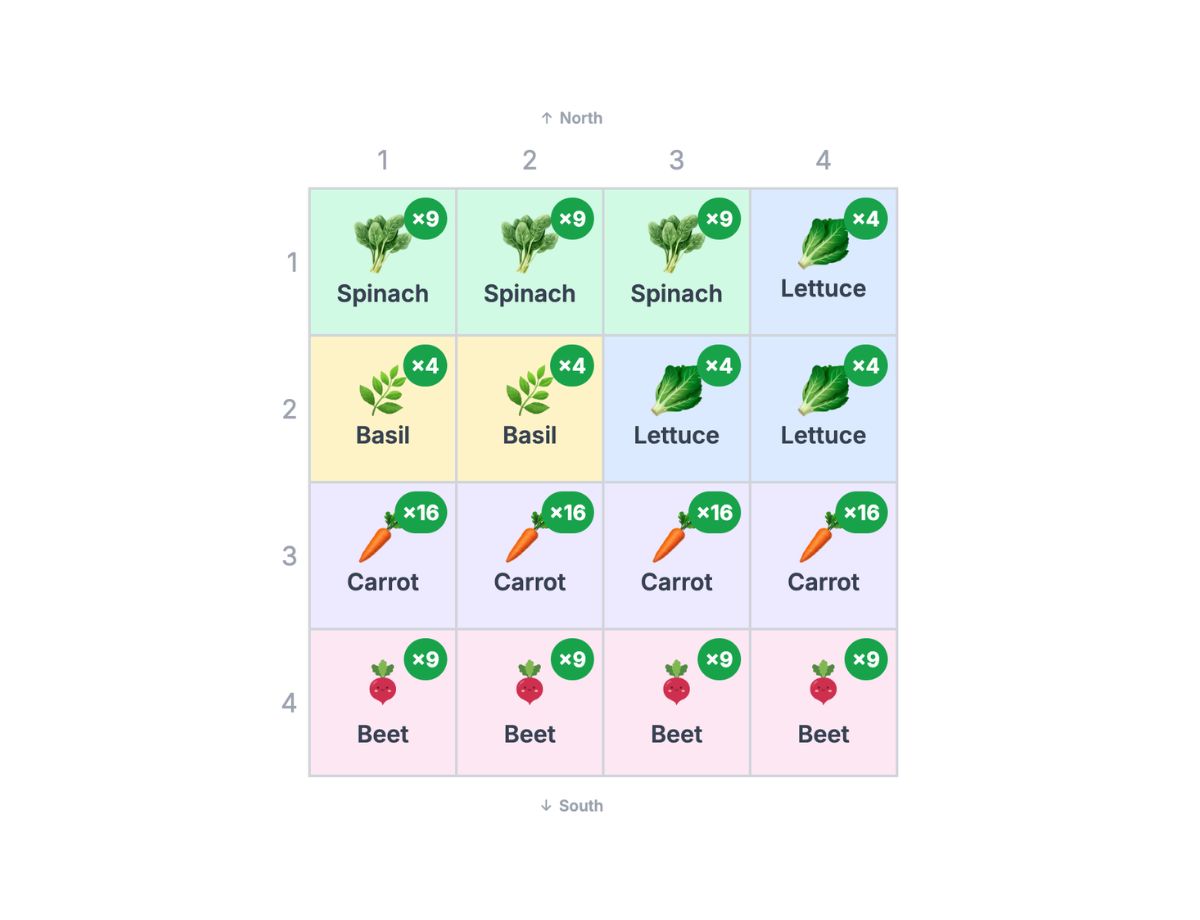
Bed: 4 × 4 ft · 147 plants · 5 varieties · ~$150 of groceries
This is the bed for someone who cooks every night. The layout stacks in horizontal bands: 27 spinach and 12 lettuce across the top two rows for daily salad, 8 basil tucked in beside them, then a full row of 64 carrots, and a full row of 36 beets along the south edge.
Three companion pairings do the heavy lifting here. Beets and lettuce grow at compatible rates so neither crowds the other; carrots and lettuce use the space efficiently, with lettuce shading the soil while the carrots root down; spinach and lettuce want identical conditions, so the whole top half of the bed gets watered the same way.
One warning on the basil: it's a warm-season herb, so it's really only earning its space through October in 9a. Once it goes, that square is free for more lettuce.
🌿 View the Everyday Fall Kitchen Bed →
Plan 4 — 2×8 Late September Garden Bed
Best for: A narrow bed along a fence, path, or driveway — and for pest-free carrots
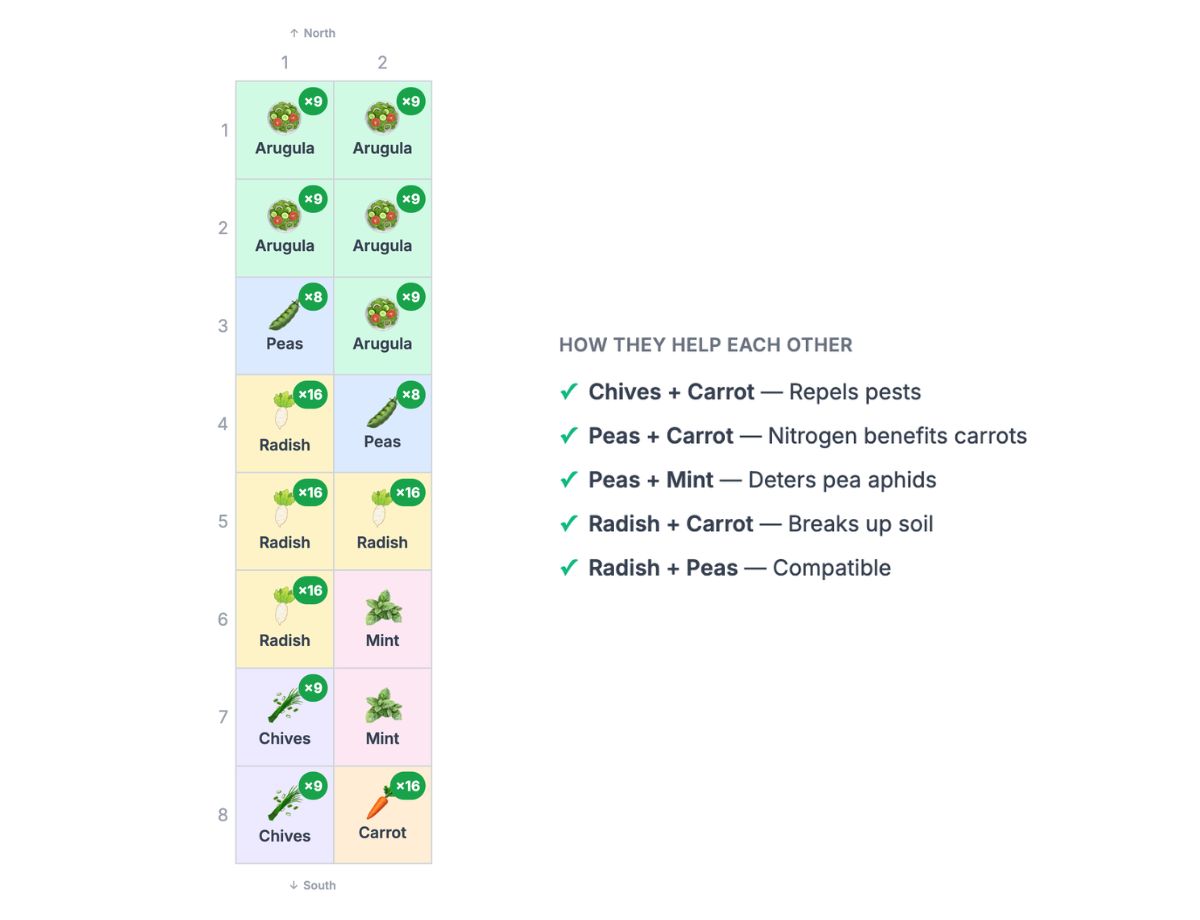
Bed: 2 × 8 ft · 161 plants · 6 varieties · ~$126 of groceries, plus ~$75/yr once the perennials establish
Long, narrow beds are the ones people struggle to plan, because you can only reach two feet in and nothing tall can go in the middle.
This layout solves it with a gradient: 45 arugula at the north end, then 16 peas on a trellis, then 64 radishes through the middle, and chives, mint, and 16 carrots at the south end.
The companion work in this bed is the most deliberate of any plan here. Chives sit directly beside the carrots to repel carrot fly. Peas fix nitrogen next to those same carrots.
Radishes break up the soil ahead of the carrot roots.
And the mint is planted against the peas to deter pea aphids — mint is a spreader, so keep it in a sunken pot or accept that it will own that corner.
The chives and mint are perennial, which is where the recurring value comes from: plant once, cut for years.
🌿 View the 2×8 Late September Garden Bed →
Plan 5 — Zone 9a Cool-Season Leafy Bed (4×8)
Best for: Anyone who eats a lot of greens, and for South Asian kitchen staples
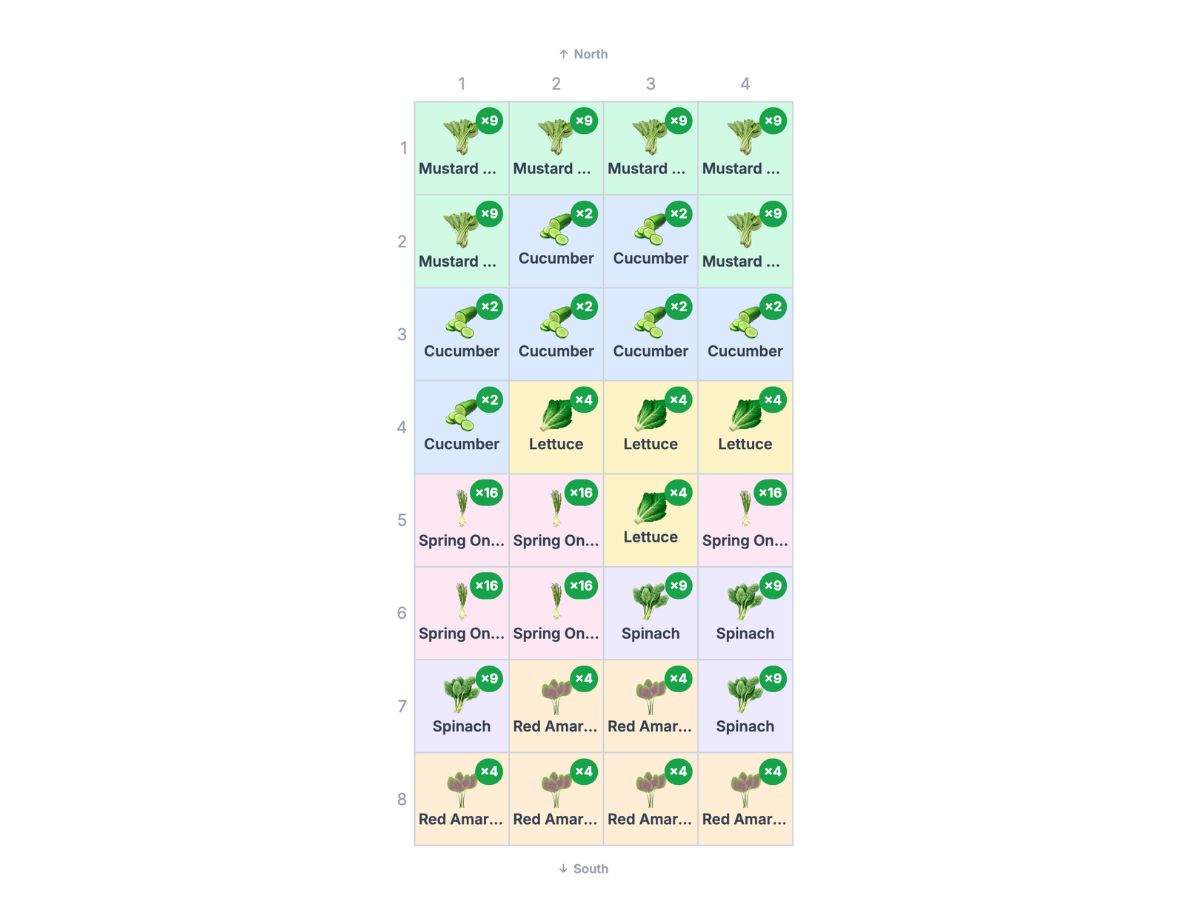
Bed: 4 × 8 ft · 224 plants · 6 varieties · ~$246 of groceries
This is a cutting bed. Almost everything in it is harvested by the leaf or the stem rather than pulled whole, which means it keeps producing for months rather than giving you one harvest and finishing.
The bed runs north to south in bands: 54 mustard greens across the top, 14 cucumbers on a trellis through the middle (sown in August while it's still warm enough), 16 lettuce, then 80 spring onions, 36 spinach, and 24 red amaranth filling the southern half.
That spring onion block is the sleeper — 80 plants at 16 per square, harvested a few at a time, will cover your scallion needs from November through spring.
Cucumber and lettuce share the middle because they use the space well, lettuce and spring onion make an excellent border pairing with matching water needs, and spinach sits beside both lettuce and mustard greens because all three want the same cool, damp conditions.
🌿 View the Zone 9a Cool-Season Leafy Bed →
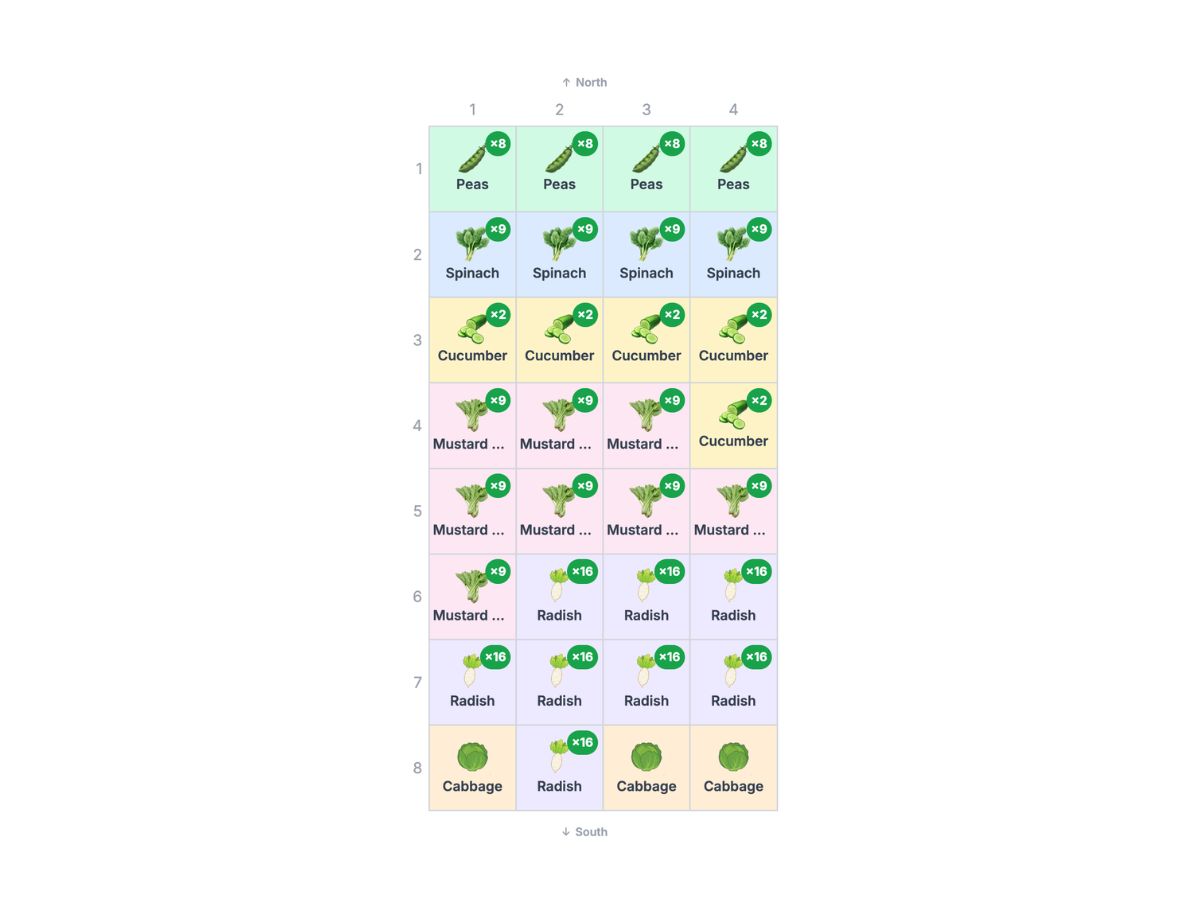
Plan 6 — Zone 9a Quick-Harvest Fall Bed (4×8)
Best for: Impatient gardeners who want food on the table in under a month
Bed: 4 × 8 ft · 281 plants · 6 varieties · ~$214 of groceries
281 plants is the densest bed in this guide, and it's built entirely around fast crops. 128 radishes and 72 mustard greens make up more than two-thirds of the planting — both are ready inside 30–45 days. Behind them: 32 peas on a north trellis, 36 spinach, 10 cucumbers, and 3 cabbages holding the south corner as the long-season crop.
The companion network here is the richest of any plan — nine beneficial pairings across six crops. Peas fix nitrogen for the cabbage, mustard greens, spinach, and cucumbers all at once. Radishes planted with the cucumbers repel cucumber beetles.
Spinach benefits from being next to the peas, sits happily beside radish and mustard, and shares a family with cabbage.
The trap in a bed this dense is treating it as one planting. It isn't — as each radish square empties, resow it. Done properly this bed gives you something to pick every week from late September until spring.
🌿 View the Zone 9a Quick-Harvest Fall Bed →
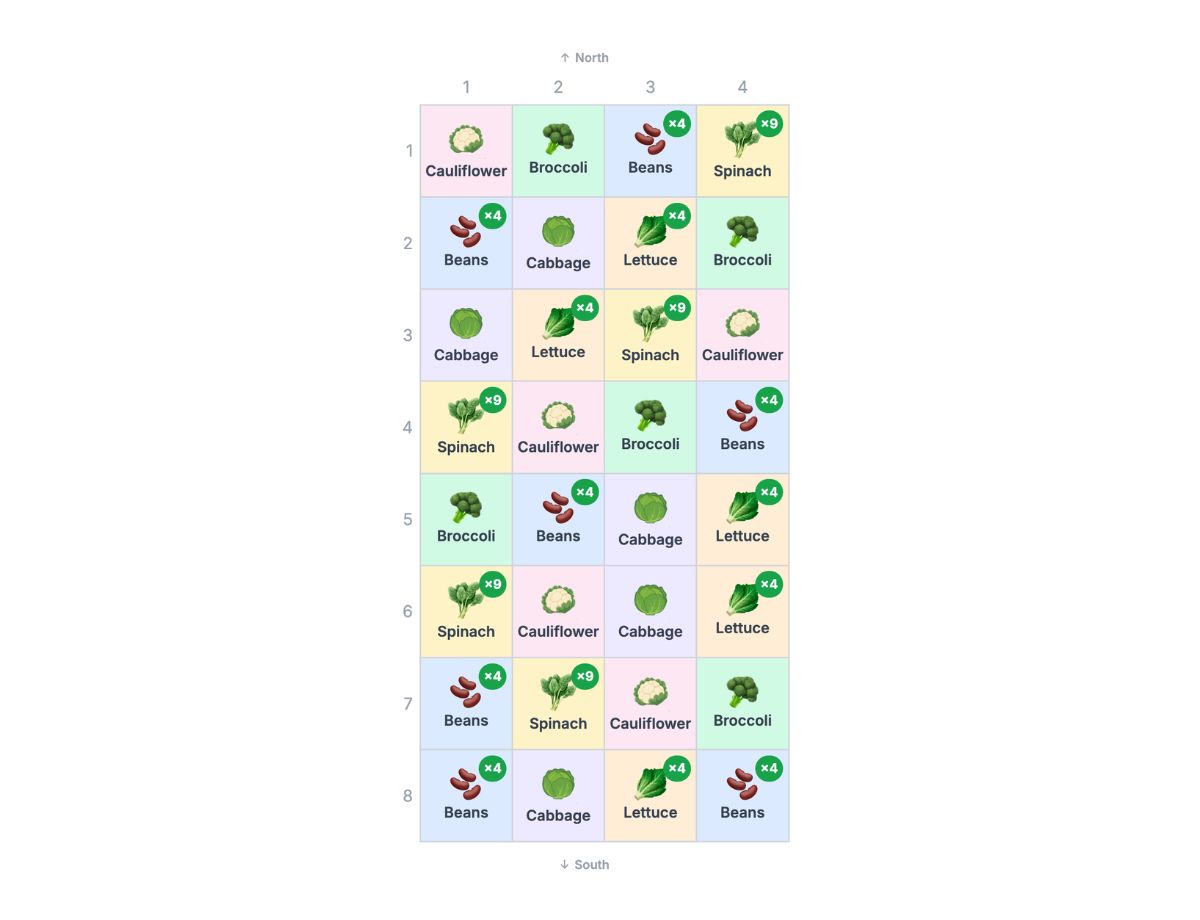
Plan 7 — Companion-Focused Fall Garden (4×8)
Best for: Growers who want soil that improves over the season, not soil that gets stripped
Bed: 4 × 8 ft · 108 plants · 6 varieties · ~$221 of groceries
Look at the grid on this one and you'll see it's not banded like the others — it's checkerboarded. Beans, spinach, lettuce, broccoli, cauliflower, and cabbage are deliberately scattered so that every heavy feeder has a nitrogen fixer next to it.
That's the entire design principle. 28 beans are distributed through the bed rather than blocked together, feeding nitrogen to the 5 cabbages, 5 broccoli, 5 cauliflower, and 45 spinach plants around them. Spinach also pairs with the cabbage as a same-family neighbour and with the 20 lettuce for shared conditions, while cabbage and lettuce co-exist without competing.
At 108 plants this is the lightest-planted 4×8 here, and that's intentional — brassicas need room, and five well-grown cauliflower heads beat fifteen stunted ones.
Start the brassicas in trays in August, set them out from mid-September, and direct sow the beans and greens around them.
🌿 View the Companion-Focused Fall Garden →
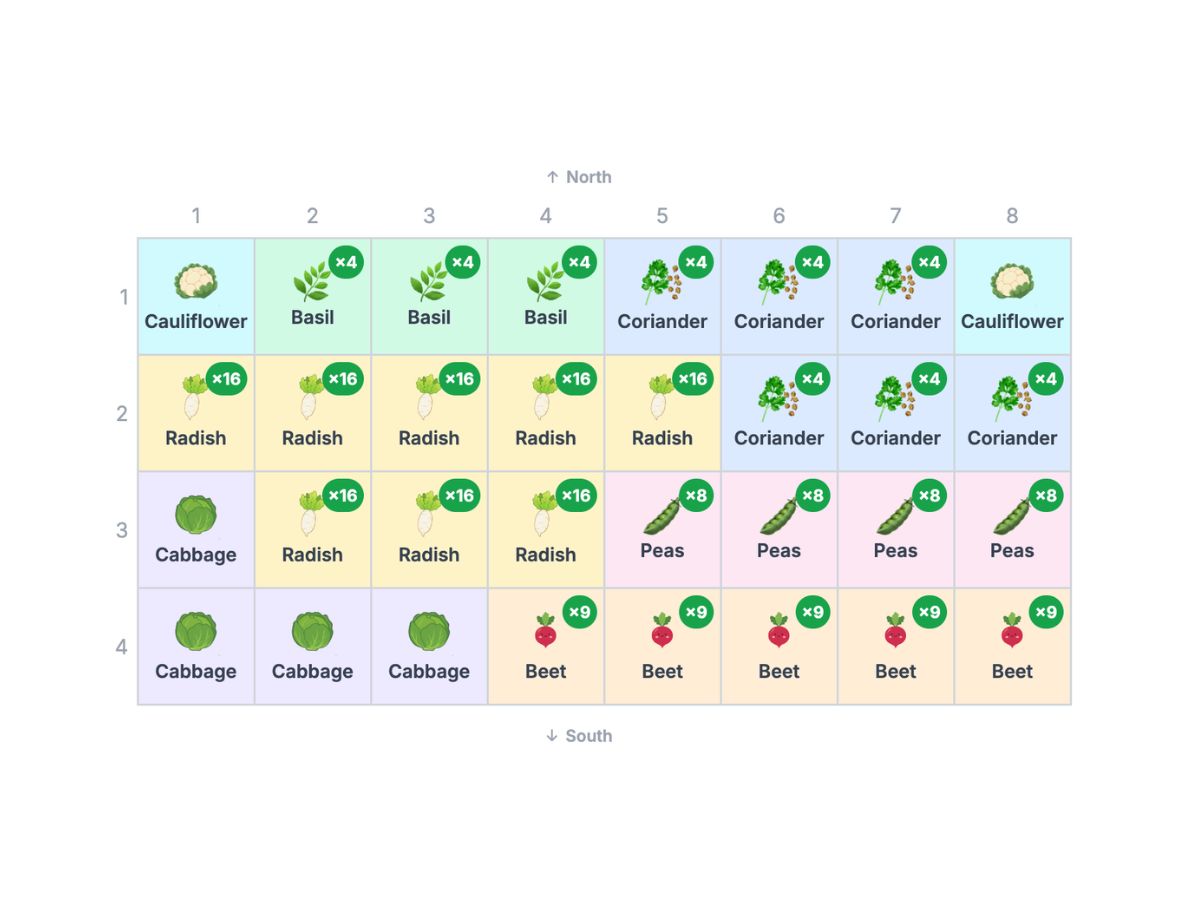
Plan 8 — 8×4 Fall Brassica & Roots Bed
Best for: The main fall bed — the one that actually replaces grocery trips
Bed: 8 × 4 ft · 247 plants · 7 varieties · ~$252 of groceries
This is the flagship plan, and the most valuable bed in the guide.
It's laid out in four clean rows so it's easy to manage: cauliflower anchoring the corners with 12 basil and 24 coriander between them, a full row of radishes, then radishes and 32 peas, and a bottom row of 4 cabbages beside 45 beets.
The 128 radishes are there as a succession crop, not a single harvest — that row is designed to be resown three or four times over the season.
The coriander block is timed for October sowing, when it will finally stop bolting and give you cut-and-come-again leaves all winter. Peas fix nitrogen for the cabbage, beets sit comfortably beside the brassicas, and radishes and peas share space without competing.
If you only build one fall bed this year, build this one.
Start the cauliflower and cabbage indoors in early August, set them out mid-September, and direct sow everything else through late September and October.
🌿 View the 8×4 Fall Brassica & Roots Bed →
Five Things That Make or Break a Zone 9 Fall Garden
1. Germinate in the shade, not in the bed
This is the single biggest reason Zone 9 fall gardens fail. September soil in full sun regularly sits above 90°F, and lettuce, spinach, and most brassicas will not germinate in it.
Start them in trays somewhere shaded — the north side of the house, under a bench, inside — and transplant once they're up. For crops that must be direct sown, like carrots and radishes, sow them and then lay a board or shade cloth over the row until you see green.
2. Count backwards, then add two weeks
The days-to-harvest number on a seed packet assumes long summer days. From mid-October onward, growth in Zone 9 slows noticeably as daylight shortens.
A 60-day crop sown in November behaves like a 75-day crop. Build that buffer in or you'll be waiting on a harvest that never quite arrives.
3. Succession sow the fast crops
Several of these plans lean heavily on radishes, arugula, mustard, and lettuce — crops that go from sowing to finished in a month.
Sowing a 128-radish block all at once gives you 128 radishes in one week and an empty bed afterwards. Sow a quarter of the block every two weeks instead and the same square footage feeds you for four months.
4. Keep frost cloth on hand, not on order
Zone 9 gets a handful of freezing nights a winter, and they're usually forecast three days out. A roll of frost cloth in the shed is the difference between covering the bed on Tuesday evening and losing your peppers and basil overnight.
Established greens, roots, brassicas, and peas will take a light frost uncovered — it's the leftover warm-season crops that need protecting.
5. Water less than you think
The habits you build in a Zone 9 summer will drown a fall bed. Evaporation drops sharply once nights cool, and overwatering cool-season crops in heavy fall soil invites root rot and downy mildew. Check two inches down with a finger before you water; if it's damp, skip it.
Frequently Asked Questions
When should I start my fall garden in Zone 9?
Start seeds for brassicas — broccoli, cauliflower, cabbage — indoors or in shade in early August. Begin direct sowing carrots, beets, chard, and mustard greens in September, and sow lettuce, spinach, peas, arugula, and coriander in October once the soil has cooled below about 75°F.
What is the first frost date in Zone 9?
Zone 9a averages a first frost around December 10 and Zone 9b around December 20, with typical winter lows of 20–25°F and 25–30°F respectively. Both dates vary by a week or two year to year, so confirm against your local forecast before planting anything frost-sensitive.
Can I grow tomatoes in a Zone 9 fall garden?
Only if you set out transplants by early August. Tomatoes need roughly 60–80 days from transplant, and fruit set stops once nights drop below about 55°F, so a September planting won't ripen. Most Zone 9 gardeners get better results treating fall as a cool-season window and saving tomatoes for a January-started spring crop.
Do I need a raised bed for a fall garden in Zone 9?
No — every plan here works equally well as an in-ground block, and in Zone 9 in-ground beds actually hold moisture better through a dry autumn. Raised beds help most where drainage is poor or where fall rains are heavy, as they are along the Gulf Coast.
What can I plant in Zone 9 in November?
November is still a productive sowing month: radishes, spinach, lettuce, arugula, peas, spring onions, beets, and coriander can all go in, along with garlic and short-day onion sets for a May–June harvest. Anything sown now grows slowly but reliably through winter.
Will my fall garden survive the winter in Zone 9?
Most of it will. Kale, chard, spinach, carrots, beets, spring onions, radishes, and peas all handle Zone 9 winter lows without protection once established. Only the warm-season holdovers — basil, chillies, okra, gourds, cucumbers — need covering or will be lost to the first hard freeze.
Plant Your Zone 9 Fall Garden This Week
The window is open now. Every plan above is live in EdenVatika with the square-foot spacing already calculated, the companion pairings already checked, and the plant counts already worked out — so the only decision left is which bed size fits your space.
Copy one, adjust it for what your family actually eats, and get the brassicas started in trays this weekend.
🍂 Your Zone 9 Fall Garden Plan Is One Click Away.
All eight layouts in this post are free to copy, customise, and print. You see the full grid, the plant counts, and the companion pairings before anything goes in the ground. Your work is always saved. We never delete your plans.
Copy a Free Garden Plan →Free account. No credit card. Plans stay yours forever.