How to Grow Tomatoes: The Complete Guide From Seed 2 Harvest
One tomato plant returns about $20 of fruit on a $4 seedling — if you get the timing, spacing and watering right. The complete tomato playbook, straight from EdenVatika's own plant database: when to plant, how deep, which of 10 varieties to pick, and who to plant beside it.
Somewhere right now, a supermarket tomato is being sliced onto a sandwich, and somebody is chewing it with the quiet resignation of a person who has forgotten what tomatoes are supposed to taste like.
It's not their fault. Commercial tomatoes are picked green, gassed to turn red in a truck, and bred for surviving a 2,000-mile journey — not for flavour.
The tomato that tastes like sunshine, the one that drips down your wrist over the kitchen sink in July? That one doesn't ship. You have to grow it.
Here's the part that surprises people: it's genuinely worth it, even on cold economics.
In our plant database, a single healthy tomato plant yields around 4.5 kg (10 pounds) of fruit over the season. At this summer's shelf price of about $4.41 per kg, that's roughly $20 of tomatoes from one $4 seedling — a 5× return, before you even count the flavour dividend.
This guide walks through the whole journey — when to plant, how to plant, what to do every week in between, which varieties to pick, and when to finally take the harvest — using the same data that powers the EdenVatika app.
Let's grow the sandwich tomato you actually deserve.
Tomato Basics: The Full Spec Sheet
Before the how-to, here is the tomato's complete profile — every line pulled straight from the plant library that powers the EdenVatika app, the same data it uses to place, schedule and water your plants.
| Basics | |
| Botanical name | Solanum lycopersicum |
| Plant family | Solanaceae — the nightshades, alongside pepper, potato and eggplant |
| Ease of growing | Easy |
| Grown as | Annual |
| Hardiness | Tender — a single frost ends the season |
| Hardiness zones | 3–13 — a spring/summer annual in temperate zones; in tropical zones 11–13 it yields best as a winter crop |
| Growing season | Temperate: spring & summer, ideal March–August. Tropics (zones 11–13): plant October–November, harvest February–March |
| Rotation group | Nightshades (Solanaceae) — wait 3 years before replanting the family in the same bed |
| Nutrition (per 100 g) | 18 calories, vitamin C, potassium and a hefty 2,573 µg dose of lycopene |
| Sowing & Timing | |
| Start indoors? | Yes — 6–8 weeks before last frost (the recommended route) |
| Start outdoors? | Yes — direct sow after last frost in long-season climates |
| Planting months | Temperate: March–May, after the last frost. Tropics: October–November, after the rains ease |
| Planting depth | ¼ inch |
| Germination | 5–10 days at a soil temperature of 70–80°F |
| Transplant | 2–4 weeks after sowing, once frost danger has passed |
| Growing temperature | 70–85°F is the sweet spot; sustained heat above 84°F (29°C) causes blossom drop |
| First flowers | 30–45 days |
| First harvest | 60–80 days from transplant (variety-dependent — 52 for Early Girl, 80 for Brandywine) |
| Harvest window | 6–8 weeks of continuous picking |
| Size, Space & Support | |
| Spacing | 24–36 inches apart |
| Square-foot gardens | Yes — one plant per 2×2 ft block (a tomato claims four squares) |
| Mature height | 24–36 in (determinate/bush); 4–6 ft (indeterminate/vining) |
| Mature spread | 18–36 inches |
| Support needed? | Yes — stake or cage indeterminate varieties; determinate types are self-supporting |
| Vertical growing? | Yes for indeterminate varieties — train up a stake or spiral rod |
| Position & Care | |
| Light | Full sun, minimum 6–8 hours daily |
| Soil | Well-drained, rich loam |
| Soil pH | 6.0–6.8 |
| Water | Moderate — 1–2 inches per week, deep and consistent |
| Feeder | Heavy — fertilize every 2–3 weeks through the season |
| Good companions | Basil, borage, marigold, nasturtium, garlic, onion, parsley |
| Bad companions | Potato, fennel, corn, cabbage, Brussels sprouts, kohlrabi |
When to Plant Tomatoes
Tomatoes are the definition of a tender crop — a single light frost ends the season, full stop. So the whole schedule hangs off one date: your area's last spring frost.
- 6–8 weeks before last frost: start seeds indoors, ¼ inch deep. Seeds germinate in 5–10 days at a soil temperature of 70–80°F — a sunny windowsill is usually too cold in early spring, a heat mat is not cheating.
- After the last frost: transplant outdoors once nights stay reliably above 50°F. Rushing this by a week gains you nothing; a chilled tomato just sulks.
- Prime growing weather: tomatoes cruise at 70–85°F. In most zones that means transplanting between March and May and enjoying the plant straight through summer.
One number worth writing down: 29°C ( 84°F). That's the heat-stress threshold in our database, in prolonged heat above it, tomatoes start dropping blossoms instead of setting fruit.
If you garden somewhere with brutal summers, plant early enough that flowering beats the worst heat, and expect a lull in the hottest weeks. Warm-climate gardeners get a consolation prize: a second planting in late summer for a fall crop.
Gardening in the tropics? Flip the calendar. In zones 11–13 there is no frost to dodge — the enemy is summer itself, when heat and monsoon humidity push tomatoes past that 29°C threshold for months and invite every fungal disease going.
There, tomatoes yield best as a winter crop: transplant in October–November as the rains taper off, let the plants flower and set fruit through the mild dry season, and harvest from February into March. Same plant, same rules about heat — just applied to the opposite half of the year.
How to Plant Tomatoes (Deeper Than Feels Right)
Tomatoes have one weird superpower that changes how you plant them: the buried stem grows roots. Every fuzzy hair on a tomato stem is a root waiting for permission.
- Dig a hole deep enough to bury two-thirds of the seedling — yes, including healthy leaves lower down the stem (pinch them off first). A leggy, awkward seedling planted deep becomes a stocky plant with a monster root system.
- Space plants 24–36 inches apart. Crowded tomatoes trade airflow for blight — this is the spacing mistake half of new gardeners make.
- Install the stake or cage now, at planting time. Driving a stake into the root zone of a six-week-old plant tears up exactly the roots you worked so hard to grow.
- Water deeply at the base and lay down mulch. Mulch keeps soil moisture even and stops rain from splashing soil-borne disease spores onto the lower leaves.
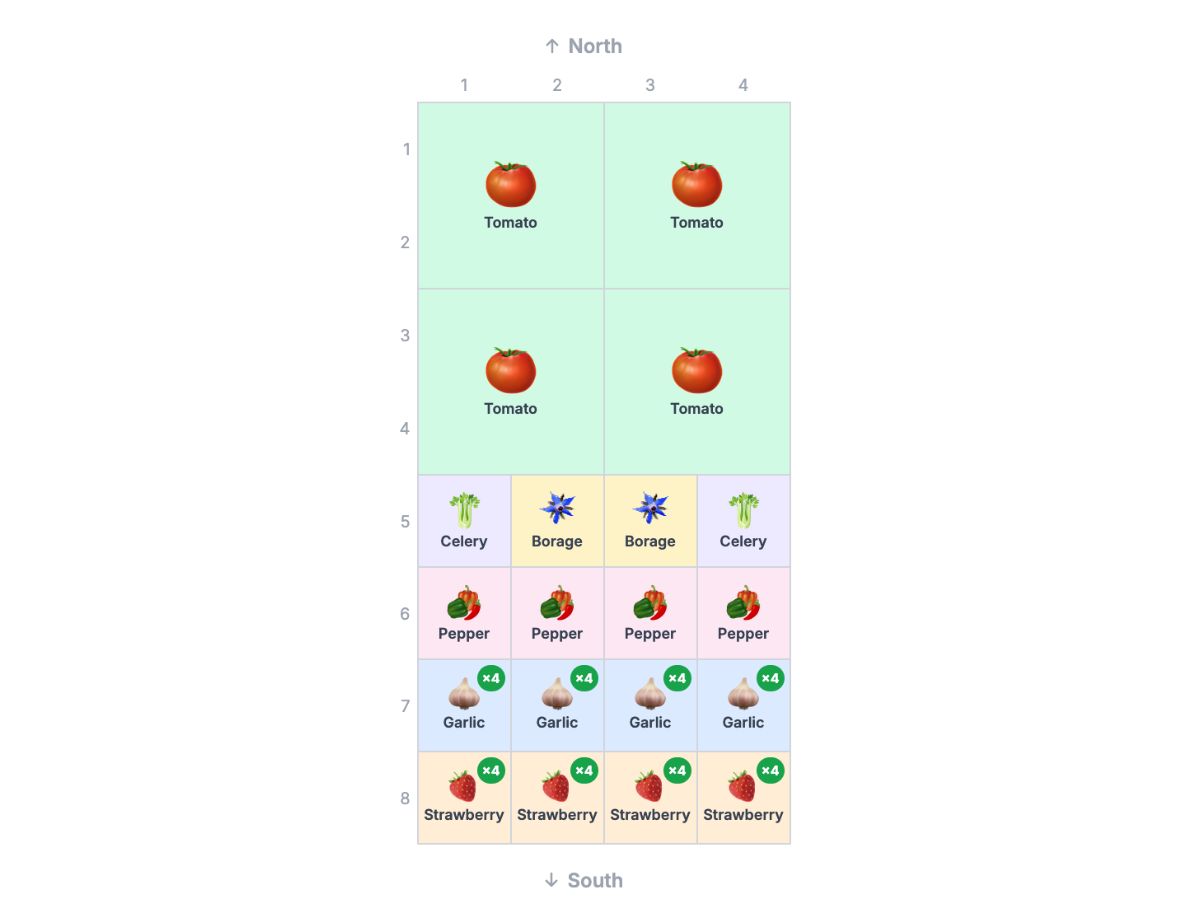
A 4×8 tomato companion bed from the EdenVatika Garden Designer — tomatoes on proper centers with basil and marigolds tucked between.
Not sure when your last frost is?
Tell EdenVatika where you garden and it builds your tomato schedule automatically — seed-start date, transplant date and expected harvest, all worked back from your local frost date.
Get My Planting Dates Free →The Tomato Timeline: What Happens When
Knowing what "normal" looks like saves a lot of mid-season panic. Here's the full life of a tomato plant, from our plant library's growth-stage data:
| Stage | Days from sowing | What you'll see |
|---|---|---|
| Germination | 5–10 | Seeds sprout |
| Seedling | 10–30 | True leaves develop |
| Vegetative growth | 30–50 | Rapid growth — this is when support pays off |
| Flowering | 50–60 | First yellow flowers appear |
| Fruiting | 60–80 | Green fruit swells and begins to colour |
| Harvest | 80–120 | Continuous picking for 6–8 weeks |
Caring for Tomatoes Through the Season
Tomato care is less about doing clever things and more about doing boring things consistently. Four habits carry the season:
- Water deeply, at the base, 1–2 inches a week. Erratic watering — bone dry, then drenched — is the number one cause of cracked fruit and blossom end rot. Overhead watering, meanwhile, is a personal invitation to leaf disease. Water the soil, not the plant.
- Feed every 2–3 weeks once fruit sets. Tomatoes are hungry, but go easy on high-nitrogen feeds — they buy you a gorgeous leafy bush with no tomatoes on it.
- Prune the suckers — the little shoots that appear in the V between the main stem and a branch. On tall vining (indeterminate) varieties, pinching suckers channels energy into fewer, larger fruit. Bush (determinate) types can be left alone.
- Strip the lowest leaves once the plant is established. Better airflow at the base is the cheapest blight prevention there is.
10 Tomato Varieties Worth Growing
"Tomato" is not one decision — a paste tomato and a cherry tomato are practically different vegetables. These ten varieties from the EdenVatika library cover every use case, with days from transplant to first ripe fruit:
| Variety | Days | Why grow it |
|---|---|---|
| Early Girl | 52 | Popular hybrid; sets fruit early, medium round, all-purpose |
| Sun Gold | 57 | Orange cherry; exceptionally sweet, crack-resistant, prolific |
| Sweet 100 | 65 | Cherry type; clusters of 100+ very sweet red fruits |
| Celebrity | 70 | Disease-resistant hybrid; medium globe, crack-resistant |
| Better Boy | 72 | High-yielding hybrid; large round fruit, dependable |
| Roma | 75 | Paste/plum type; meaty, low moisture, ideal for sauce & canning |
| Black Krim | 75 | Russian heirloom; dark red-black flesh, earthy salty flavour |
| San Marzano | 78 | Italian paste heirloom; elongated, low-acid, the DOP sauce tomato |
| Cherokee Purple | 80 | Heirloom beefsteak; deep dusky-rose skin, complex smoky flavour |
| Brandywine | 80 | Classic pink heirloom beefsteak; rich flavour, large fruit |
If you only have room for two plants, the classic pairing is one Sun Gold — the cherry tomato that has converted more tomato skeptics than any other, sweet enough that most of the harvest never reaches the kitchen — and one slicer or paste type for actual cooking. A short-season gardener should lean toward Early Girl and Sun Gold; a sauce-maker toward Roma and San Marzano.
Friends and Enemies: Tomato Companion Planting
Tomatoes are sociable plants with strong opinions. From our companion-planting database, the neighbours that earn their spot:
- Basil — improves flavour and repels pests (and lives next to tomatoes in the kitchen anyway)
- Borage — deters tomato hornworms
- Marigold — repels nematodes and aphids
- Nasturtium — lures aphids away from the tomatoes as a trap crop
- Garlic — repels spider mites and aphids
- Onion and parsley — pest deterrence and beneficial insects, respectively
And the neighbours to keep away:
- Potato — same family, shares blight and pest problems (the worst pairing on the list)
- Fennel — actively inhibits tomato growth
- Corn — attracts the same pests (corn earworm and tomato fruitworm are the same moth)
- Cabbage, Brussels sprouts, kohlrabi — heavy feeders that compete for nutrients and can stunt growth
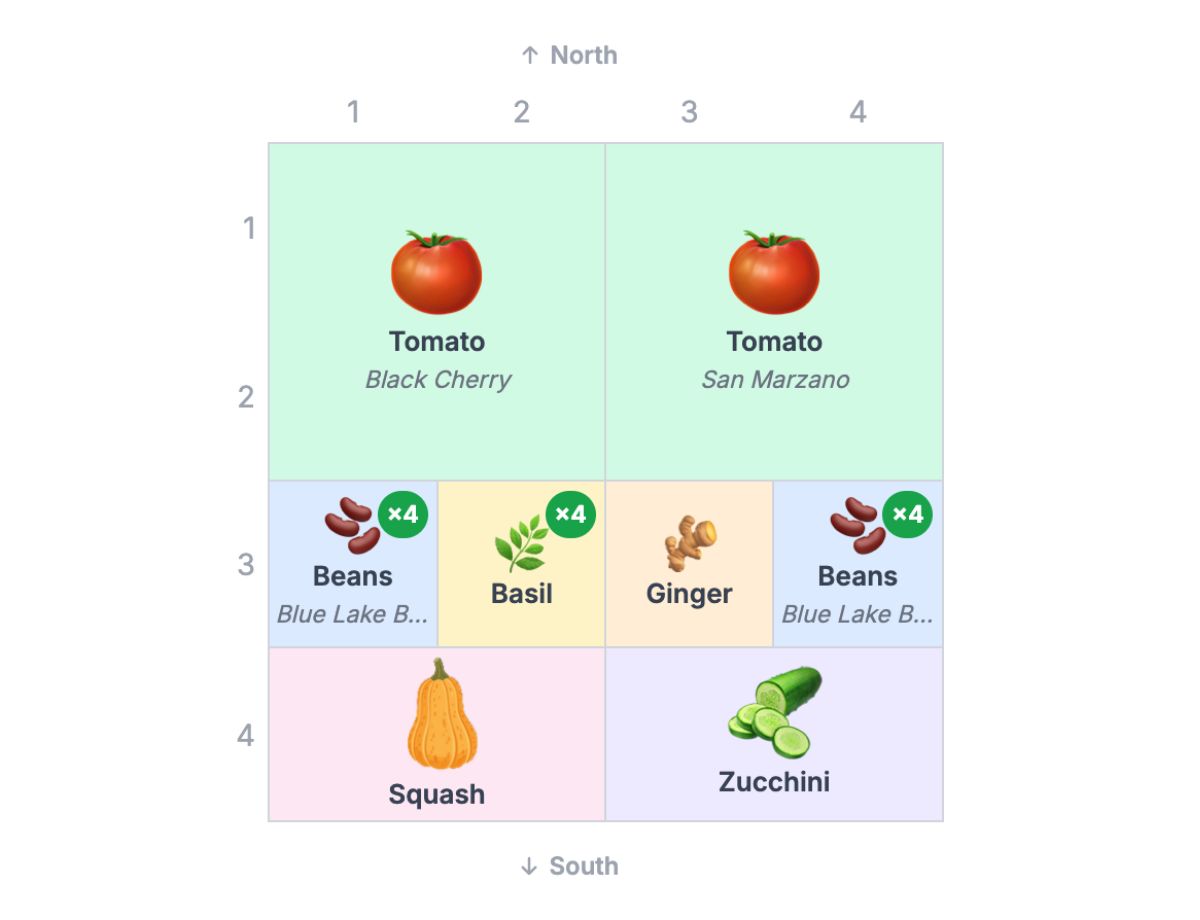
A 4×4 heirloom tomato bed with its full entourage — basil, marigold and nasturtium on pest duty.
The Two Troublemakers to Watch For
Tomato hornworm. A green caterpillar the size of your finger that can defoliate a branch overnight, camouflaged so well you'll swear the plant ate itself.
Check under leaves near fresh damage and black droppings; handpick them (chickens consider this a delicacy) or use Bt spray for heavy infestations. Regular inspection is the whole prevention plan — and borage nearby helps deter them in the first place.
Early blight. Brown target-shaped spots on the lower leaves that creep upward through the plant. Remove affected leaves as soon as you spot them and treat with copper fungicide if it spreads. Prevention is everything you've already done if you followed this guide: mulch to stop soil splash, base watering, good spacing, stripped lower leaves — and never planting tomatoes where tomatoes (or potatoes) grew last year.
Harvesting: The Payoff
First ripe fruit lands 60–80 days after transplant, and then the faucet opens: expect continuous picking for 6–8 weeks, longer in warm climates.
- Pick when fully coloured and slightly soft to a gentle squeeze. A tomato picked at "breaker" stage (just blushing) will ripen fine on the counter — but never in the fridge, which kills the flavour compounds you spent 80 days building.
- Pick often. A vine that's carrying ripe fruit slows down on making new fruit. Clearing the ripe ones tells the plant to keep going.
- End of season: when the first fall frost threatens, pick everything — mature green tomatoes ripen indoors in a paper bag, and the truly green ones have a date with a frying pan.
- Winter job: save seeds from your best open-pollinated fruit (heirlooms like Cherokee Purple and Brandywine come true from seed; hybrids like Sun Gold don't).
Remember the math from the top: at around 10 pounds per plant, four plants is a summer of salads, sauce and sandwiches — call it $80 of tomatoes — from a corner of one raised bed.
Frequently Asked Questions
Why are my tomato flowers falling off without setting fruit?
Usually heat — sustained temperatures above about 84°F (29°C) make tomatoes drop blossoms. Water consistently, mulch well, and wait; fruit set resumes when the heat breaks.
Determinate or indeterminate — which should I grow?
Determinate (bush) varieties like Roma and Celebrity stay 24–36 inches, need little pruning and deliver the crop in a concentrated window — great for containers and canning.
Indeterminate (vining) types like Sun Gold and Brandywine reach 4–6 feet, need a sturdy stake or cage, and keep producing until frost.
How many tomato plants fit in a square-foot garden?
One plant per 2×2 ft block — a tomato needs four squares to itself. It's the most common spacing mistake in small beds, and the EdenVatika Garden Designer enforces the right footprint automatically when you drop a tomato into a bed.
Can I grow tomatoes in the same bed as last year?
Better not to. Blight spores and nematodes persist in soil, so give any bed that held nightshades (tomato, pepper, potato, eggplant) a three-year break from the family.
If you track your beds in EdenVatika, it remembers last season for you and flags the repeat before you plant it.
Grow It Once, Then Never Wing It Again
Everything in this guide — the frost-based schedule, the 2×2 ft spacing, the companion pairings, the rotation warning — is knowledge you can keep in your head. Or you can let the app that already knows all of it do the remembering.
Plan your best tomato season yet
EdenVatika turns this whole guide into a personal plan: seed-start and transplant dates from your local frost date, correct spacing in the Garden Designer, companion and rotation warnings as you place plants, and a calendar that reminds you to water, feed and harvest on time. Your $20-a-plant harvest starts with a free account.
Start Growing Free →