When to Sow Tomato Seeds: Dates for Every Zone + Step-by-Step Starting Guide
When to sow tomato seeds in every USDA zone, and how to grow tomato plants from seed: the classic 6–8 week indoor start, the faster 4-week method EdenVatika uses, seedling sizes week by week, and when to transplant so frost and summer heat don't catch you out.
Every spring around the first sunny weekend in February, a gardener walks past a seed rack, picks up a packet of tomatoes, and thinks: it's practically spring, I'll start these today.
By April they have a windowsill of pale, foot-tall stalks leaning toward the glass like they're trying to escape. Too tall to stand, too early to go out, and still three weeks from the last frost.
Growing tomatoes from seed is genuinely easy. The seeds are big, they sprout fast, and a single packet costs less than one nursery plant while giving you twenty.
What trips people up isn't the how. It's the when — and once you have the date right, almost everything else falls into place.
The Honest Bit: Most Tomato Seeds Are Sown Too Early
The instinct is that an earlier start means earlier tomatoes. It doesn't.
A tomato is a tender crop: one light frost kills it outright, so it cannot go outside until the frost is behind you, no matter how big it is.
That means the transplant date is fixed by your weather, not by when you sowed.
Start too early and the seedling spends its extra weeks indoors outgrowing its pot, stretching for light and getting root-bound, leaving it weaker at transplant than a younger plant.
The window that works is 6–8 weeks before your average last spring frost. That's long enough to raise a stocky, 6–10 inch plant with several sets of true leaves, and short enough that it never runs out of room or light.
The one-line rule
Find your last frost date. Count back 8 weeks for the earliest sowing date and 6 weeks for the latest. Transplant 2–3 weeks after the last frost, once nights stay above 50–55°F. That's the whole calendar. Short on space or grow lights? There's a faster 4-week method too, and it's the one EdenVatika's planting calendar uses.
Tomato From Seed: The Spec Sheet
These numbers come straight from the tomato record in the EdenVatika plant database, the same figures the app uses to build your planting schedule.
| Basics | |
| Botanical name | Solanum lycopersicum |
| Plant family | Solanaceae — the nightshade family, alongside pepper, eggplant and potato |
| Ease of growing | Easy — one of the most forgiving crops to start from seed |
| Frost tolerance | Tender — killed by a single frost |
| Grown in zones | 3–13, as a summer annual (a winter crop in the tropics) |
| Sowing & Germination | |
| When to sow | Indoors, 6–8 weeks before your last spring frost (or about 2 weeks before it with the 4-week method) |
| Sowing depth | ¼ inch |
| Germination temperature | 70–80°F ideal (about 75°F / 24°C is the sweet spot); slow below 60°F, stalls near 50°F (10°C), struggles above 90°F (32°C) |
| Days to sprout | 5–10 days at the right temperature |
| Transplant & Payoff | |
| Transplant outdoors | 2–3 weeks after last frost, once nights stay above 50–55°F |
| Growing temperature | 65–85°F; heat stress and blossom drop above about 84°F (29°C) |
| Spacing | 24–36 inches apart; one plant per 2×2 ft block in square-foot beds |
| Sun | Full sun, 6–8 hours a day |
| First flowers | 30–45 days after transplant |
| First harvest | 60–80 days after transplant, then picking for 6–8 weeks |
When to Sow Tomato Seeds: Dates for Every Zone
Here's the rule applied to the average last frost date for each USDA zone. The 6–8 week method is the classic indoor start covered step by step below.
The 4-week method is the shorter route EdenVatika's planting calendar uses, explained further down. Both plant out on the same date.
Treat these as a starting point. Frost dates vary by a week or two within a zone, and a city on the coast can be a fortnight ahead of a town 50 miles inland.
For your exact date, look up your town in the Frost Date Lookup.
| Zone | Avg. last frost | Sow: 6–8 week method | Sow: 4-week method | Transplant outdoors | Example areas |
|---|---|---|---|---|---|
| 3 | Jun 1 | Apr 6 – Apr 20 | May 18 – May 25 | Jun 15 – Jun 22 | Northern MN, interior AK |
| 4 | May 15 | Mar 20 – Apr 3 | May 1 – May 8 | May 29 – Jun 5 | Minneapolis MN, Bismarck ND |
| 5 | May 1 | Mar 6 – Mar 20 | Apr 17 – Apr 24 | May 15 – May 22 | Chicago IL, Denver CO |
| 6 | Apr 15 | Feb 18 – Mar 4 | Apr 1 – Apr 8 | Apr 29 – May 6 | Washington DC, Kansas City MO |
| 7 | Apr 1 | Feb 4 – Feb 18 | Mar 18 – Mar 25 | Apr 15 – Apr 22 | Atlanta GA, Nashville TN |
| 8 | Mar 1 | Jan 4 – Jan 18 | Feb 15 – Feb 22 | Mar 15 – Mar 22 | Houston TX, Charlotte NC |
| 9 | Feb 1 | Dec 7 – Dec 21 fall crop: early–mid Jul |
Jan 18 – Jan 25 fall crop: early Aug |
Feb 15 – Feb 22 fall crop: late Aug |
Phoenix AZ, Sacramento CA |
| 10 | Frost rare | Aug – Sep spring crop: Dec – Jan |
Sep – Oct spring crop: Jan – Feb |
Oct – Nov spring crop: Feb – Mar |
Miami FL, San Diego CA |
| 11–13 | No frost | Aug – Sep | Sep – Oct | Oct – Nov, as the rains ease | Hawaii, the tropics |
Why the warm zones look upside down
In zones 3–8 the enemy is frost, so you sow late enough to dodge it. In zones 9 and warmer the enemy is heat. Our database puts a tomato's heat-stress threshold at 84°F (29°C).
In a long run of days above that, plants keep growing but drop their blossoms instead of setting fruit. EdenVatika's planting calendar checks for this: plan a zone 9 tomato to go out in May and it warns you that the plant will grow through heat it can't set fruit in.
So warm-climate gardeners plan backwards from summer, not from frost. They sow early enough for plants to flower before the heat arrives, then sow again in midsummer for a fall crop that ripens as temperatures drop.
In the true tropics the main season flips completely: tomatoes go in during October–November and crop through the mild, dry months.
Step 1: Choosing Your Tomato Seeds
Two choices on the packet matter more than the variety name.
- Determinate or indeterminate. Determinate (bush) types stop at 24–36 inches, ripen most of their fruit in a few weeks and mostly hold themselves up. Indeterminate (vining) types keep growing to 4–6 feet or more and crop until frost, but need a stake or cage from day one. Small bed or container: determinate. Long season and room to go up: indeterminate.
- Heirloom or F1 hybrid. Heirlooms are open-pollinated, so seeds you save from the fruit grow the same tomato next year. F1 hybrids usually bring vigour and disease resistance, but their saved seeds won't grow true.
- Days to maturity suits your season. Packet days are counted from transplant, not from sowing. In zones 3–4, pick varieties around 55–70 days. Long-season beefsteaks of 85+ days are a gamble there.
- Sow extra. Germination is high, but plan on sowing about 50% more seeds than the plants you want, so you can keep the strongest ones.
Can you grow tomatoes from the seeds in a store-bought tomato?
Yes, and unlike apple seeds they sprout without any chilling. Tomato flowers mostly pollinate themselves, so an heirloom from a farmers market usually comes back close to its parent. Most supermarket tomatoes are F1 hybrids, though, and their seeds give a mixed bag. Scoop out the seeds, let them ferment in a little water for 2–3 days to strip off the gel coat, rinse, and dry them on a plate.
Step 2: How to Sow Tomato Seeds
Sowing is the five-minute part.
- Use seed-starting mix, not garden soil. It's fine, sterile and drains well, which matters later for preventing damping-off. Moisten it before filling the cells, so it's as damp as a wrung-out sponge.
- Sow 2 seeds per cell, ¼ inch deep. Small cells or plug trays are ideal. You'll keep the stronger seedling and snip the other at soil level. Pulling it out would disturb the roots of the one you keep.
- Cover lightly and firm gently. Tomato seeds don't need light to germinate, but they do need good contact with moist mix.
- Keep them at 70–80°F. This is the step that decides whether you see sprouts in 5 days or 3 weeks. A windowsill in early spring is often closer to 60°F than 75°F. A seedling heat mat under the tray is the single best $20 a seed-starter spends.
- Cover with a dome or plastic wrap to hold humidity, and label every tray with the variety and date.
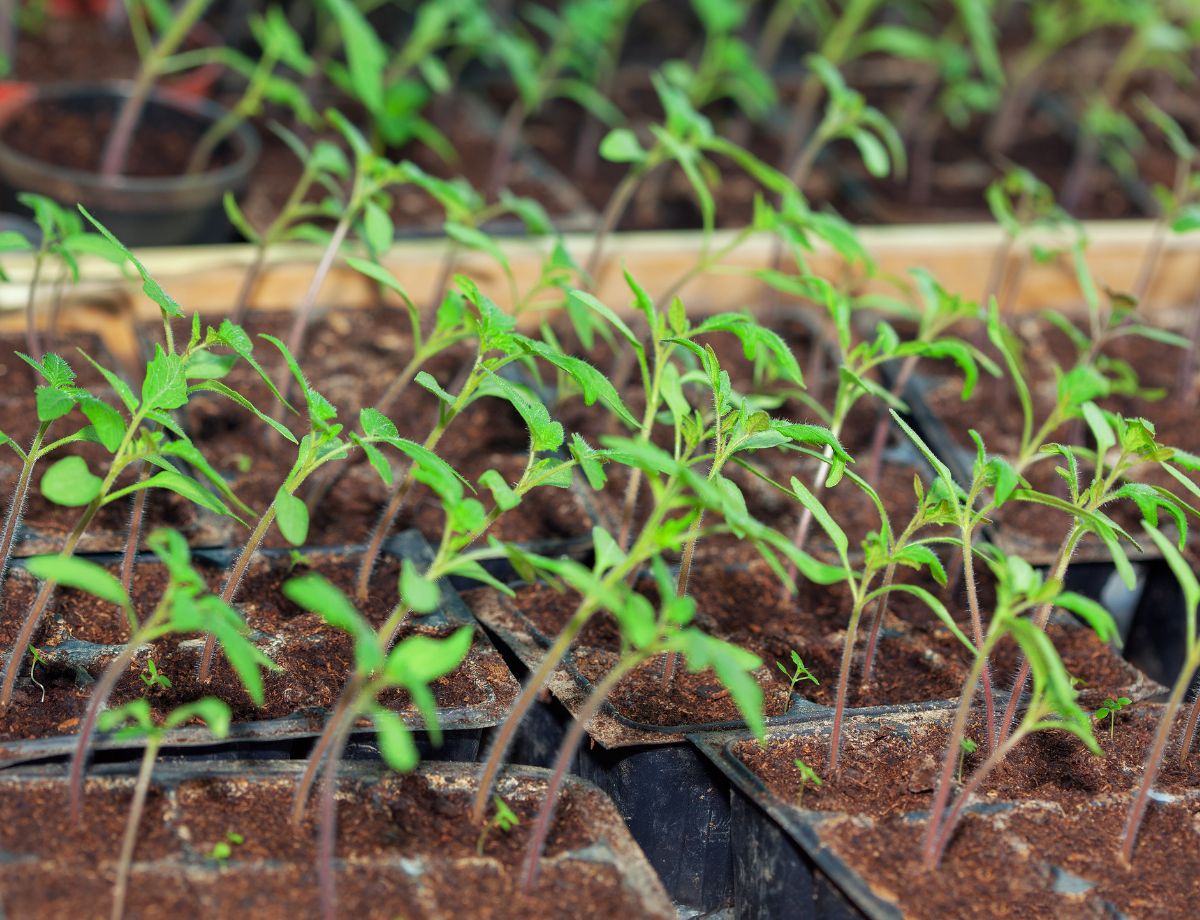
At around 75°F, the first loops of stem push through in 5–10 days. The moment you see them, take off the dome and turn on the light. The warm, humid conditions that helped them sprout will now help mould and stretching.
Step 3: Light — The Cure for Leggy Seedlings
Leggy seedlings are the number-one tomato seed-starting complaint, and they almost always come from not enough light. A seedling that can't find enough light stretches upward to look for it, and the stem it builds in the process is thin, pale and floppy.
- Use a grow light, not a window. Even a south-facing window in February gives a fraction of the light a seedling wants. Inexpensive LED shop lights work perfectly well.
- Keep the light 2–4 inches above the leaves (or follow the fixture's guidance for stronger LEDs) and raise it as the plants grow.
- Run it 14–16 hours a day, on a timer. Seedlings need a dark period too, so don't leave it on around the clock.
- Drop the temperature after germination. Once seedlings are up, 65–70°F days and slightly cooler nights grow stockier stems than keeping them on the heat mat.
- Add some movement. A small fan on low for a few hours a day, or brushing your hand across the tops once a day, makes stems thicken up the way they would in a breeze.
Step 4: Seedling Care and Potting Up (Deeper Each Time)
The first pair of leaves are seed leaves. The next, jagged pair are the first true leaves, which is the signal to start looking after the plant properly. In our timeline the seedling stage runs from roughly day 10 to day 30.
- Water from the bottom when the surface feels dry. Set the tray in an inch of water for 20 minutes, then drain. Constantly wet surfaces invite damping-off, the fungal rot that pinches seedlings at the soil line and topples them overnight.
- Feed lightly once true leaves appear: a balanced liquid fertilizer at quarter to half strength, about once a week.
- Pot up at 2–3 sets of true leaves into 3–4 inch pots. And here is the tomato trick: bury the stem. Set the seedling deeper than it was, right up to just below the seed leaves. The fuzzy hairs on a tomato stem turn into roots wherever they meet soil, so every potting up gives you a sturdier plant with a bigger root system. It's also the fix if your seedlings did go leggy.
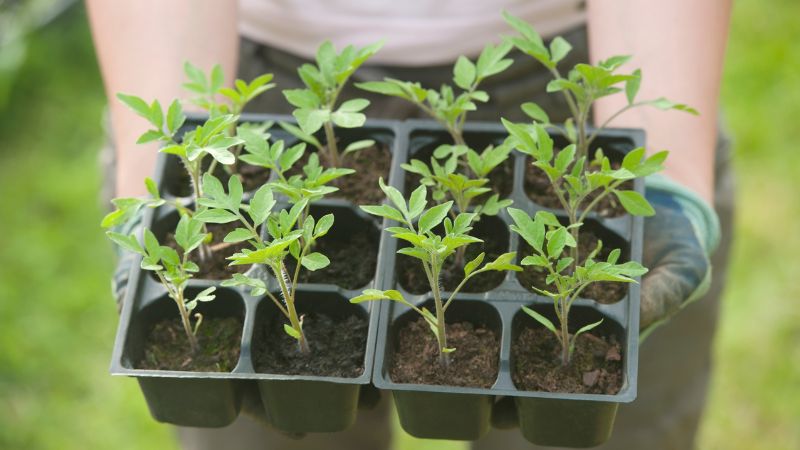
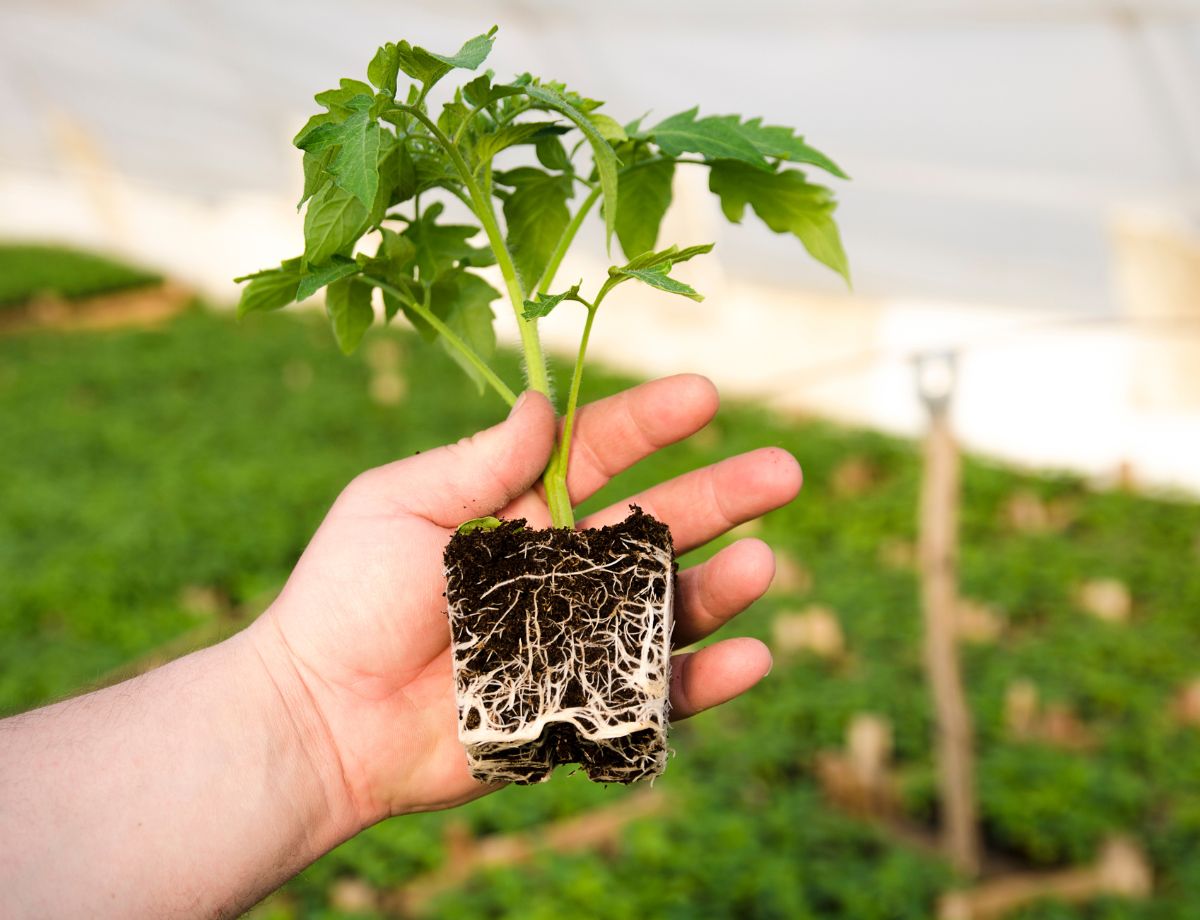
By planting-out day, 8–11 weeks after sowing, you want a plant 6–10 inches tall with a stem about pencil-thick, deep green leaves and roots just filling the pot. Roots circling the pot and yellow lower leaves mean it needs a bigger pot or the garden, whichever comes first.
Step 5: Hardening Off and Transplanting
A seedling raised indoors has never felt wind, direct sun or a cold night. Move it straight outside and it scorches, wilts and stalls for weeks. Hardening off fixes that over 7–10 days:
- Days 1–2: 1–2 hours outside in shade and out of the wind.
- Days 3–5: half a day, with a little morning sun.
- Days 6–8: most of the day in full sun. Bring them in if nights drop below 50°F.
- Days 9–10: outside day and night.
Then transplant, 2–3 weeks after your last frost date, once nights stay reliably above 50–55°F and the soil has warmed. The last frost date is an average, so in about half of years frost comes later than it, and those extra weeks are your margin.
Rushing it gains you nothing: a tomato that gets chilled just sits and sulks, while one planted a week later in warm soil catches up and overtakes it.
Plant deep again, burying up to two-thirds of the stem. Give each plant 24–36 inches of space, and put the stake or cage in at the same time so you don't stab it through the roots later.
From here, planting, care and harvest are covered step by step in our complete guide to growing tomatoes.
The 4-Week Method: How EdenVatika Times It
Everything above is the classic approach: sow early, pot up, and keep the plants under lights for two months or more. It gives the biggest transplants and the earliest tomatoes, and it's what most seed packets mean by "start indoors 6–8 weeks before last frost".
EdenVatika's planting calendar times it differently. In the app, tomato seedlings stay in the seed tray for 2–4 weeks, then go straight into the growing space you picked for them, whether that's a pot, a raised bed or the open ground. There's no long middle stage of potting up indoors.
Work it backwards and the sowing date moves much later. To plant out 2–3 weeks after your last frost, sow only about 1–2 weeks before that frost date, which is the "4-week method" column in the zone table. You don't have to count it yourself, either: in the weeks before tomatoes can go out, the app's "What to plant now" list shows them as "🏠 Start seeds indoors now — plant out in May" (or whichever month fits your location).
When you plan a tomato sowing on the calendar, the app works out the expected transplant date and first harvest, and checks the plan three ways:
- Transplant date against your last spring frost. 🔴 Less than 2 weeks after it: too early, tender plants won't survive outdoors yet. 🟡 2–4 weeks after: fine, but harden off first. 🟢 4 weeks or more after: safe. The same check catches the other end of the season, so a transplant date less than 2 weeks before your first fall frost is flagged 🔴 too.
- First harvest against your first fall frost. It tells you roughly how many days of picking you'll get before frost. Less than 2 weeks of picking is flagged 🟡, so you know to choose a faster variety. A first harvest that would land after frost is flagged 🔴.
- Summer heat. Tomatoes drop their flowers in long spells above about 84°F (29°C). In hot zones, the app warns 🟡 when your plants will grow through heat like that, and 🔴 when it's bad enough for fruit set to fail. That's the zone 9 May planting that looks fine on frost dates but spends its summer cooking.
That transplant date is an expected date, not a deadline. If your seedlings are running small or a cold snap is on the way, wait a few days. When you confirm the day you actually transplanted, earlier or later, the app moves your harvest dates to match. Confirming the day they sprouted shifts both the expected transplant and harvest dates the same way.
How big is a tomato seedling at 2–4 weeks?
Smaller than most people expect. Here's what typical growth looks like with good light at around 70°F:
| Time after sowing | Typical size | Ready to transplant? |
|---|---|---|
| Days 5–10 | Just sprouted: two smooth seed leaves, about 1 in | No |
| About week 2 | First true leaves opening, 1–2 in | Not yet: too small for open ground |
| About week 3 | 1–2 sets of true leaves, 2–3 in | Yes, into a pot or a sheltered bed |
| About week 4 | 2–3 sets of true leaves, 3–4 in, thin stem | Yes: the usual moving-out point |
| Weeks 6–8 (long method) | 6–10 in, 4–6+ true leaves, pencil-thick stem | Yes, as a bigger plant |
Go by the leaves, not the calendar. Move a seedling once it has at least two sets of true leaves and you're at least 2 weeks past your last frost. A transplant that small still needs hardening off, and it's an easy target for wind, slugs and cutworms.
A collar cut from a toilet-roll tube, pushed an inch into the soil around the stem, stops cutworms. Plant it deep like any tomato, burying the stem up to the lowest leaves.
Why do it this way?
- Young transplants settle in faster. A 4-week seedling with a small, active root ball suffers less transplant shock than an older plant that has started circling its pot. It often catches up within a few weeks of warm weather.
- Far less indoor setup. Four weeks in a seed tray fits on one shelf under one light. Eight to eleven weeks, with potting up, means a lot more pots, light and shelf space.
- Fewer chances to go wrong. Most seedling problems, such as legginess, root-bound pots, nutrient-starved yellow leaves and damping-off, build up with time indoors. Less time indoors means fewer of them.
- The checks are built into the date. Because the calendar ties transplant day to your frost dates and your zone's summer heat, you can't accidentally plan to plant out into frost, or into a heatwave in a hot zone.
The trade-off: smaller plants on planting-out day, and a first harvest that typically comes a couple of weeks later than with the long method.
Which method should you use?
Choose the 6–8 week method if you're in zones 3–5 and want every possible week of ripening, if you grow long-season beefsteaks, or if you already have a grow-light setup. Choose the 4-week method if you're short on indoor space or lights, garden in zone 6 or warmer, or missed the early sowing window. Both methods plant out on the same date, so you can't go wrong on frost either way.
Get your exact sowing and transplant dates
Three free tools do the maths for you. The Frost Date Lookup gives your local last frost date. The Crop Timeline Calculator turns it into a seed-start, transplant and first-harvest date for tomatoes. The Soil Temperature Checker tells you when the ground is actually warm enough.
Browse the Free Tools →The Tomato Timeline: Seed to First Harvest
These stages come from the EdenVatika plant database and are counted from the day you sow.
| Stage | When | What you'll see |
|---|---|---|
| Germination | Days 5–10 | Hooked stems push up and open into two smooth seed leaves |
| Seedling | Days 10–30 | True leaves; thin to one per cell, start feeding, pot up deep |
| Transplant-ready | Weeks 8–11 (6–8 week method) Weeks 2–4 (4-week method) |
Harden off, then plant out 2–3 weeks after last frost |
| Vegetative | Days 30–50 | Rapid growth once roots settle in warm soil |
| Flowering | Days 50–60 | Yellow flower clusters (sometimes earlier, on the windowsill) |
| Fruiting | Days 60–80 | Green fruit sizing up |
| Harvest | Days 80–120 | First ripe tomatoes, then a steady harvest for 6–8 weeks or more |
Frequently Asked Questions
When should I start tomato seeds indoors?
6–8 weeks before your average last spring frost. In zone 5 (last frost around May 1) that's early to mid March; in zone 7 (around April 1) it's early to mid February. See the zone table above, or look up your town's exact date. If you'd rather keep seedlings indoors for a shorter time, the 4-week method sows only 1–2 weeks before last frost.
When should I transplant tomato seedlings outside?
2–3 weeks after your last frost date, once nights stay reliably above 50–55°F. In zone 7 that's usually mid to late April; in zone 5, mid to late May.
Is it too late to start tomato seeds?
Usually not. With the 4-week method you can sow as late as your last frost date and still plant out on time. Seedlings are smaller on transplant day but catch up quickly in warm soil. Running later than that? Pick a fast variety of 55–65 days, or a cherry tomato, and you'll still get a crop in most zones.
Can I sow tomato seeds directly in the garden?
Yes, where the season is long. Sow ¼ inch deep after the last frost, once the soil is above about 60°F. In zones 3–6, direct-sown tomatoes often run out of summer before they finish ripening, which is why indoor starting is standard.
Why are my tomato seeds not germinating?
Nine times out of ten it's temperature. Below about 60°F germination slows to a crawl, and near 50°F it stops. The other usual causes are mix that's too dry (or soggy enough to rot the seed), seeds buried too deep, or old seed. Tomato seed stays viable for around 4–6 years when stored cool and dry.
How do I fix leggy tomato seedlings?
Lower the light to just a few inches above the leaves, cool the room slightly and add a fan. Then pot them up deeper, burying the stretched stem up to the seed leaves. Tomatoes root along any buried stem, so a leggy seedling becomes a well-anchored one.
How long do tomato seeds take to sprout?
5–10 days at 70–80°F. Below 60°F it can take 2–3 weeks, if they come up at all.
Count Back From Frost. Grow Them Stocky.
Starting tomatoes from seed comes down to two things: picking the right sowing date, and giving the seedlings enough light. Find your last frost, count back 6–8 weeks (or 1–2 for the 4-week method), keep the seeds warm until they're up and the seedlings bright once they are, and bury them deeper every time you move them.
Do that and transplant day brings sturdy, dark-green plants you grew yourself, in exactly the varieties you wanted, for the price of a single nursery pot.
Let your planting calendar do the counting
Tell EdenVatika where you garden and it sets your local frost dates. It tells you when to start tomato seeds indoors. Plan a sowing and it works out the expected transplant date and first harvest, warns you if either lands too close to frost or into summer heat, and moves the harvest dates when you transplant earlier or later. Then lay out the bed to scale, with each plant on its proper 2×2 ft block. Free to start.
Plan My Garden Free →