Vegetable Pairs to Grow in Pots: 12 Best Container Combos
Companion planting charts are written for garden beds, not pots. In a container, a good pair comes down to two things the chart never mentions — matching water needs and different root depths. Here are twelve pot pairs that pass both tests.
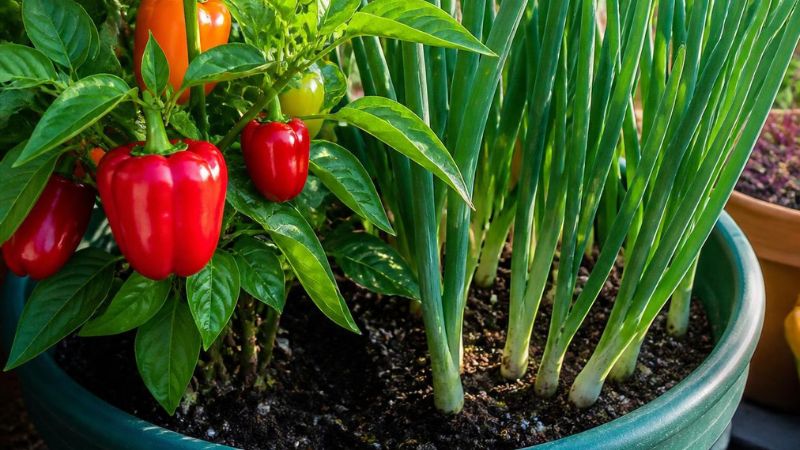
The pot on my balcony that failed hardest was also the most expensive. A 16-inch glazed thing, good compost, and three plants I loved: a tomato, a pepper and a clump of onions, arranged the way you would arrange flowers.
By July the tomato had thrown a canopy over everything, the pepper had set two fruit and stopped, and the onions had gone to a thin green nothing in the shade.
Nobody in that pot was a bad plant. Every one of them appears on the standard companion planting chart as a friend of the others. Tomato and onion, pepper and onion — both are recommended pairings, and both are perfectly true in a garden bed.
The problem is that a companion planting chart is written for ground, not for pots. In a bed, "these plants get along" means their pests and their chemistry get along, and the plants themselves have as much root run and soil as they care to take. A pot removes that.
Fourteen inches of mix is the entire world, and two plants in it are not neighbours — they are flatmates sharing one bank account.
So a good pot pair has to pass a test the chart never asks about: do these two want the same water, and do their roots want different depths?
Get those two right and the classic pairings work brilliantly in a container. Get them wrong and it does not matter how well the plants are supposed to like each other.
This guide covers the three rules that make container pairs work, what pot size each pair actually needs, twelve complete pot plans you can copy, and the pairings to keep out of the same container entirely.
Why Pairing Matters More in a Pot Than in a Bed
In open ground, a mismatched pairing fails slowly. Roots wander sideways to find what they need, rain and soil life buffer the fertility, and a plant that is being watered wrongly can usually reach a zone that suits it better. You get a mediocre crop rather than a dead one.
A container takes away all three escapes at once. Everything in the pot shares one volume of mix, one drainage rate, one feeding schedule and one watering can. If a tomato wanting two inches of water a week shares a pot with thyme that wants to dry out between drinks, there is no compromise setting — one of them is being harmed every time you water.
The same is true underground. A carrot sends a root straight down for ten to twelve inches. Lettuce feeds in the top four. In a bed those two barely meet. In a shallow pot they are fighting over the same three inches of soil, and the carrot loses, forking around the lettuce roots.
This is why the best container pairs are not the most enthusiastic friendships on the chart.
They are the pairs where one plant is clearly the main crop and the other is doing something useful in the space the main crop is not using — the rim, the shade underneath, the soil below, or the four weeks before the main crop needs the room.
The Three Rules for Pot Pairs
Rule 1 — Pair on water first, benefits second. Before anything else, check that both plants want the same amount of water. Tomato, pepper and eggplant all want roughly an inch to two inches a week and steady moisture.
Lettuce, spinach and coriander want to be kept evenly moist and will bolt the moment they dry out. Thyme and marigold want to dry out between waterings.
A pair from within one of those groups can be watered on instinct. A pair from across two groups needs you to be right every single time, which nobody is.
Rule 2 — Stack root depths instead of sharing one. The best pot pairs occupy different layers. Radish is done and out of the way in the top few inches.
Carrot, turnip and potato work the middle and lower pot. Lettuce, spinach and bok choy are all shallow feeders in the top four to six inches. Pair a deep root with a shallow one, and the same pot supports two crops on the same footprint.
Pair two shallow feeders and you simply need a wider pot.
Rule 3 — One big plant per pot, and pick it first. A container has room for one plant with real presence — one tomato, one eggplant, one chilli, one potato — plus small things around it.
Decide which plant is the reason the pot exists, give it the centre and the full depth, and let the second plant take the rim. Two large plants in one pot is the mistake that ruined my glazed pot, and it is the most common one in container gardening.
A fourth rule sits underneath all of them: pots run out of food. A bed can feed a heavy crop for a season from its own fertility; fourteen inches of potting mix cannot.
Every pair below wants a liquid feed every two weeks once the main crop starts flowering or bulking, and the pairs with two hungry plants want it weekly.
Match the Pot to the Pair
Pot size does more damage than any other single decision. The pairs below are ordered roughly from smallest container to largest, and the depth column matters more than the width — a wide, shallow pot will fail a carrot or a potato that a narrow, deep one grows perfectly.
| Pot pair | Smallest pot that works | Depth needed | Sun | First harvest |
|---|---|---|---|---|
| Lettuce + Radish | 10–12 in wide | 8 in — both shallow | 4–6 hrs, shade in summer | Radish 25–30 days, lettuce 30–45 |
| Radish + Spinach | 10–12 in wide | 8 in | Full sun to partial shade | Radish 25–30 days, spinach 40–50 |
| Spinach + Strawberry | 14–16 in wide, or a trough | 10 in | 6+ hrs for the strawberries | Spinach 40 days, strawberry 60–90 |
| Peas + Turnip | 12–14 in wide | 12 in for the turnip root | 6–8 hrs | Peas 60–80 days, turnip 60–80 |
| Bok Choy + Beans | 12–14 in wide | 10 in | Full sun to partial shade | Bok choy 45 days, beans 60–80 |
| Beans + Carrot | 12–14 in wide | 12 in minimum for carrots | 6–8 hrs | Beans 60–80 days, carrot 70–80 |
| Carrot + Green Chillies | 14 in wide | 12 in | 6–8 hrs, warm | Carrot 70–80 days, chillies 60–90 |
| Tomato + Basil | 14–16 in (5 gal) for a bush type | 12 in; 14+ for indeterminates | 6–8 hrs | Basil 30 days, tomato 60–80 |
| Eggplant + Thyme | 14–16 in (5 gal) | 12 in | 6–8 hrs | Thyme 40–60 days, eggplant 60–80 |
| Chinese Long Beans + Marigold | 14–16 in plus a 5–6 ft trellis | 12 in, heavy and stable | 6–8 hrs, hot | Beans 60–80 days, marigold all season |
| Pepper + Onion + Mustard Greens | 16 in wide (7 gal) or a long trough | 12 in | 6–8 hrs | Mustard 30–40 days, pepper 60–90 |
| Potato + Beans + Coriander | 10–15 gal grow bag or tub | 16 in+ for hilling | 6–8 hrs | Coriander 21 days, potato 10–12 weeks |
12 Best Vegetable Pairs to Grow in Pots
Every plan below was built in EdenVatika's planner and is free to open and copy. You can see exactly what goes where, swap any plant for something you actually eat, and the spacing and pairings come already worked out.
One note on quantities before you start. The planner shows each pot as a single container square, so a plan may list "1 radish" where you would really sow a dozen seeds.
Treat the plan as the pairing and the layout; the numbers below each plan are what to actually plant in a real pot of that size.
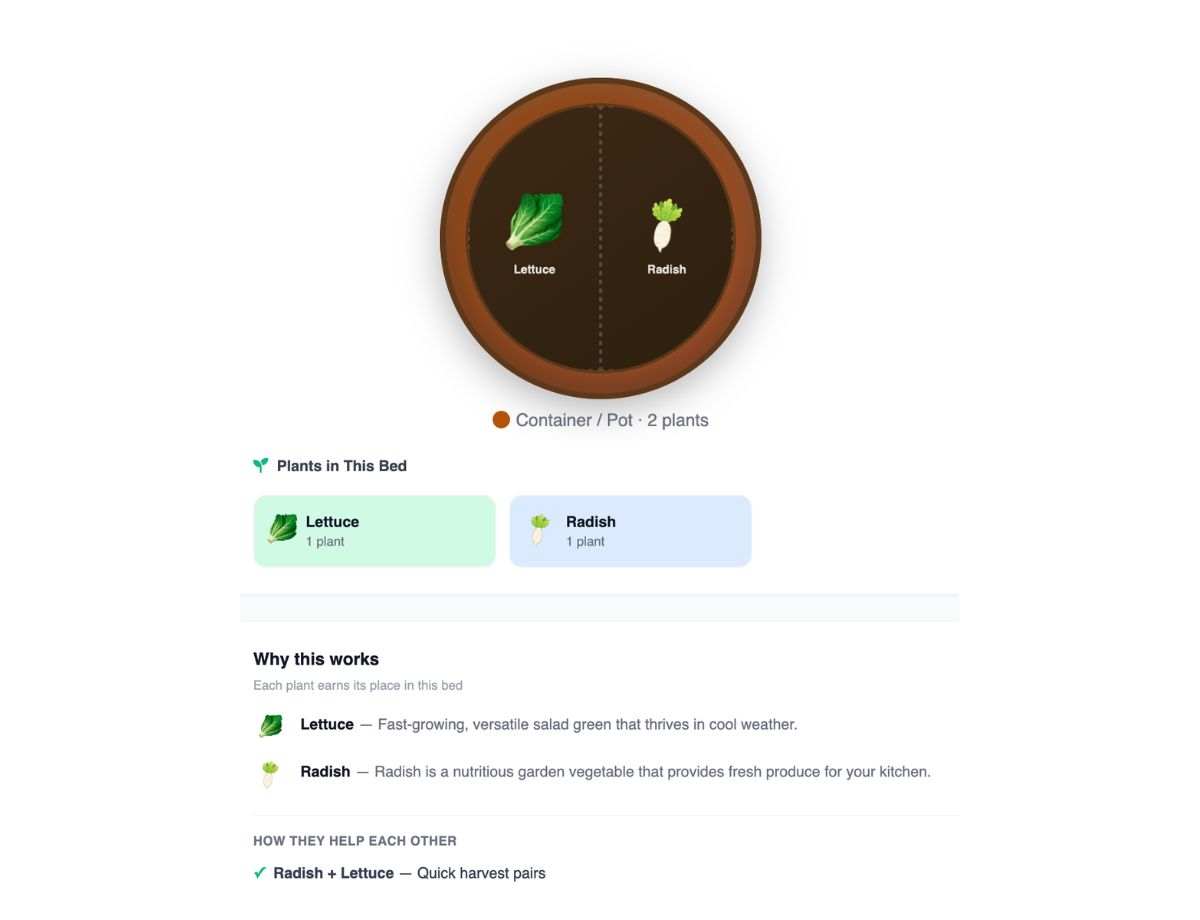
Plan 1 — Lettuce Radish Pot
If you have never paired anything in a container, start here. Lettuce and radish are the two fastest crops in this guide, they are both shallow-rooted, and they want the same steady moisture — so the entire pot can be watered on one instinct.
What makes the pairing work is timing rather than chemistry. Radish is pulled at 25 to 30 days, well before the lettuce reaches full size at 45.
Sow them together and the radishes come out exactly as the lettuce starts needing the room, which means the pot carries two crops on one footprint without either being crowded. Radish also deters aphids, which is the pest most likely to find a pot of soft salad leaves.
Give it four to six hours of sun rather than full blazing exposure, and move it into afternoon shade once summer heat arrives — lettuce runs to seed above about 65°F and turns bitter as it does. Cut the outer lettuce leaves rather than pulling whole heads and one sowing keeps producing for three to five weeks.
What's in it: Lettuce, Radish | Plant: 3–4 loose-leaf lettuce around the rim, 10–12 radish seeds through the middle
Best for: Beginners, balconies, salad in a month | Pot: 10–12 in wide, 8 in deep
See the full planting and copy this plan to your account.
View & Copy This Plan → Free account required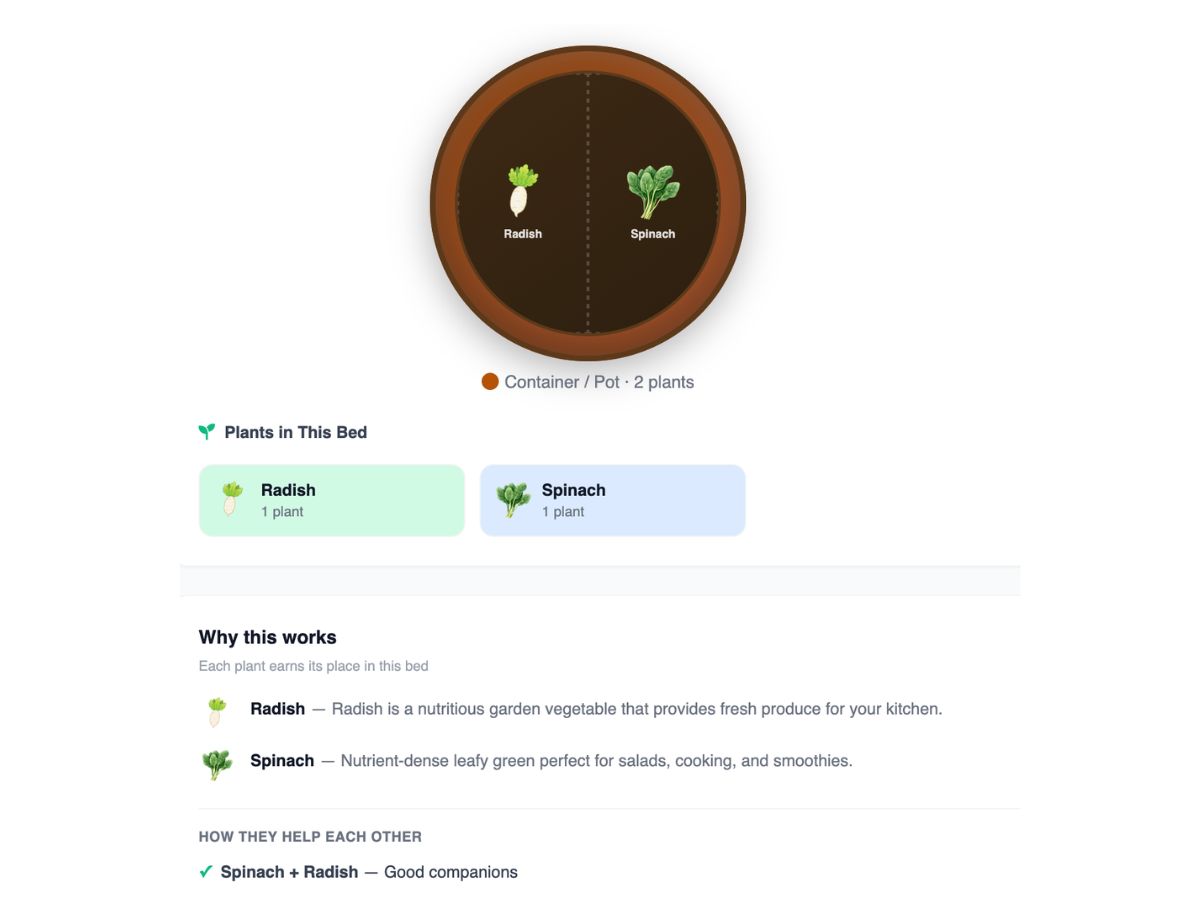
Plan 2 — Cool Season Quick Greens Pot
The same idea as the salad pot, swapped for the crop that handles cold better. Spinach is hardy where lettuce is only semi-hardy, and it grows happily at 50–60°F — which makes this the pot to run in early spring and again in autumn, when a lettuce pot would sulk.
Radish and spinach are listed as companions in both directions, and the reason is the same efficiency as before: radish clears out at 28 days, spinach fills the gap and is ready at 40 to 50.
Spinach is also the denser planting of the two — nine plants to a square foot against lettuce's four — so this pot gives you noticeably more leaf for the same soil.
Keep it evenly moist, at one to one and a half inches of water a week.
Spinach bolts under heat and drought stress, so this is a pot to grow in the shoulder seasons rather than push through midsummer. Cut the outer leaves from about four inches tall and it keeps coming for three to four weeks.
What's in it: Radish, Spinach | Plant: 8–9 spinach, 10–12 radish seeds between them
Best for: Spring and autumn, cold balconies, smoothies | Pot: 10–12 in wide, 8 in deep
See the full planting and copy this plan to your account.
View & Copy This Plan → Free account required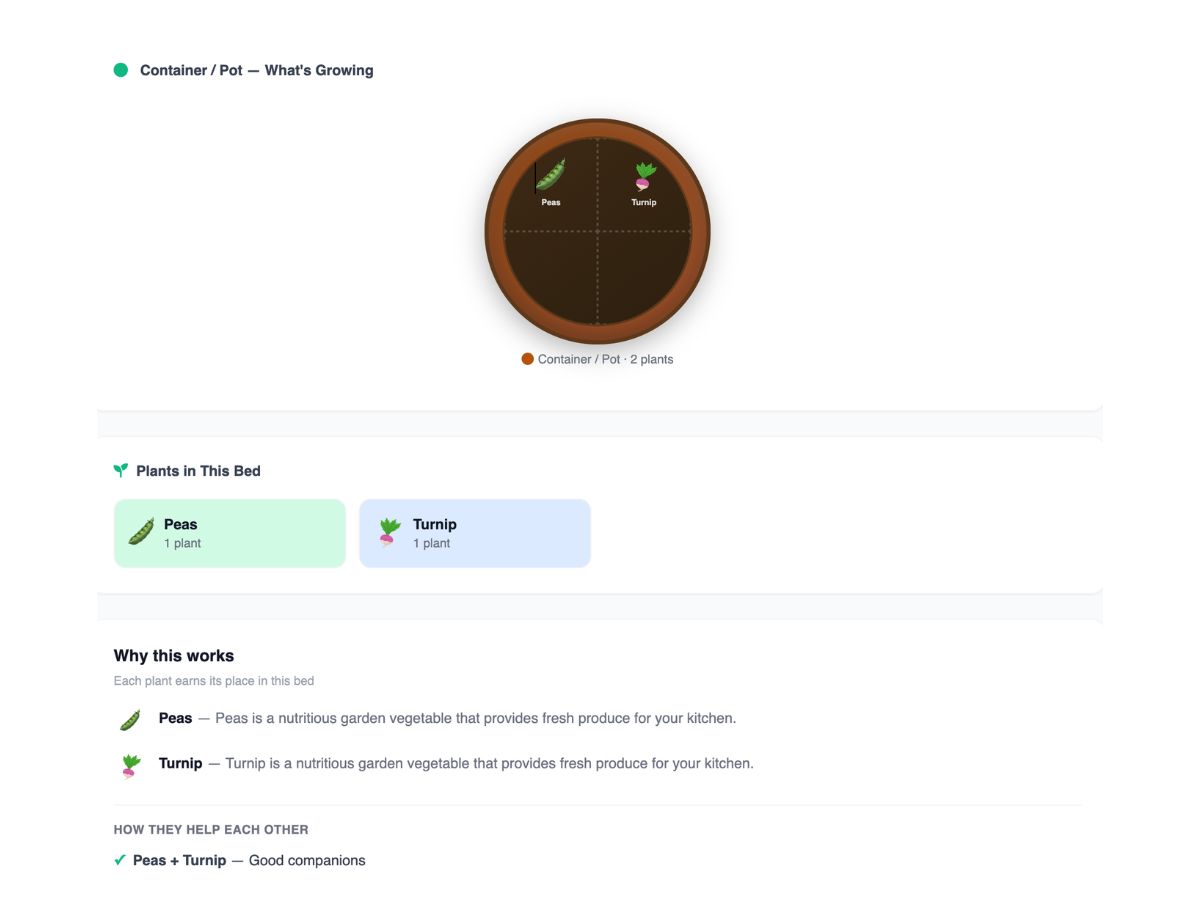
Plan 3 — Cool Season Duo
Peas and turnip is the first genuinely layered pair in this guide, and the first that needs real depth. The turnip is doing its work eight to twelve inches down while the peas climb upward, so the two crops barely touch — different levels, different directions, one pot.
The peas are also feeding the turnip. As legumes they fix nitrogen in the soil, which matters far more in a container than in a bed, because a pot has no reserves to draw on.
Turnip is a leafy brassica below the ground and a hungry one above it, and it responds directly to what the peas put back.
Two things decide whether this pot works. Use a bush pea unless you are prepared to build for a climbing one — bush types top out at 12 to 24 inches and support themselves, while climbing varieties want three to six feet of netting and a pot heavy enough not to tip.
And give the turnip twelve inches of loose, stone-free depth; a shallow pot produces all leaf and no root. Both plants are hardy, so this pot goes out earlier in spring than almost anything else here.
What's in it: Peas, Turnip | Plant: 6–8 bush peas around the edge, 4 turnips in the centre
Best for: Early spring, cold-hardy growing, soil that improves as it goes | Pot: 12–14 in wide, 12 in deep
See the full planting and copy this plan to your account.
View & Copy This Plan → Free account required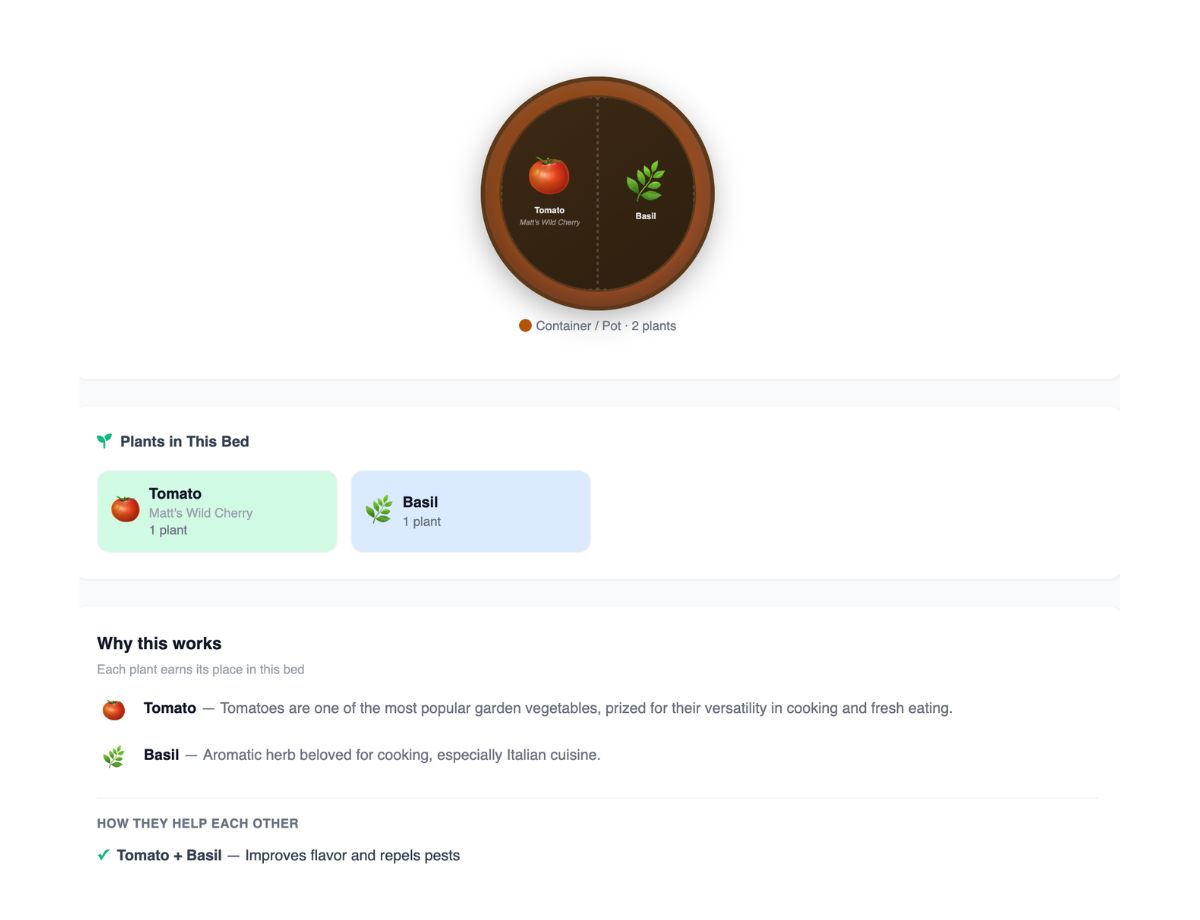
Plan 4 — Tomato & Basil Pot
The most famous pairing in gardening, and one of the few that is even better in a pot than in the ground. Basil repels aphids, whitefly and thrips — the three pests that find a container tomato on a balcony before they find one in a garden.
And the two plants want almost identical conditions: full sun for six to eight hours, rich soil, and steady water at one to two inches a week.
The pot decision that matters is which tomato. A determinate or bush variety stops at 24 to 36 inches and is genuinely happy in a 14 to 16-inch pot.
An indeterminate will run four to six feet, wants a 10-gallon container and a stake, and will shade the basil out unless you keep it pruned to a single stem.
The plan uses Matt's Wild Cherry, which is indeterminate and enormously productive — grow it up a stake against a wall and keep the basil on the sunny side.
Basil is ready first at around 30 days, and the tomato needs 60 to 80, so you are cutting basil for a month before the first tomato colours up. Pinch the basil tips out constantly — never let it flower — and it stays bushy and low instead of racing upward to compete.
Feed the pot every two weeks once the tomato sets fruit; this is the hungriest pair in this guide.
What's in it: Tomato (Matt's Wild Cherry), Basil | Plant: 1 tomato centre, 2 basil at the rim
Best for: Sunny balconies, pasta, the single most rewarding pot here | Pot: 14–16 in for a bush type, 10 gal and a stake for a cherry vine
See the full planting and copy this plan to your account.
View & Copy This Plan → Free account required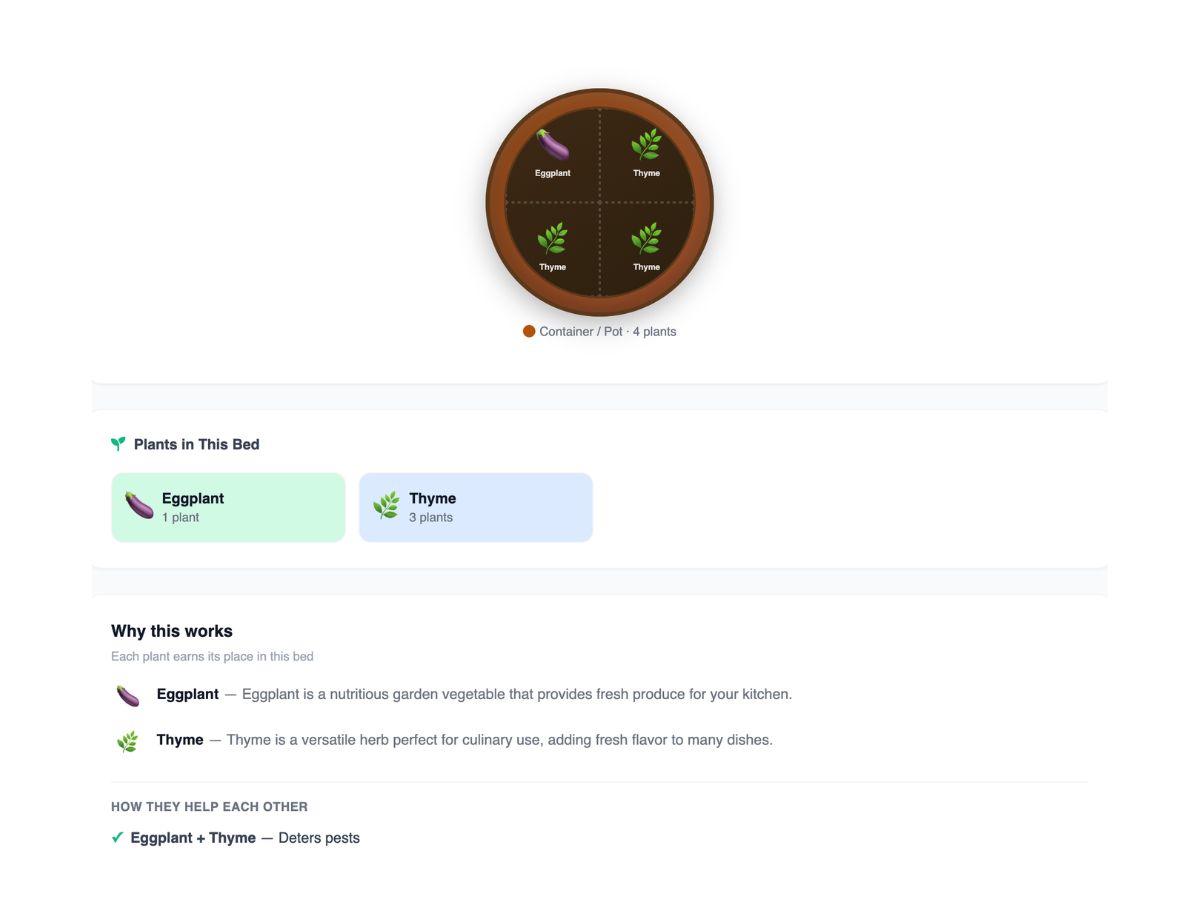
Plan 5 — Eggplants in Pots With Thyme
Eggplant is a natural container crop — one plant per square foot, 24 to 36 inches tall, and it fruits well in the reflected warmth of a balcony. Its problem is flea beetles and spider mites, which shred the leaves of a potted eggplant faster than a bedded one.
Thyme is the answer: it is a listed companion specifically as a pest deterrent, and being a low spreading perennial at 6 to 12 inches tall, it takes the rim of the pot without competing for light.
This is the one pair in the guide that breaks Rule 1, and it is worth knowing how.
Eggplant wants an inch of water a week and consistent moisture; thyme wants moderate water and to dry out between drinks.
The fix is physical — plant the thyme right at the rim where drainage is fastest and the mix dries first, water into the centre of the pot at the eggplant's base rather than over the whole surface, and add extra grit to the mix so nothing stays sodden.
Done that way the pairing holds for a full season.
The thyme is also the long-term half. It is a hardy perennial that will keep producing for years and comes back after the tender eggplant is killed by the first frost, so the pot is worth overwintering rather than emptying.
First thyme cutting at 40 to 60 days, first eggplant at 60 to 80.
What's in it: Eggplant, Thyme | Plant: 1 eggplant centre, 3 thyme spaced around the rim
Best for: Hot balconies, curry and grilling, a pot that survives winter | Pot: 14–16 in (5 gal), gritty free-draining mix
See the full planting and copy this plan to your account.
View & Copy This Plan → Free account required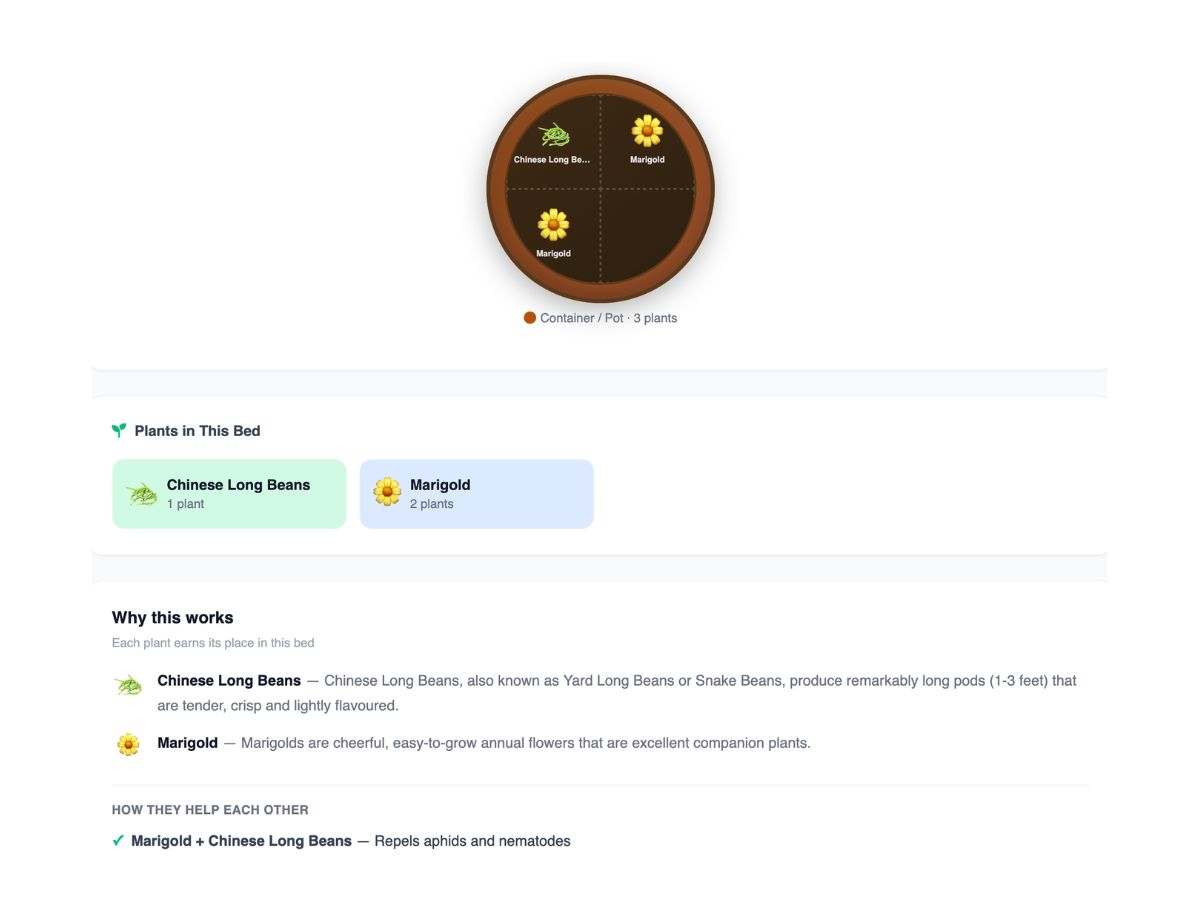
Plan 6 — Classic Companion-Planting Combo
Chinese long beans and marigold is the pairing that turns a pot into a vertical crop. The beans — also called yard long or snake beans — produce pods one to three feet long and vine to eight or twelve feet, which sounds absurd for a container until you realise that all of that growth happens upward on a footprint of two or three feet.
Marigold is the working half. It repels aphids and nematodes, and long beans are prone to both; it also flowers continuously until frost, so the pot stays useful to pollinators the whole season. At six to eighteen inches tall it sits entirely below the bean canopy, using light the beans are not.
Two non-negotiables. The trellis is essential, not optional — five to six feet of strong support, tied to a rail or a wall, because a loaded bean vine in a pot is a sail. And these beans want real heat: 75 to 95°F, hotter than almost anything else in this guide, so this is a high-summer pot for the most exposed spot you have.
They are drought tolerant once established and dislike waterlogging, which makes them unusually forgiving on watering. Pick every two to three days once they start, and they keep producing.
What's in it: Chinese Long Beans, Marigold | Plant: 2 bean vines at the trellis, 2 marigolds at the front rim
Best for: Hot climates, vertical space, growing up a balcony rail | Pot: 14–16 in and heavy, with a 5–6 ft trellis
See the full planting and copy this plan to your account.
View & Copy This Plan → Free account required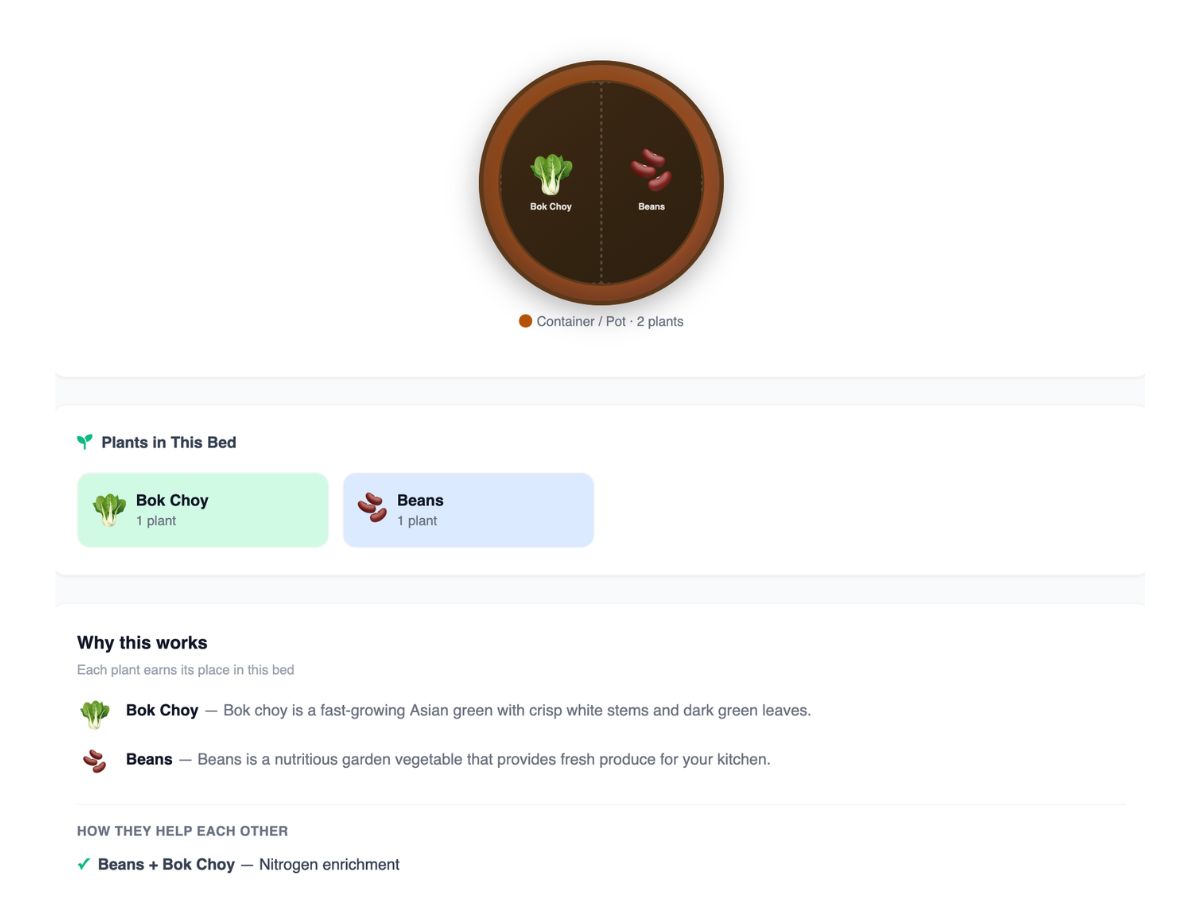
Plan 7 — Bok Choy & Beans Pot
Bok choy is one of the best container vegetables nobody thinks to grow. It is ready in 45 days, stays at 10 to 18 inches, tolerates partial shade, and is hardy enough to shrug off a light frost — everything you want from a balcony crop.
What it needs is nitrogen, because it is a fast leafy brassica and a hungry one.
Bush beans supply exactly that. They fix nitrogen into the soil as they grow, which in a container is the difference between one good crop of bok choy and two.
Bok choy lists beans as a companion for precisely this reason. Sow the beans at the same time, cut the bok choy at 45 days, and resow into soil the beans have already improved.
Keep the moisture consistent at about an inch a week — bok choy bolts if it dries out and goes stringy. Use a bush bean, not a pole variety: bush types stay at 12 to 18 inches and need no support, while pole beans reach six to eight feet and will shade the bok choy out completely. Harvest bok choy whole at the base or take outer stems as you need them.
What's in it: Bok Choy, Beans | Plant: 3–4 bok choy, 4 bush beans around them
Best for: Stir-fries, partial shade, fast turnaround | Pot: 12–14 in wide, 10 in deep
See the full planting and copy this plan to your account.
View & Copy This Plan → Free account required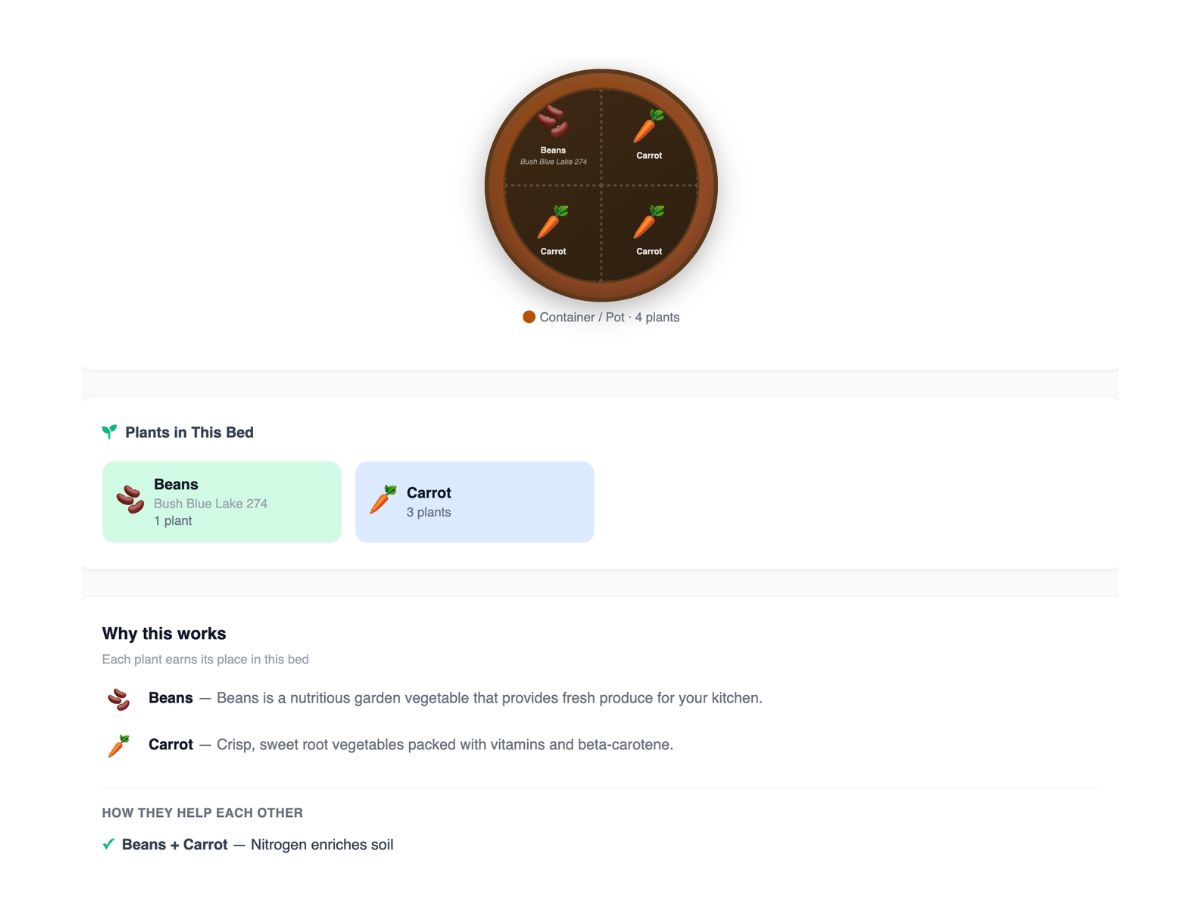
Plan 8 — Underground & Up Pot
The name is the whole design. Carrots work downward through ten to twelve inches of soil; bush beans work upward from a shallow root plate. Neither is competing for the other's layer, which is why this pot fits four plants where most containers of the same size fit one or two.
The beans fix nitrogen, and carrots benefit from soil that is fed rather than force-fertilised — a heavily fertilised carrot forks and grows hairy roots instead of one clean taproot, so a slow biological nitrogen supply suits them far better than a fistful of feed.
Bush beans also deter nothing in particular here, but radish's beetle-deterring trick works if you want to add a third crop.
Carrots are the fussy half and the pot is where most people get them wrong. Twelve inches of depth is a minimum, and the mix must be loose and free of stones and lumps or the roots fork around every obstruction.
Sow thinly, thin ruthlessly to three or four inches apart, and keep moisture consistent — irregular watering splits carrots. A short variety like Nantes or a round type is far more forgiving in a pot than a long Imperator.
What's in it: Beans (Bush Blue Lake 274), Carrot | Plant: 3–4 bush beans at the edge, 12–16 carrots sown through the centre
Best for: Making a small pot carry two real crops | Pot: 12–14 in wide, 12 in deep, loose stone-free mix
See the full planting and copy this plan to your account.
View & Copy This Plan → Free account required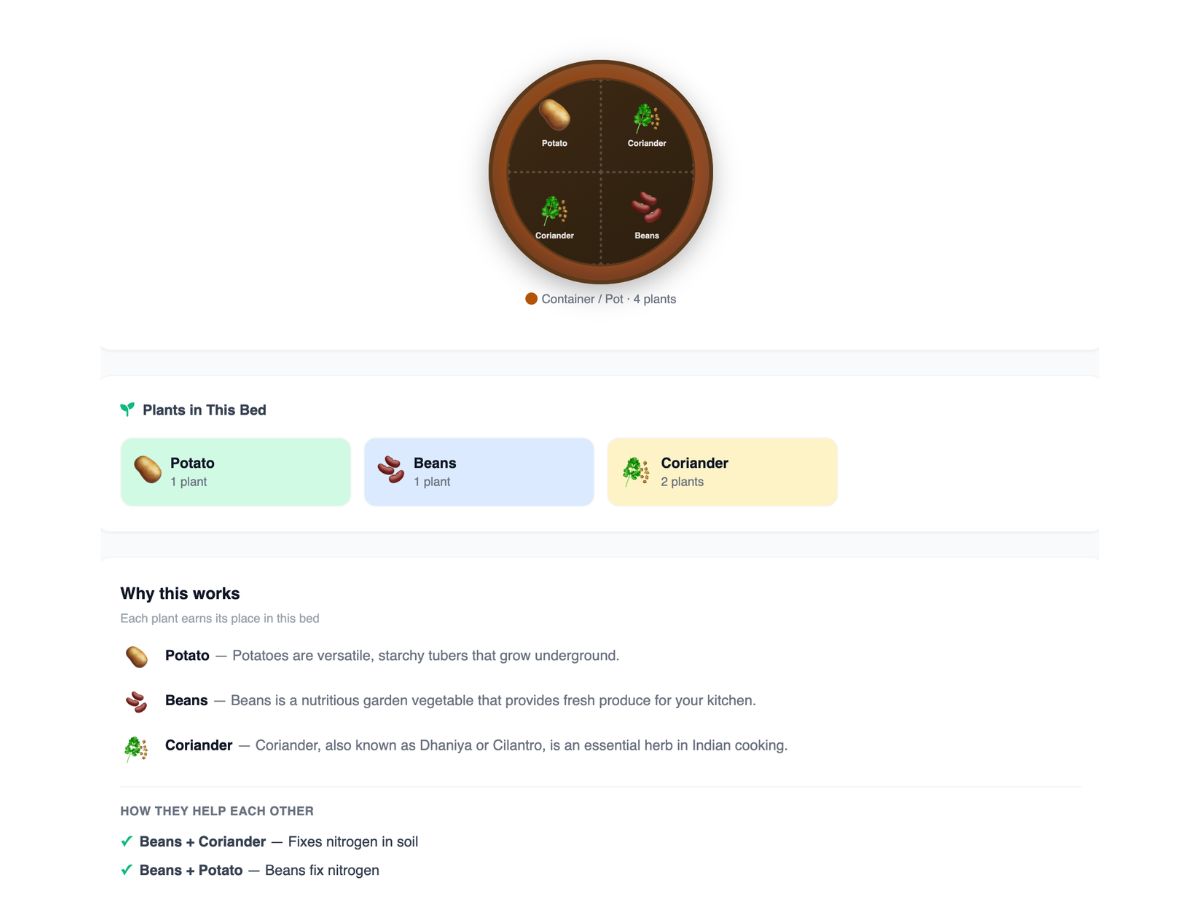
Plan 9 — Comfort Food Container Bed
Three plants, three jobs, and the deepest container in this guide. Potatoes are grown in a bag or tub rather than a pot because they need hilling — soil added around the stems as they grow, which is where the extra tubers form.
Sixteen inches of depth is the working minimum, and a 10 to 15-gallon grow bag does the job better than anything rigid.
The beans are there for nitrogen; potatoes list them as a companion specifically because they fix it, and a potato bulking tubers is one of the hungriest things you can grow in a container.
The coriander is there because it wants partial shade and only four to six hours of sun, which is exactly what it gets under the skirt of potato foliage — a spot that would otherwise be wasted.
Coriander is the quick return at 21 days for leaves, so you are cutting it within three weeks while the potatoes are still bulking toward ten to twelve weeks for new potatoes. It bolts fast, so resow a pinch every two to three weeks in the same gap.
Keep the bag consistently moist during tuber formation — this is when uneven watering causes hollow and misshapen potatoes — and never plant tomatoes in a container that has just grown potatoes, since the two share blight.
What's in it: Potato, Beans, Coriander | Plant: 1–2 seed potatoes, 2–3 bush beans at the edge, coriander sown in the gaps
Best for: Grow bags, a real staple crop, Indian cooking | Pot: 10–15 gal bag or tub, 16 in+ deep
See the full planting and copy this plan to your account.
View & Copy This Plan → Free account required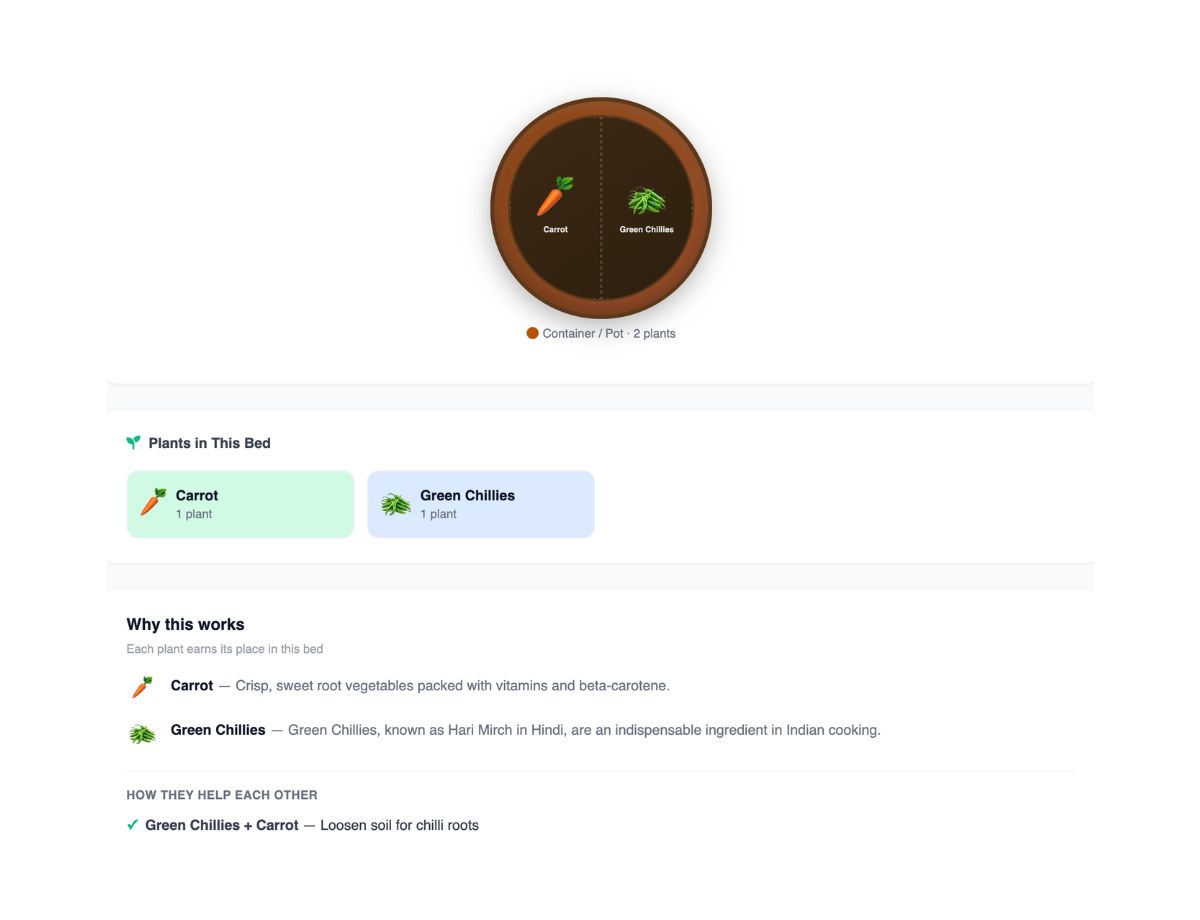
Plan 10 — Sweet & Spicy Pot
Green chillies are among the best possible container crops — 18 to 30 inches tall, one plant per square foot, and genuinely more productive in the reflected heat of a balcony than in open ground. What they want is 20 to 35°C and soil that stays evenly moist without waterlogging.
Carrots are a listed companion for chillies, and the stated benefit is a physical one rather than chemical: they loosen the soil for the chilli roots. In a container that is more useful than it sounds, because potting mix compacts over a season and a chilli in a settled, airless pot stalls.
The carrots also occupy the deep layer the chilli's shallower root plate is not using.
Sow the carrots around the chilli rather than under it, so they are not permanently shaded by the canopy — a ring near the rim works well.
Twelve inches of depth is the minimum, the same as any carrot pot.
First chillies come 60 to 90 days after transplanting and the harvest window runs 90 to 120 days, so this is a long-season pot that keeps giving; pick green regularly to keep the plant setting more, or leave a few to redden.
What's in it: Carrot, Green Chillies | Plant: 1 chilli in the centre, 10–12 carrots sown in a ring around it
Best for: Hot balconies, Indian cooking, a long harvest window | Pot: 14 in wide, 12 in deep
See the full planting and copy this plan to your account.
View & Copy This Plan → Free account required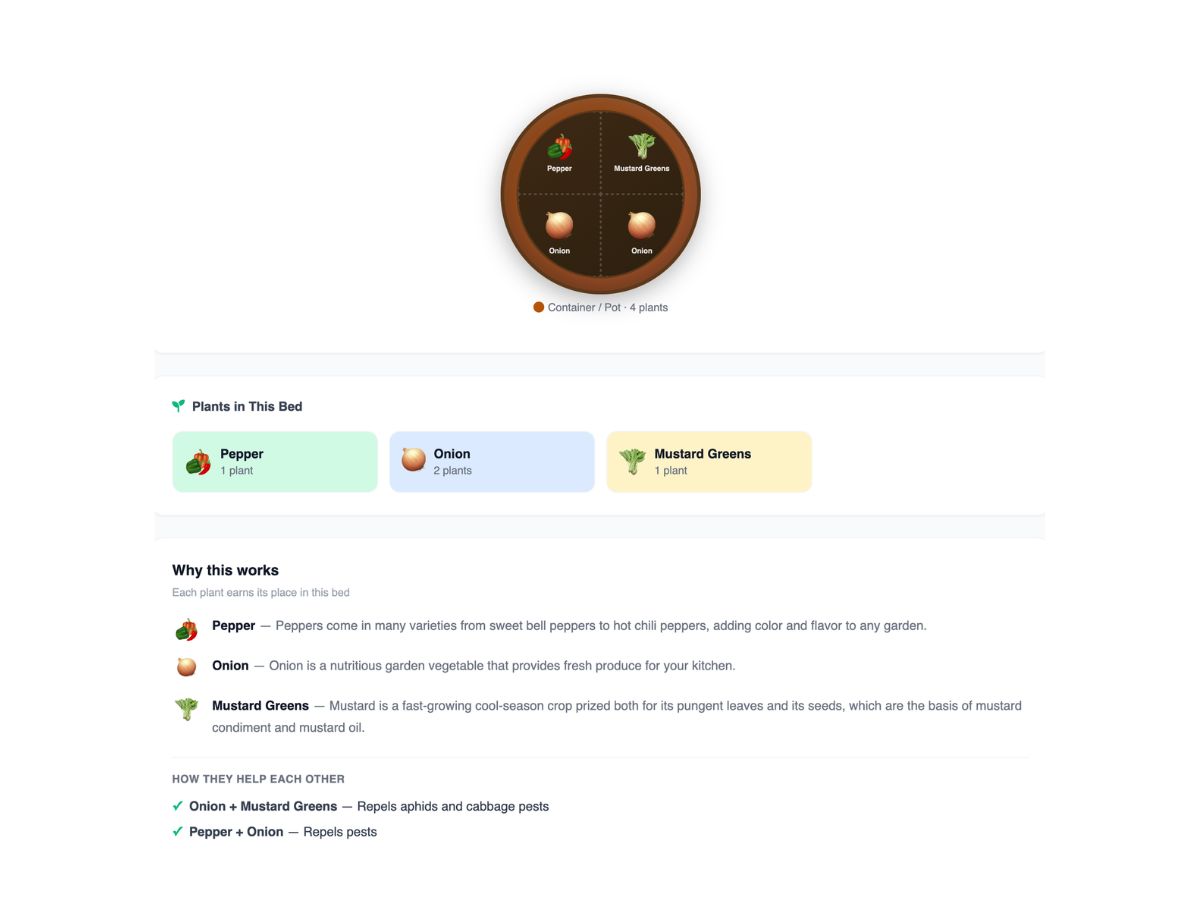
Plan 11 — Zesty Trio Pot
Three plants and two separate pest defences, which is why this is the pot to copy if aphids are your recurring problem. Onions repel pests from the peppers with their scent, and onions paired with mustard greens deter aphids and the cabbage pests that go for brassica leaves.
The mustard is the crop most likely to be eaten and it has the most protection sitting right beside it.
The layering works too. Pepper is the single big plant at 18 to 36 inches and takes the centre. Onions are narrow — four to six inches each — and slot into the gaps without casting shade.
Mustard greens are cut-and-come-again from 30 to 40 days, so they are harvested and regrowing long before the pepper needs the full width of the pot at 60 to 90 days.
Give this one a 16-inch pot or a long trough; three plants of this size in a 12-inch pot is the classic overcrowding mistake. One caution worth knowing: mustard greens are a brassica and should not join tomatoes or strawberries in a pot, so if you swap the pepper for a tomato, take the mustard out. Peppers and tomatoes are fine together in a bed but they are two large plants, which breaks Rule 3 in a container.
What's in it: Pepper, Onion, Mustard Greens | Plant: 1 pepper centre, 4–6 onions in the gaps, mustard greens sown along one side
Best for: Aphid-prone balconies, three crops from one pot | Pot: 16 in wide (7 gal) or a trough, 12 in deep
See the full planting and copy this plan to your account.
View & Copy This Plan → Free account required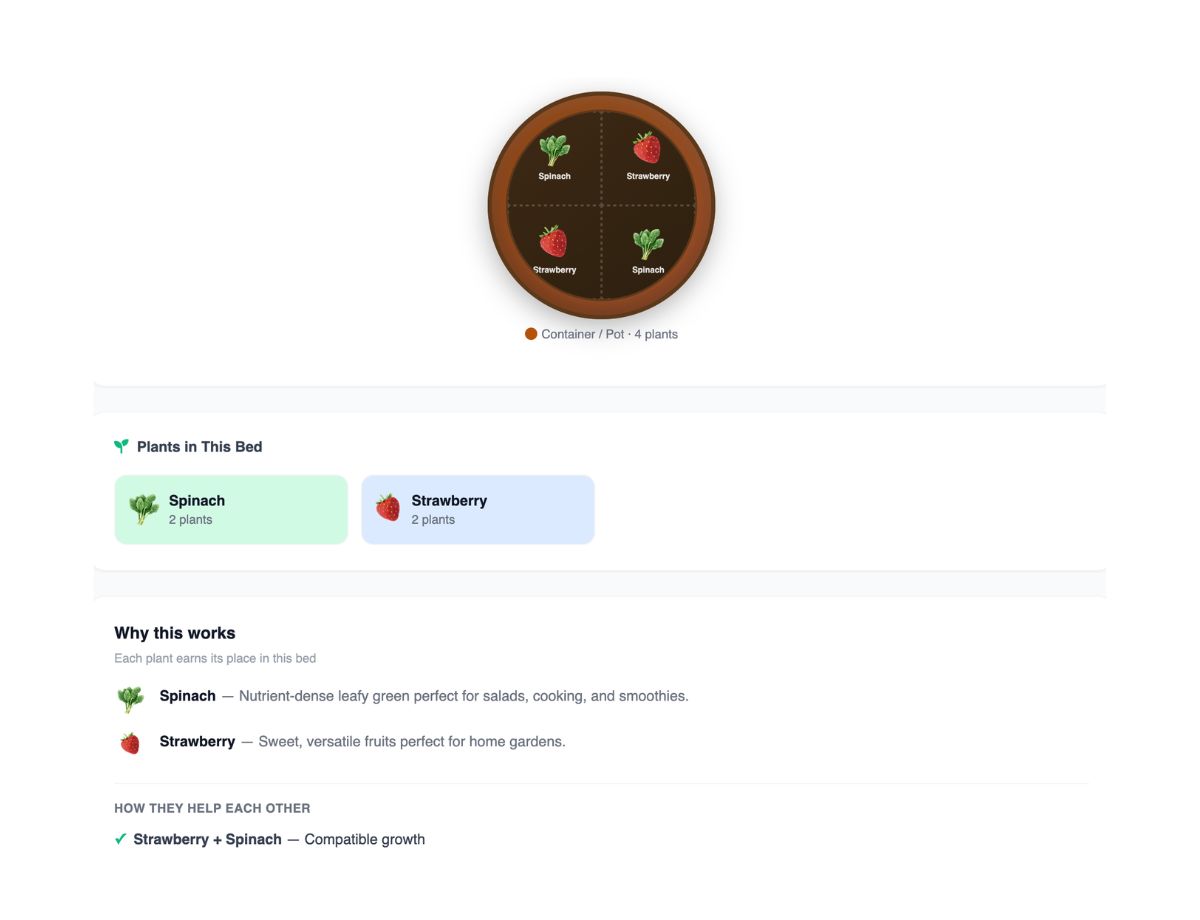
Plan 12 — Spinach-Strawberry Salad Pot
The only pot here built around a perennial, and the one that pays off across years rather than weeks.
Strawberries and spinach list each other as companions in both directions, and in a container the relationship is mostly about ground cover: strawberry foliage shades the soil surface, which keeps the mix cooler and damper and delays the moment spinach decides to bolt.
They also drink almost identically — one to one and a half inches a week for both — which is what makes a genuinely mixed pot possible here rather than a compromise.
Spinach is the fast half at 40 days, strawberries are the slow half at 60 to 90, and June-bearing varieties will not fruit properly until their second year. Choose an ever-bearing type if you want fruit in the first season.
Give it a wide pot rather than a deep one — both are shallow-rooted at six to twelve inches — and ten inches of depth is plenty.
Strawberries send out runners and will fill the container over time; snip them off in the first year to push energy into fruit, then let a few root to replace the parent plants in year three.
Because the strawberries stay put, treat the spinach as the replaceable half: sow it in spring, cut it out when it bolts, sow again in autumn.
What's in it: Spinach, Strawberry | Plant: 2–3 strawberry crowns, 6–8 spinach sown between them
Best for: A pot that comes back every year, kids, breakfast | Pot: 14–16 in wide or a trough, 10 in deep
See the full planting and copy this plan to your account.
View & Copy This Plan → Free account requiredVegetable Pairs to Keep Out of the Same Pot
Some pairings are worse in a container than a bed, and a few are bad everywhere. These are the ones worth memorising before you plant.
| Don't pair | Why it fails | What to do instead |
|---|---|---|
| Onion + Beans or Peas | Alliums inhibit legume growth, and the effect is listed in both directions — onions stunt beans, beans and peas both suffer | Onions belong with peppers, tomatoes and brassicas; keep legumes in a separate pot |
| Tomato + Potato | Same family, and they share blight and pest problems — in a shared pot an infection reaches both within days | Separate containers, and don't reuse potato mix for tomatoes the following year |
| Beans + Peppers or Chillies | Different nutrient needs, and beans shade chilli plants — the nitrogen benefit does not offset it | Pair peppers with onions and basil; pair beans with brassicas or carrots |
| Mustard Greens + Strawberry or Tomato | Brassicas stunt strawberry growth and compete heavily with tomatoes for nutrients | Put mustard with onions, peas or spinach — all listed companions |
| Carrot + Dill or Parsnip | Dill cross-pollinates and stunts carrot growth; parsnip shares carrot fly and the same diseases | Carrots with onions, lettuce, tomatoes or rosemary — all deter or tolerate carrot fly |
| Lettuce + Parsley or Celery | Celery releases compounds that inhibit lettuce germination; parsley stunts lettuce growth | Lettuce with radish, carrot, chives or strawberries |
| Fennel + almost anything | Allelopathic — it inhibits tomatoes, beans, carrots, coriander, chillies and most brassicas | Give fennel a pot entirely of its own, always |
| Any two large fruiting plants | Tomato and pepper are fine companions in a bed, but two 30-inch plants in one pot means neither gets enough root volume or light | One big plant per pot, plus small companions — run two pots side by side instead |
How to Adapt These Pairs to Your Space
Start with the sun, not the pot. Watch where light actually falls before buying anything. Six to eight hours means the tomato, chilli, eggplant, pepper and long bean pots will all crop properly.
Four to six hours puts you in lettuce, spinach, bok choy, radish and coriander territory — every one of which produces well in partial shade, and several of which prefer it. A tomato in a genuinely shady corner will grow tall and set almost nothing, no matter how well you feed it.
Buy depth before width. If you can only afford one upgrade, make it depth. Carrots and turnips need twelve inches, potatoes need sixteen and room to hill. Widening a shallow pot just gives you more shallow soil, and the deep-rooted half of the pair fails either way.
Swap within the same water group. If you do not eat bok choy, put lettuce or spinach in its place — all three are shallow, thirsty leafy crops and the pot is watered identically. If radish is not your thing, spring onions work in the same gap and the same timeframe. Substituting inside a group changes nothing about how the pot is run.
Run two pots rather than one big mixed one. The instinct after reading twelve plans is to combine the best plants into one large container.
Do the opposite. Two 14-inch pots side by side look like one garden and behave like two independent systems, which means one can be watered hard and the other left to dry.
Size up if you water rarely. Small pots in full summer sun can dry out inside a day. A larger container holds more moisture and buys an extra day or two, which is the single most useful adjustment if you travel or forget.
Common Pot-Pairing Mistakes
Trusting a bed chart in a container. The mistake that started this article. Companion charts tell you about pests and chemistry; they say nothing about who wins the fight for twelve inches of soil. Check water and root depth first, then consult the chart.
Two large plants in one pot. Tomato and pepper. Eggplant and chilli. Two tomatoes. All of these are recommended pairings and all of them starve each other in a container. One main crop per pot.
Skipping the feed. A pot's fertility is finite and a paired pot burns through it twice as fast. Liquid feed every two weeks from the point the main crop starts flowering, weekly for the tomato and potato pots.
Pots without drainage holes. A decorative container with no hole kills a pairing faster than any pest, and it kills the drier-loving half first — which is why thyme dies in the eggplant pot when the pot, not the schedule, was at fault. Drill it or use it as a cachepot with a plain pot inside.
Sowing both halves and then forgetting the fast one. Radish left in the ground past 30 days goes woody and hot, and it also stops being the polite neighbour that leaves room for the lettuce. The quick-crop half of a pair is only an advantage if you actually pull it on time.
Reusing last year's mix. Spent potting mix is compacted and depleted, and it carries over disease — particularly blight from potatoes and tomatoes. Refresh at least the top half of the pot each season and start fresh for any Solanaceae crop.
Frequently Asked Questions
What vegetables grow well together in pots?
The best container pairs combine one main crop with a smaller plant that uses space the main crop is not using.
Reliable examples are tomato with basil, lettuce with radish, carrot with green chillies, eggplant with thyme, bok choy with bush beans, spinach with strawberries, and peas with turnip.
What they have in common is matching water needs and different root depths — the two things that decide whether a shared pot works, and the two things companion planting charts do not cover.
Can you plant two vegetables in the same pot?
Yes, provided they want the same amount of water and they are not both large plants. Two shallow leafy crops share a 10 to 12-inch pot comfortably.
A large fruiting plant plus a small herb or a root crop works in a 14 to 16-inch pot.
Two big fruiting plants — two tomatoes, or a tomato and a pepper — do not work in one container regardless of how compatible they are on paper, because each needs the full root volume to crop properly.
What size pot do you need for two vegetables?
Match depth to the deepest root and width to the combined spread. Two shallow salad crops need 10 to 12 inches wide and 8 inches deep. Anything including a carrot, turnip or beetroot needs 12 inches of depth minimum.
A tomato, eggplant, pepper or chilli with a companion wants 14 to 16 inches, roughly a 5-gallon pot. Potatoes need a 10 to 15-gallon bag with 16 inches or more of depth so you can hill them. Every one of them needs drainage holes.
Which vegetables should not be planted together in containers?
Keep onions and garlic away from beans and peas — alliums inhibit legume growth, and the effect runs both ways. Never share a pot between tomatoes and potatoes, which pass blight to each other. Avoid beans with peppers or chillies, since beans shade them and the two want different nutrients.
Keep brassicas like mustard greens away from strawberries and tomatoes. And give fennel a container entirely to itself, because it inhibits the growth of almost everything else in this guide.
Can you grow tomatoes and peppers in the same pot?
In a garden bed, yes — they are listed companions with similar care needs. In a pot, no. Both reach 18 to 36 inches or more, both are heavy feeders, and in a single container they compete for root volume, light and nutrients until neither crops properly.
Grow each in its own 14 to 16-inch pot with a small companion — basil for the tomato, onions for the pepper — and stand the two pots beside each other.
How often should paired vegetables in pots be watered and fed?
Check the soil rather than the calendar: push a finger an inch into the mix and water when that inch is dry. In peak summer a 12-inch pot in full sun may need water daily, while the same pot in spring might go three or four days.
Feeding is where paired pots differ from single ones — two plants exhaust a container's fertility roughly twice as fast, so use a balanced liquid feed every two weeks from the point the main crop starts flowering, and weekly for the hungriest pots like tomato and potato.
Do companion plants actually work in containers?
The pest-repelling effects do, and often more visibly than in a bed, because a pot is a small enough space for a strongly scented plant like basil, thyme, marigold or onion to mask the crop beside it. The soil effects work too — legumes genuinely add nitrogen, and in a container with no reserves that is more valuable than in open ground.
What does not transfer is the assumption of unlimited space, which is why pairing on water and root depth has to come first.
Which Pair to Start With
If you have never paired vegetables in a pot, start with lettuce and radish. It is one 10-inch pot, it costs almost nothing, and you will be pulling radishes inside a month — which teaches the timing lesson faster than any amount of reading.
If you want one pot that earns its place all summer, make it tomato and basil. If you want a pot that comes back on its own, plant the strawberries and spinach.
And if what you have is a hot balcony rail and no floor space, the long beans and marigolds will give you a crop eight feet tall on a two-foot footprint.
Whichever you choose, the rule underneath all twelve is the same one. Plants that drink alike and root at different depths can share a pot. Everything else just needs a pot of its own.
Each plan above opens in EdenVatika, where you can copy it and swap in the vegetables you actually eat. Free to start — no rush.