How Much Space Do You Need for a Vegetable Garden? Real Numbers by Size
One zucchini plant too many, or a 20×20 plot lost to weeds by July. Here's how much food each garden size really grows, how much space one person or a family needs, and how much time each size takes.
Every new gardener eventually does the same bit of math.
It goes like this: "One zucchini plant can't possibly produce that much. I'll put in six, just to be safe."
By August, that gardener is creeping up to neighbours' porches after dark, leaving zucchini on the doormat, ringing the bell and running.
The opposite mistake is quieter, but it hurts more. Someone digs up a big 20×20 plot in April, full of hope. By July the weeds are taller than the tomatoes. The garden hasn't failed. It has simply outgrown the time its owner can give it.
Both mistakes come from the same missing number: how much food a square foot actually grows, and how much time it asks for in return.
So let's put numbers on it.
First, What Do Real Gardeners Actually Plan?
Before writing this, we looked at the gardens people really plan in EdenVatika. We counted raised beds and in-ground plots, and left out our own demo accounts.
Two things stood out:
- The most common garden is one 4×8 bed. About 1 in 5 gardeners planned exactly 32 square feet — one 4×8 bed's worth — and nothing else.
- The typical (median) gardener plans 48 square feet in total. That's a 4×8 bed plus a 4×4, or about half a 10×10 plot.
Hold on to that number: 48. It turns up again further down, and it's a nice surprise.
⚡ The short answer
For one person who wants a homegrown serving of vegetables every day through the growing season, plan about 50 sq ft of growing space — roughly a 4×8 bed plus a 4×4.
For a family of four, that becomes about 200 sq ft. To grow most of your summer vegetables, triple it. To preserve food for winter too, go bigger again. And if you've never gardened before, start with one 4×8 bed. It's the size most gardeners pick, and for good reason.
The Currency of a Garden: Square Feet per Plant
Every garden-size question is really a crop-by-crop question. A square foot can hold 16 carrots, or one quarter of a single tomato plant.
The table below uses the spacing rules from the EdenVatika plant library. They're the same numbers the garden designer uses when it fills a bed. Yields are typical figures for one planting, from our free Garden Yield Estimator.
| Crop | Space per plant | Days to harvest | Yield per sq ft |
|---|---|---|---|
| 🍅 Tomato | 1 plant per 4 sq ft | 75 | ~1.2 lb (0.56 kg) |
| 🥒 Zucchini | 1 plant per 2 sq ft | 80 | ~1.6 lb (0.74 kg) |
| 🥒 Cucumber | 2 plants per sq ft (on a trellis) | 50 | ~1.0 lb (0.46 kg) |
| 🫑 Pepper | 1 plant per sq ft | 90 | ~0.6 lb (0.28 kg) |
| 🫘 Beans | 4 plants per sq ft | 60 | ~0.8 lb (0.37 kg) |
| 🫛 Peas | 8 plants per sq ft | 80 | ~0.15 lb shelled (0.07 kg) |
| 🥔 Potato | 1 plant per sq ft | 110 | ~0.9 lb (0.42 kg) |
| 🥕 Carrot | 16 plants per sq ft | 75 | ~0.9 lb (0.42 kg) |
| 🟣 Beet | 9 plants per sq ft | 60 | ~0.8 lb (0.37 kg) |
| 🧅 Onion | 4 plants per sq ft | 80 | ~0.8 lb (0.37 kg) |
| 🥬 Lettuce | 4 plants per sq ft | 45 | ~0.6 lb (0.28 kg) per sowing |
| 🌿 Spinach | 9 plants per sq ft | 40 | ~0.4 lb (0.19 kg) per sowing |
| 🥬 Kale | 1 plant per sq ft | 76 | ~0.4 lb (0.19 kg) |
| 🥦 Broccoli | 1 plant per sq ft | 80 | ~0.3 lb (0.14 kg) |
| 🌽 Corn | 4 plants per sq ft (in blocks) | 100 | ~0.4 lb (0.19 kg) |
| 🌿 Basil & herbs | 4 plants per sq ft | 30 | ~0.1 lb (0.06 kg) — but a lot of meals |
Three things jump out of that table:
- Zucchini is the heavyweight champion. It grows the most weight per square foot of anything here. That's the science behind the doorstep deliveries. One or two plants are plenty.
- Peas, broccoli and corn are the luxury crops. They're delicious, but they return very little food for the space they take. In a small bed, grow them because you love them, not for the harvest.
- Herbs weigh almost nothing and flavour almost everything. A single square foot of basil yields more servings than any vegetable on the list. In a tiny garden, herbs pay the best rent.
These are single-planting numbers. Fast crops like lettuce, spinach and radishes can be sown again as soon as a square comes free, so the same space produces two or three times a year. In frost-free and tropical climates, where you can garden through the cool season as well, the whole garden can crop more than once a year.
What Each Garden Size Actually Grows
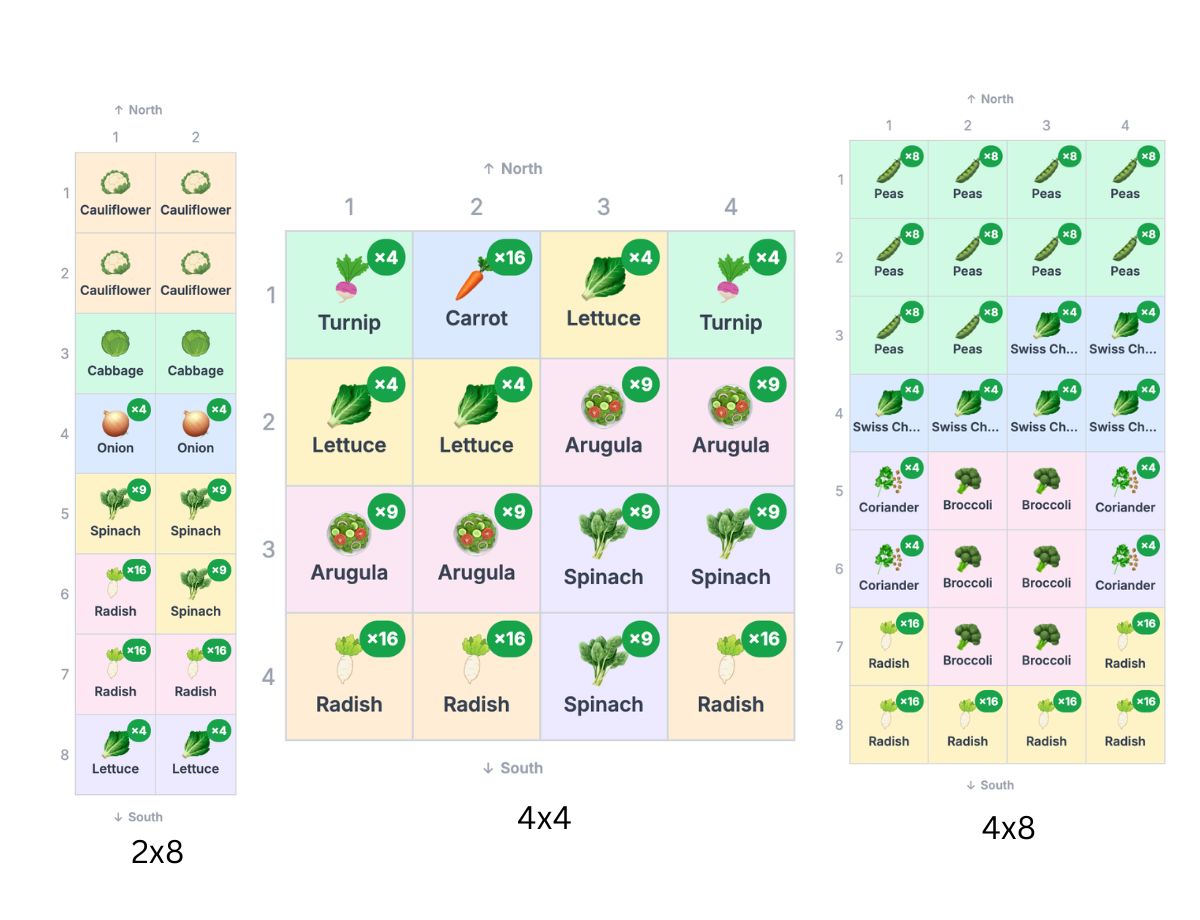
Here's what a mixed garden of each size can realistically produce in one growing season. The plant counts follow the app's spacing rules. The harvests add up the yields in the table above. Weekly time is our own estimate for a mulched garden at the peak of summer.
🪴 2×4 bed — 8 sq ft
Season harvest: ~7 lb (3 kg), ~26 servings · Time: 10–15 min a week
What fits: 1 caged tomato, 8 lettuce, 9 spinach and 4 basil.
What it really is: a salad-and-sauce bed. It won't feed you, but it will make you a gardener. It fits on a patio or balcony, and it's hard to neglect something you pass every day.
➜ Plans to copy: 2×4 raised bed layouts
🥬 4×4 bed — 16 sq ft
Season harvest: ~13 lb (6 kg), ~46 servings · Time: 20–30 min a week
What fits: 1 tomato, 2 peppers, 8 bush beans, 8 lettuce, 32 carrots, 9 spinach, 8 onions and 4 basil.
What it really is: a real taste of homegrown food a few times a week. You can reach every square from the edges, so there's no stepping on the soil and hardly any weeding.
➜ Plans to copy: 4×4 garden bed layouts
🍅 4×8 bed — 32 sq ft Most popular
Season harvest: ~29 lb (13 kg), ~88 servings · Time: 45–60 min a week
What fits: 2 tomatoes, 1 zucchini, 2 trellised cucumbers, 4 peppers, 16 bush beans, 12 lettuce, 48 carrots, 18 spinach, 18 beets, 8 onions and 4 basil.
What it really is: the sweet spot. It's big enough to change how you eat all summer, and small enough to keep on top of in an hour a week. Standard lumber comes in 8-foot lengths, which is partly why this size is everywhere.
➜ Plans to copy: 4×8 raised bed layouts
🥔 10×10 plot — 100 sq ft (about 80 sq ft of growing space)
Season harvest: ~67 lb (30 kg), ~195 servings · Time: 1.5–2.5 hours a week
What fits: two 4×10 beds with a 2-foot path between them. That's room for 4 tomatoes, 2 zucchini, 4 cucumbers, 6 peppers, 40 beans, 48 peas, 7 potatoes, 24 lettuce, 36 spinach, 96 carrots, 36 beets, 24 onions, 2 kale and 4 basil.
What it really is: the first size where you start growing "storage" crops like potatoes and onions alongside the salad. Remember that paths take a fifth of the space — you can't grow food where you walk.
➜ Plans to copy: 10×10 garden layouts
🌽 20×20 plot — 400 sq ft (about 250 sq ft of growing space)
Season harvest: roughly 200 lb (90 kg) or more, 600+ servings · Time: 4–6 hours a week
What fits: about eight 4×8 beds' worth of growing space, once paths are taken out. There's finally room for the space hogs — a block of corn, sprawling winter squash, a proper potato patch.
What it really is: a family garden, and a part-time hobby. It rewards people who already know they enjoy gardening. It punishes people who are finding out.
➜ Plans to copy: 20×20 garden layouts
⚠️ Time grows faster than space. Going from 32 to 250 square feet multiplies your harvest by about 8. But it also means longer walks, longer paths to weed, and a heavier load of watering in August. Most gardens aren't abandoned because they were too small.
A handy rule from seed growers: weeding alone takes about 20–30 minutes a week for every 100 sq ft. Watering, picking and tying up plants come on top of that. Count your free hours before you count your square feet.
How Much Space Do You Need for One Person?
Here's the math, done in the open so you can change the assumptions.
- Say you want one homegrown serving of vegetables every day through a 20-week harvest season. That's 140 servings.
- A mixed bed like the ones above yields about 2.7 servings per square foot per season.
- 140 ÷ 2.7 ≈ 52 square feet.
Remember the 48 square feet the typical EdenVatika gardener plans? Without doing any of this math, most of them have landed almost exactly on a one-serving-a-day garden for one person. Gardeners' instincts turn out to be pretty good.
How safe is that 2.7? Experienced raised-bed gardeners often quote about 1 lb of food per square foot a season. Our mixed beds work out at 0.8–0.9 lb, so if your soil is good and you sow again as squares come free, you'll likely beat these numbers.
From there, scale by how much of your eating you want the garden to cover:
| Your goal | Per person | Couple | Family of 4 |
|---|---|---|---|
| A taste — fresh salad and herbs a few times a week | 16 sq ft | 32 sq ft | 50–64 sq ft |
| A serving a day through the season | ~50 sq ft | ~100 sq ft | ~200 sq ft |
| Most of your summer vegetables (about 3 servings a day) | ~150 sq ft | ~300 sq ft | ~600 sq ft |
| Summer plus preserving for winter | 200+ sq ft | 400+ sq ft | 800+ sq ft |
All figures are growing space, not counting paths. Young children eat less, so a family with small kids can shade these numbers down.
And full self-sufficiency? That's a different league. Guidance based on Britain's wartime allotments put it at around 8,000 sq ft to grow a third to half of a family's food. That's a small farm, not a backyard bed — and a full-time hobby.
How many plants per person?
If you'd rather think in plants than square feet, these per-person counts are a common starting point for fresh eating. The space in brackets comes from the EdenVatika spacing rules.
- 🍅 Tomatoes: 2–4 plants (8–16 sq ft)
- 🫑 Peppers: 3–5 plants (3–5 sq ft)
- 🫘 Bush beans: 5–10 plants (about 2 sq ft)
- 🥬 Lettuce: 5 plants at a time (about 1–2 sq ft), sown again every few weeks
- 🥕 Carrots: 10–20 plants (about 1 sq ft)
- 🥒 Zucchini: 1 plant. For the whole household. Trust us.
Planning to can, freeze or ferment? Grow about four times as many plants of the crops you'll preserve.
Five ways to need less space
- Shrink the paths. Traditional farm-style rows can give up to half the ground to walking paths. Beds about 4 ft wide — so you can reach the middle from either side — with 18–24 inch paths keep most of your space growing food.
- Grow up, not out. Cucumbers, pole beans and tomatoes on a trellis or stake take a fraction of the ground they'd sprawl across.
- Sow again. When lettuce or radishes come out, put something back in that square the same week. An empty square grows nothing.
- Grow what's expensive, buy what's cheap. Potatoes and onions are cheap in shops and slow in beds. Herbs, salad leaves and heirloom tomatoes are the opposite.
- Skip the space hogs. Corn, pumpkins and melons need big plots. Square foot for square foot, zucchini grows four times as much food as corn.
So Which Size Should You Start With?
A simple rule: start at the size you can keep weeded in the time you're sure you'll have. Then add one bed a year.
- Never grown anything? One 4×4 or 4×8 bed.
- Grown in pots, want more? A 4×8, plus a 4×4 for herbs and salad by the kitchen door.
- A few seasons in and hooked? A 10×10, or two or three 4×8 beds.
- Feeding a family and you know you love it? 20×20 is where it gets serious.
Adding a second bed next spring is a joy. Letting half a plot go to weeds in July is a chore that often ends the hobby.
Frequently Asked Questions
How much space do you need for a vegetable garden for one person?
About 50 square feet of growing space gives one person roughly one homegrown serving of vegetables a day through the season. For most of your summer vegetables, plan around 150 square feet.
How much space do you need for a family of four?
Around 200 square feet of growing space for a daily serving each, and about 600 square feet to grow most of the family's summer vegetables. Add more if you plan to can, freeze or store food for winter.
Is a 4×8 raised bed enough for a beginner?
Yes, and it's the most common size in EdenVatika. A mixed 4×8 bed can grow around 29 lb (13 kg) of food in a season for about an hour of work a week.
How many tomato plants fit in a 4×8 bed?
Following the square-foot spacing in the EdenVatika plant library, each tomato plant needs 4 square feet. You could fit up to 8, but 2–4 leaves room for other crops.
How much time does a vegetable garden take each week?
Roughly 10–15 minutes for a 2×4 bed, 45–60 minutes for a 4×8, 1.5–2.5 hours for a 10×10 and 4–6 hours for a 20×20 at the peak of summer. Mulch and drip irrigation cut these a lot.
Your Garden, Your Numbers
Every number in this article is an average. Your own garden will beat some of them and miss others, depending on your climate, your soil and whether you really pick the beans every other day.
The best answer to "how much space do I need?" is the one your own garden gives you. That's the idea behind EdenVatika:
- 📐 See what fits as you draw. Set your bed size and the designer uses the same per-plant spacing you saw above, so you know it'll fit before you buy seeds.
- 📅 Plant on your frost dates. Every sowing and harvest date is worked out from your local frost dates, not a generic calendar.
- ⚖️ Weigh what you pick. Log harvests by weight and see what each bed produced and saved you. Next year, you plan from your own numbers instead of ours.
Just want quick numbers? The free Garden Yield Estimator and Plant Spacing Calculator give you answers in a few seconds — no account needed.
🌱 Curious what fits in your space?
Pick a bed size, plant it square by square, and see real sowing dates for where you live — plus what the bed is worth at store prices.
Try a Free Demo Garden →No signup, no card. Ready to keep it? Create a free account.